
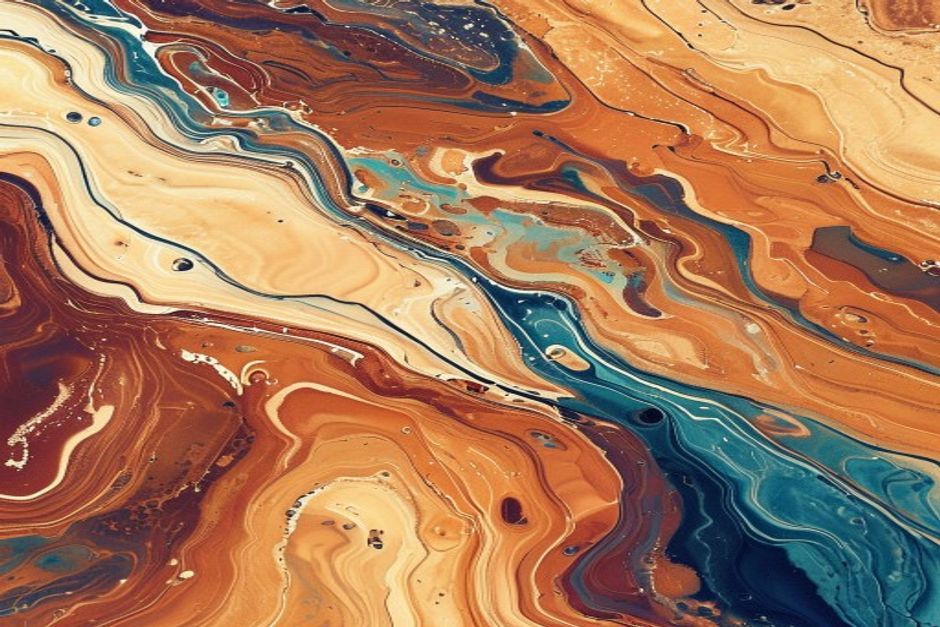
Ebru art offers a captivating glimpse into Islamic spirituality, revealing themes of humility, patience, and divine connection through the delicate interplay of color and water. This ancient Turkish tradition is more than just an artistic endeavor; it’s a journey of self-discovery and submission to Allah.
What is Ebru? The Art of Water Marbling
The name ‘ebru’ itself is believed to derive from the Persian words âb-ı rû, meaning “water of face,” or ebrî, signifying “cloudy.”
Originating in Ulu Türkistan and brought to Anatolia by Turkish peoples, ebru carries with it echoes of distant landscapes. The early artisans, migrating across vast plains, captured the essence of their homeland – the verdant hills and boundless steppes – by reflecting nature’s colors onto water.
Like a human being, ebru has many similarities. Its raw materials are water and earth, just as ours are. (The colors used in Ebru are obtained by crushing soil, stone, and various metal oxides.) Each ebru emerges with a unique pattern, like fingerprints or eye color. The artwork is not immediately understood; it requires deep observation. It’s a reflection of the human soul colored by Allah’s 99 Names.
The Mirror of Divine Presence
In psychology, it’s said that humanity’s greatest desire is to be seen. Allah, the ultimate artist, is most deserving of being known and recognized. As stated in the Quran: “Indeed, I was a hidden treasure, and I desired to be known, so I created the universe.” Ebru serves as one of the mirrors reflecting this divine presence.
True ebru artworks lack signatures; this is because the true artist is Allah. The ebru artisan simply reflects the artistry of the Divine, thus cannot claim ownership of the work.
Colors of Humility and Submission
Ethem Efendi, a renowned Ebru master, said: “Ebru is magic; sometimes it works, sometimes it doesn’t.” Sometimes, despite perfect materials, the water or the tray refuses to cooperate. This is when the ebru artisan experiences their greatest sense of helplessness.
One student constantly complained about the kitre (a substance used to give water consistency). “Why is this so temperamental? Sometimes it works, sometimes it doesn’t!” The teacher smiled and replied: “The water is testing you, my son. You are trying to fight and dominate the water, but you must befriend it.”
If the dye tried to break the water’s resistance in ebru, it would only become muddy; but because it adapts to the nature of the water, magnificent patterns emerge. In life too, those who struggle with water drown. Those who surrender to it reach their destination.
The Importance of Patience
A single speck of dust can ruin an artwork created with great effort. The ebru artisan becomes anxious and immediately seeks to correct the error caused by the tiny particle. Similarly, a single sin can corrupt the human heart. A believer’s first task is to cleanse their heart with the water of repentance.
Ebru requires more patience than talent. Mistakes are made when one rushes. Patience is the ebru artisan’s greatest ally.
Finding Divine Beauty
As Ziya Pasha eloquently stated:
“One reaches the desired destination by proceeding slowly / The hasty one’s hem skirts swirl around him.”
Ebru is about seeking the Creator by imitating created colors and drawing closer to Him.
It’s a reflection of the Divine Beauty, transforming into art. Ebru teaches the artisan humility.
In Anatolian wisdom, the sixth requirement of Islam is to know one’s limits, and the seventh is to demonstrate that knowledge. Ebru perfectly fulfills these sixth and seventh requirements.
The Heart Colored by Allah’s Hue
Musa Topbaş Efendi said: “We love those who love us, and we also love those who do not.”
This is their philosophy of life – to extend compassion under one’s wings to those created with Allah’s attribute of Rahman.
As Yunus Emre wisely stated: “We love the Created for the Creator’s sake.”
Loving even those who do not reciprocate is a sign of the soul within a person, originating from Allah. As the heart becomes illuminated, it expands. One way to illuminate and expand the mirror is to be able to love even those who do not.
Those who reach this point are like Hz. Abu Bakr (may Allah be pleased with him), whose life was devoid of the Prophet Muhammad’s (peace be upon him) qualities, colored by Quranic morals: “O Lord! Expand my body so that it may fill Hell and leave no room for others.”
Reading a person whose heart is colored by Allah’s hue is as delightful as observing a masterpiece created by a skilled ebru artisan.
As Mevlana said: “Let those who say that water does not hold patterns be gone!”