

Hadith
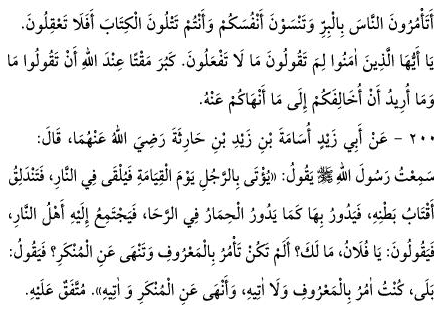
“While you are reading this book, how can you advise people to do good while forgetting about yourself? Will you not use your reason?” Surah Al-Baqarah (2), 44 In the previous section, we attempted to explain how important the duty of enjoining good and forbidding evil is and what a great virtue it possesses. Those who undertake this superior and important task must perfect themselves, possess virtue and superior morality as exemplary figures so that they can reform others and enable them to be virtuous, moral, and exemplary individuals. Otherwise, they will contradict themselves with their words and actions. It has been addressed in a separate heading regarding the importance of those who advise good and deter from evil to adhere to it themselves and for their words and actions not to contradict each other. These few verses along with the hadith that follows reveal the independent importance of this topic. Of course, these texts are not exhaustive. This 44th verse of Surah Al-Baqarah was revealed in relation to the scholars of the Jews, according to a narration from Ibn Abbas. The religious scholars of the Medinan Jews ordered those who followed them and emulated them to adhere to the Torah while denying the attributes of our Noble Prophet in their own books and contradicting their own words. They would encourage people to obey Allah but themselves would fall into sins; they would advise people to give charity but themselves would be stingy. We attempted to explain in a previous section how the Children of Israel were cursed due to their many betrayals and ingratitude. The Qur’an presents the states of past nations as examples so that we may take heed from them, avoid falling into the sins, rebellions, and errors they committed. Therefore, every verse concerns all times and all audiences in one respect. This verse contains a warning, an admonition, and a threat to those who do not enjoin good, rather than to those who do not perform the act of goodness. For this reason, Allah Almighty has censured those who command good deeds but do not themselves perform them, because such people do not value Allah’s prohibitions, take His rulings lightly, or find knowledge beneficial to themselves. The Prophet (peace and blessings be upon him) said: “The most severely punished of the people on the Day of Resurrection will be the scholar who has knowledge that does not benefit him.” (Suyuti, al-Fethu’l-kabir, 1:188) Enjoining good is undoubtedly a good thing. But how can someone with reason forget about themselves while wanting the good for others? Advising others and forgetting oneself, saving others but casting oneself into the fire – is this something that reason would accept? For a person to preach and give advice to people while not adhering to it himself means both denying himself and his knowledge. This situation constitutes a contradiction and conflict in a person’s personality, and instead of guiding, it leads to misguidance. Someone with reason would not fall into such a situation because people will be able to see that the person who is advising them is not practicing what they preach, and therefore they may conclude that what is being said is baseless or unimportant. This is beautifully expressed in this couplet by Fuzuli: My preaching makes my own disgrace like a comparison of near certainty If truth were present, would I not adopt the symbols of piety? The value and effect that a person’s words, sermons, and advice have is desired. How can empty words and empty commands produce this effect? In conclusion, this verse does not prohibit a disbeliever or a sinner from preaching and giving advice on the condition that he speaks truthfully and enjoins good, but it contains a very great warning to such people. It reveals their inconsistency and foolishness, and emphasizes how surprising this is from an intellectual perspective. The addressees of this verse are primarily scholars, rulers, and those with the authority to govern.
Buhârî, Bed’ül-halk 10, Fiten 17; Müslim, Zühd 51
What We Learn
- 1Hellfire is real and varied, with different degrees.
- 2Those whose words and actions contradict each other, who do not act upon their knowledge, have severe punishment from Allah.
- 3Sinful believers will also enter Hell to be punished according to the measure of their sins.
- 4The Prophet (peace and blessings be upon him) has given information about the characteristics of Hell and those suffering torment in Hell.
- 5Performing the duty of enjoining good and forbidding evil, and acting accordingly, prevents entry into Hell. ⟪BOLUM⟫KEEPING A TRUST Verses