

Hadith
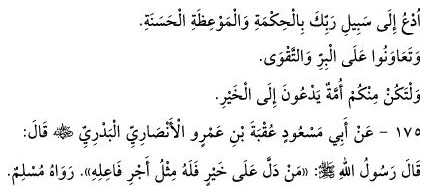
“Invite to the way of your Lord with wisdom and good counsel.” Nahl sûresi (16), 125 Âyet-i kerîmenin devamında şöyle buyurulur: “Reason with them in the best manner. Indeed, your Lord is most knowing of who strays from His path, and He is most knowing of the guided.” This verse teaches us what the fundamental principle should be regarding the method and style related to inviting to religion. Approaching people with beautiful words and a smiling face is a fundamental principle of our religion. Our proverb, “A sweet tongue can draw a snake from its hole,” so eloquently expresses this truth! If our method of inviting to religion and calling to Allah is in accordance with the commands and recommendations of the Qur’an and the practices of our Noble Prophet Muhammad (peace be upon him), we can achieve a realistic approach. This is the general strategy; however, it cannot be said that admonition, warning, and sometimes firmness will not exist. Its place, measure, and form are determined within the boundaries of the Qur’an and Sunnah. Hikmet primarily consists of the infallible truths of the Qur’an and Sunnah. Every correct word that helps to explain them, every piece of evidence that clarifies truth and reality, every fact that eliminates doubts, falls within the realm of hikmet. Therefore, one must first learn, understand, and reflect Islam in life. Beautiful counsel (mev’ıze-i hasene) is drawing beautiful lessons from events, imparting moral instruction, and warning against worrisome consequences. We find many examples of this in the Qur’an and Sunnah. The person listening is compelled to accept that what they are being told is beneficial to them and for their own good. They see and know what kind of actions and behaviors will lead to what results. For this reason, the Qur’an teaches us what is right and wrong. It announces that the reward for righteousness is reward and the consequence of wrongdoing is punishment. Knowing all of this, inviting to Allah is the best form of struggle (mücâdele). 3. “Cooperate in righteousness and piety.” Māide sûresi (5), 2 The Islamic command encompasses every act of goodness and every form of benevolence. Taqwa is the station reached by abandoning that which Allah Almighty has forbidden, disapproved of, and is displeased with. We are commanded to cooperate with each other in possessing these good qualities and advancing them further. Conversely, it is also commanded that we refrain from cooperating in committing sins, transgressing boundaries, and going to extremes in any matter. The subsequent section, “Cooperating in Righteousness and Piety,” will thoroughly address this topic in the light of verses and hadiths. 4. “Let there arise from among you a group who invite to goodness, command what is right, and forbid what is evil.” Âl-i İmrân sûresi (3), 104 The complete meaning of the verse is: “There must be among you a group who calls to goodness, commands what is right, and forbids what is wrong. These are the ones who will attain success.” The term “ummah,” which we translate as “group,” does not refer to an ordinary gathering but rather to a community that is the forerunner of humanity, encompassing various sects and groups, and serves as an example to be followed. Since the smallest sample of this ummah is the congregation in the mosque, the person standing at their forefront and whom they follow is called an imam; the words imam and ummah are derived from the same root. Just as an imam is designated for the congregation in the mosque and prayers are performed behind him, an imam is also designated for the head of the ummah, namely the state leader. The name of the largest community formed around a leader (imam) is ummah. The formation of a group that invites to goodness and righteousness, performs the duty of enjoining good and forbidding evil, is an important task that our religion asks of us after faith. Muslims who can fulfill the duty of inviting to goodness attain success and salvation. This is a communal obligation (fard-i kifaya). If this is not done and fulfilled, no Muslim can absolve himself of responsibility. The duty of every Muslim is to be filled with the determination and effort to establish such an ummah and imamate. Calamities and misfortunes that arise when the order of tawhid is disrupted do not only affect the oppressors but spread throughout society. The Islamic ummah has been experiencing these calamities for a long time. Our hope is that these misfortunes will be a means of awakening and raising awareness. Hadis 175. Narrated by Abu Mas’ud Ukba Ibn Amr (may Allah be pleased with him) from the people of Badr and Al-Ansar, “The Messenger of Allah (peace and blessings upon him) said: ‘Whoever initiates a good deed, he will receive the reward of those who do it and whoever does it.’