

Hadith
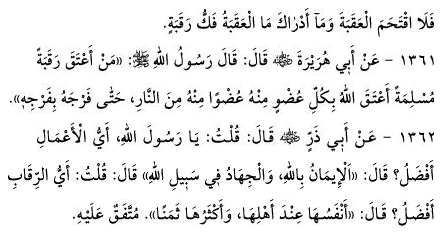
“But he could not surmount that arduous slope. How can you know what that arduous slope is? It is the emancipation of a slave.” The Ninety Chapter (90), 11-13. In the verse, the word “akaba” refers to an arduous slope rising towards a high mountain from a vast valley. Doing good deeds, especially saving a life and freeing a slave deprived of all freedom, is by no means easy. Therefore, accomplishing this great act has been likened to surmounting and overcoming an arduous slope. The essence of being human lies in possessing human freedom, and one of Islam’s highest goals is to liberate all people from servitude to others and make them servants of Allah. Imam Nawawi placing this topic immediately after his section on jihad is a testament to profound understanding and insight, elegance, and refinement. This is because the areas where humans lose their freedom and become captives are primarily battlefields. Those who are free and lead a life worthy of human dignity cannot tolerate their fellow human beings living as slaves and captives. For this reason, Islam has stipulated manumission as an expiation for certain sins and offenses. Hadiths 1361. It was narrated from Abu Huraira (may Allah be pleased with him) that the Messenger of Allah (peace and blessings of Allah be upon him) said: “Whoever emancipates a Muslim slave, Allah will liberate one of his limbs from the Fire for every limb of the slave he freed. He will even liberate his reproductive organ in exchange for his reproductive organ.”
Bukhari, Kaffarat 6; Muslim, Itk 22-23. Also see Tirmidhi, Nazir 14.
Narrator
Will be explained along with the next hadith.
What We Learn
- 1The foundation of righteous deeds and acts of kindness is faith.
- 2The most virtuous deed is striving in the way of Allah to exalt His religion.
- 3Emancipating slaves and servant girls is among the most virtuous of deeds.
- 4Through slave emancipation, a person can be saved from Hellfire and enter Paradise.
- 5It is more virtuous to emancipate the most valuable slave or servant girl.
- 6The goal of Islam is to abolish slavery in all its forms from the earth.