

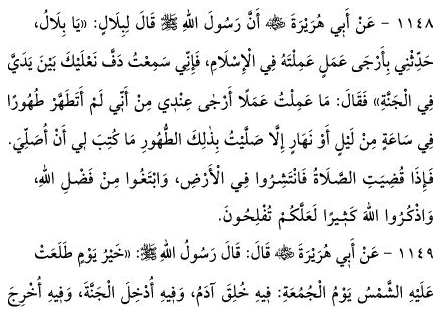
Hadith
It is narrated on the authority of Abu Huraira that: Resulullah (peace and blessings be upon him) asked Bilal: “Bilal! Of all the acts of worship you have performed since becoming Muslim, which one do you hope to receive the most reward for? Because I heard your sandals clicking in front of me in Paradise.” Bilal replied: “After performing ablution, whether at night or during the day, I perform as many prayers as I can with that same ablution. This is the act of worship for which I expect the most reward.”
Bukhari, Tahajjud 17, Tawhid 47; Muslim, Fazailu’s-Sahaba 108.
Narrator
Explanation: In the narration of the hadith in Sahih Muslim, the Messenger of Allah (peace and blessings be upon him) said to Bilal, “I heard your sandals clicking in front of me in Paradise this night.” This indicates that this event occurred in a dream of the Messenger. There are also hadiths that clearly show that the event took place in a dream (Bukhari, Fazailu ashabi’n-nabi, 6). Resul-i Ekrem (peace and blessings be upon him) did not refrain from seeking out the acts of worship and good deeds that would most please Allah Almighty, even though he worshipped more than any other person. This behavior shows that one should never consider the acts of worship and charity they perform to be sufficient, but rather seek to learn and strive to do even greater good deeds and acts of worship. Just as a teacher calls his student over and is concerned with their lessons and encourages them when he likes their situation, so too does the Prophet (peace and blessings be upon him) care for the worship of his companions and encourage them in this regard. What a pleasant and encouraging behavior it is! The Messenger’s movements of this kind show that he is a wonderful mentor and educator. Bilal al-Habashi was a virtuous person who endured great hardships for Islam, as briefly mentioned in hadith number 1105. He was one of the sincere Muslims who surrounded the Noble Prophet (peace and blessings be upon him), striving to do what he commanded and trying to live as he desired. Every time he performed ablution or ritual bath, he first discovered the method of thanking Allah Almighty for bestowing upon him the blessing of Islam and the state of performing ablution by looking at the acts of worship of the Messenger (peace and blessings be upon him) and performing at least two rak’ahs of prayer. There are narrations showing that he performed two rak’ahs of prayer immediately after ablution, as soon as his ablution was broken (Ibn Hajar, Fath al-Bari, III, 42, Tahajjud 17). With this hadith, the Messenger of Allah (peace and blessings be upon him) gives Bilal al-Habashi tidings of Paradise, telling him that they will be together in the hereafter. This prayer, which is a memory of Bilal al-Habashi, is called “shukru’l-wudu” (thanksgiving for ablution). Shukru’l-wudu can be performed immediately after ablution or ritual bath, or even tayammum, as well as at any time while the ablution lasts. A Muslim can worship at times according to his desire and eagerness to worship, just like Hz. Bilal did; he can discover new ways of doing good deeds that no one has done before. Every beautiful behavior that does not contradict the goal of Islam and the Sunnah of Resulullah certainly has a place and reward in our beautiful religion. For as long as a servant does not tire of performing worship and charity, Allah Almighty, whose treasure of rewards is limitless, will abundantly reward his servant and make him happy. What We Learned from Hadith: 1. Performing at least two rak’ahs of prayer after ablution, ritual bath or tayammum, which is spiritual purification, is a supererogatory act of worship that leads to earning the pleasure of Allah Almighty. 2. This supererogatory act of worship, which Muslims call “shukru’l-wudu,” was first performed by Bilal al-Habashi, and the Messenger of Allah (peace and blessings be upon him) approved of it by saying that it was a good thing, thus encouraging his ummah to perform this act of worship.
What We Learn
- 1Friday is the most excellent day.
- 2Hz. Adam was created on that day, he was settled in Paradise on that day, and he was sent to earth as Allah’s vicegerent on that day.
- 3People should know the excellence of Friday and spend this day with good deeds and acts of worship.