
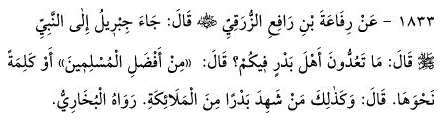
Rifāʿa ibn Rāfiʿ al-Zurāqī (may Allah be pleased with him) said:
Jibrīl (Gabriel, peace be upon him) came to the Messenger of God (peace and blessings be upon him) and asked:
– How do you regard the veterans of Badr among you?
The Prophet (peace be upon him) replied:
– “We consider them the most virtuous among the Muslims,” or he said something similar. Jibrīl (peace be upon him) said:
– We also consider those angels who participated in the Battle of Badr to be the most virtuous among the angels.
Bukhārī, Maghāzī 11. See also: Ibn Mājah, Muqaddima 11.
Transmitter
Rifāʿa ibn Rāfiʿ al-Zurāqī
Rifāʿa, who was from Medina, belonged to the Khazraj tribe. His father, Rāfiʿ ibn Mālik al-Anṣārī, was among the first in this tribe to become Muslim. He represented his tribe at the pledge of al-ʿAqaba. At this pledge, Rifāʿa was present together with his father. His mother, Umm Mālik, was the daughter of ʿAbdullāh ibn Ubayy ibn Salūl, the leader of the hypocrites of Medina. Both father and son participated not only in the Battle of Badr but also in all the battles alongside the Messenger of God.
Rifāʿa narrated several hadiths from the Messenger of God, as well as from other Companions (ṣaḥāba) such as Abū Bakr and ʿUbāda ibn al-Ṣāmit. Three of his narrations are included in Ṣaḥīḥ al-Bukhārī. Rifāʿa fought on the side of ʿAlī in both the Battles of Jamal and Ṣiffīn, and he passed away in the year 41 or 42 (661 or 662 CE).
May Allah be pleased with him.
Explanation
In our hadith, the exalted status of the heroes of Badr, known as the People of Badr (Ahl al-Badr), is indicated. This army of 313 brave men, who fought a life-and-death battle against the polytheists of Mecca at the location of Badr in the second year after the Hijra, were praised both by Allah and by the Messenger of God. The Messenger of God (peace be upon him) stated that all of them were destined for Paradise (Bukhārī, Maghāzī 9). When ʿUmar (may Allah be pleased with him) established the dīwān (register) to distribute war revenues among the Muslims, he wrote the names of the People of Badr at the top of the register. Throughout history, they have always been remembered with goodness and gratitude by Muslims. This fortunate generation, about whom many books have been written, has been regarded as the most virtuous among the Muslims.
Jibrīl (peace be upon him) states that the angels who participated in the Battle of Badr are superior to those who did not. The evidence for their being considered the most virtuous among the angels is the following verse (āya): “When your Lord revealed to the angels: ‘I am with you, so strengthen those who have iman (faith). I will cast terror into the hearts of those who have kufr (disbelief); so strike above their necks and strike every fingertip of theirs.’” [Sūrat al-Anfāl (8): 12]. What distinguishes the angels who participated in the Battle of Badr from the other angels is this: by supporting a handful of brave men who stood firm against evil forces three times their number, they prevented Islam from being wiped off the face of the earth and helped ensure that the name of Allah would echo across the world until the Day of Judgment.
Lessons Learned from the Hadith
- The heroes of Badr occupy the highest rank among the noble Companions (ṣaḥāba).
- The angels who assisted them in this battle are also considered the most virtuous among the angels because of this assistance.