
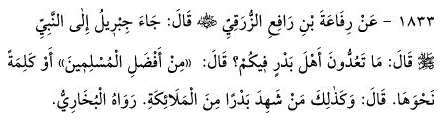
Rifaa ibn Raafi’ al-Zuraki, may Allah be pleased with him, said:
Jibril (peace be upon him) came to the Messenger of Allah (peace and blessings be upon him) and asked:
‘How do you value the veterans of Badr among yourselves?’ The Prophet (peace and blessings be upon him) replied: ‘We consider them the most virtuous of Muslims,’ or something similar. Jibril (peace be upon him) said: ‘We, the angels, also consider those who participated in the Battle of Badr to be the most virtuous among the angels.’
Bukhari, Maghazi 11. See also Ibn Maja, Muqaddima 11.
The Narrator
Rifaa ibn Raafi’ al-Zuraki
Was from the Madinah of the Banu Harith tribe. His father, Rafi’ ibn Malik al-Ansari, was among the first to embrace Islam from this tribe. He represented his tribe at the Aqaba Pledge and was accompanied by his father in this pledge. His mother, Umm Malik, was the daughter of Abdullah ibn Ubayy ibn Salul, the leader of the hypocrites of Madinah. Both father and son participated in the Battle of Badr and all subsequent battles with the Prophet (peace and blessings be upon him).
Rifaa narrated several hadiths from the Messenger of Allah (peace and blessings be upon him) as well as other companions such as Abu Bakr and Ubada ibn Sami. Rifaa, whose three narrations are included in Sahih Bukhari, participated in both the Battle of the Camel and the Battle of Siffin with Ali and passed away in 41 or 42 (661 or 662).
May Allah be pleased with him.
Explanation
Our hadith highlights the esteemed position of the People of Badr, our heroes of Badr. This valiant army of 313 men who fought a life-or-death battle against the polytheists of Mecca in the second year of Hijrah has been praised by both Allah and His Messenger (peace and blessings be upon him). The Messenger of Allah (peace and blessings be upon him) stated that they were all destined for Paradise (Bukhari, Maghazi 9). When Umar established a diwan organization to distribute war spoils among the Muslims, he wrote the names of the People of Badr at the head of the diwan register. Throughout history, they have been remembered by Muslims with goodness and gratitude. This blessed generation, for whom many books have been written, has been accepted as the most virtuous of Muslims.
Jibril (peace be upon him) states that the angels who participated in the Battle of Badr are superior to those who did not. The evidence for their being considered the most virtuous among the angels is the following verse: “Indeed, your Lord announced to the angels, ‘I am with you, so reinforce the believers with My support. I will cast terror into the hearts of the disbelievers; strike them upon their necks and strike from every joint.’” [Surah Al-Anfal (8), 12]. What makes the angels who participated in the Battle of Badr superior to other angels is that by supporting a handful of brave men who steadfastly resisted an overwhelming force three times greater, they prevented Islam from being erased from the face of the earth and helped Allah’s name resonate throughout the world until the Day of Judgment.
What We Learn From This Hadith
- The heroes of Badr occupy the highest position among the companions (Sahaba).
- The angels who aided them in this battle are also considered the most virtuous among the angels due to their assistance.