

THE SECTION ON PRAYER · 82 – HOW TO WEAR A NARROW GARMENT











Jabir (ra) relates:
We came to Jabir and he said:
I accompanied the Messenger of Allah (peace be upon him) on a campaign.
He intended to lead the prayer. I was wearing a dyed cloak. I would turn its sides, but they did not suit me. It also had tassels on the cloak’s fringes.
I brought it down and turned its sides inside out. Then I bent my waist so that it would not fall, and constricted it around my neck. Then I came [to stand for prayer]. I stood on the left side of the Messenger of Allah (peace be upon him). The Messenger of Allah (peace be upon him) took hold of my hand and attempted to lead me behind him and place me on his right. Ibn Sahir arrived and stood on his left, holding us both with his two hands and stopping us behind him. Jabir says:
The Messenger of Allah (peace be upon him) was looking at me attentively. I did not understand it. Then I understood it. He indicated for me to button it [the cloak]. When the Messenger of Allah (peace be upon him) departed, he said, “O Jabir,”
– “I am listening, O Messenger of Allah,” I replied. "When it is wide, throw its sides crosswise over your shoulders; when it is narrow, use it as a lower garment and tie it around your waist.” [413]
**EXPLANATION:**
*Bürdetü:* Cloak.
*Zebazib:* It refers to the tassels of a veil.
*Nekestu:* I turned it.
*Tevakastu:* I bent my neck and constricted the garment.
*Yermuku:* He was looking attentively.
*Hakv:* Middle. The middle of a person is his waist, so the waist is called "hakv."
This hadith indicates that someone who cannot find another garment can cover between his navel and knees and perform prayer. But a man who finds something to wear on top should not pray only in a lower garment and undergarment. It also serves as evidence for the necessity of standing in the rear rank behind the Imam when two people are praying in congregation. The jurists, including Abu Yusuf, hold this view. This hadith is proof that minimal effort during prayer does not invalidate it.



According to a narration from Ibn ‘Umar (may Allah be pleased with him), he said:
The Messenger of Allah (peace and blessings upon him) said, or 'Umar (may Allah be pleased with him) said:
“Let one of you who has two garments pray in them, but if he has only one garment, let him tie it around his waist, and not cloak himself as the Jews do.”


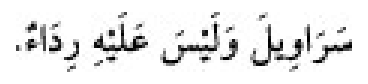
Abdullah ibn Burayda, may Allah be pleased with him, narrated from his father, Burayda, may Allah be pleased with him, that the Messenger of Allah, peace and blessings be upon him, forbade praying in a garment whose edges pass under the armpits and are not tied on the chest, and forbade praying without a shirt over one’s lower garment (sirwal).
Note:
Tawassugh: A garment is thrown from the front over the right shoulder, its end is brought up from beneath the left armpit, then its end is passed behind the right armpit and tied in front.
Sirwal: Means undergarment/drawers.