
PRAYER SECTION · 132 – THE AMOUNT OF RECITAL IN MAGHRIB (EVENING) PRAYER




From Ibn Abbas, may Allah be pleased with him:
– Haris's daughter, Umm Fadl, heard Ibn Abbas reciting (the verses customarily recited), and said, “O young man, by your recitation of this chapter, you have reminded me that I heard the Messenger of Allah recite it during the evening prayer he performed last.” [501]
The Messenger of Allah, peace and blessings be upon him, performed his last prayer as the noon prayer, as narrated from Aisha. Then, the last prayer the Messenger of Allah, peace and blessings be upon him, led was in the Masjid an-Nabawi. Umm Fadl’s narration is of an evening prayer that he performed at home. It is possible to reconcile these two narrations; for Ibn Abbas's mother, Umm Fadl, may Allah be pleased with her, reported that the last prayer the Messenger of Allah, peace and blessings be upon him, led in his house was the evening prayer, while Aisha, may Allah be pleased with her, reported that the last prayer the Messenger of Allah, peace and blessings be upon him, led was the noon prayer in the Masjid.


From Muhammad ibn Jubayr ibn Mut'im, from his father Jubayr ibn Mut'im:
I heard the Messenger of Allah ﷺ reciting Surah Tur while performing the evening prayer.
**Note:** The accompanying commentary is not translated as per the instructions.




Mervan ibn Hakim (may Allah be pleased with him) narrated:
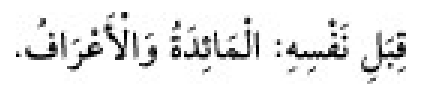
He said, “Zayd ibn Sabit, why do you recite short, detailed chapters in the evening prayers, while I saw the Messenger of Allah (peace and blessings upon him) reciting the longer of two long chapters in the evening prayer?” I asked Ibn al-Mulayka which was the longer of the two, and Urwa said, “The Chapter of Araf (the other being Al-Ma’idah).” Ibn Jurayj said, "I asked Ibn Abu Mulayka, and he stated – without referring to any narration – that it was the Chapters of Al-Ma'idah and Araf.”
[Explanation]
These chapters are called “detailed” because they are separated from one another by the basmala. The detailed chapters are divided into three sections: from Surat al-Hujurat to Surat al-Buruj, which is known as the "upper detailed" section; from Surat al-Buruj to Surat al-Bayyina, which is known as the “middle detailed” section; and from Surat al-Bayyina to the end of the Qur’an, which are the short chapters, known as the "lower detailed" section.
The meaning of “two long chapters” refers to Araf and An'am. It is unanimously agreed that the Chapter of Araf is one of the long chapters. As for the second chapter, there are three opinions. However, the most reliable opinion is that it is the Chapter of An’am. The Chapter of Araf is longer than the Chapter of An’am.
The Messenger of Allah (peace and blessings upon him) used to recite both long and short chapters according to the situation.