
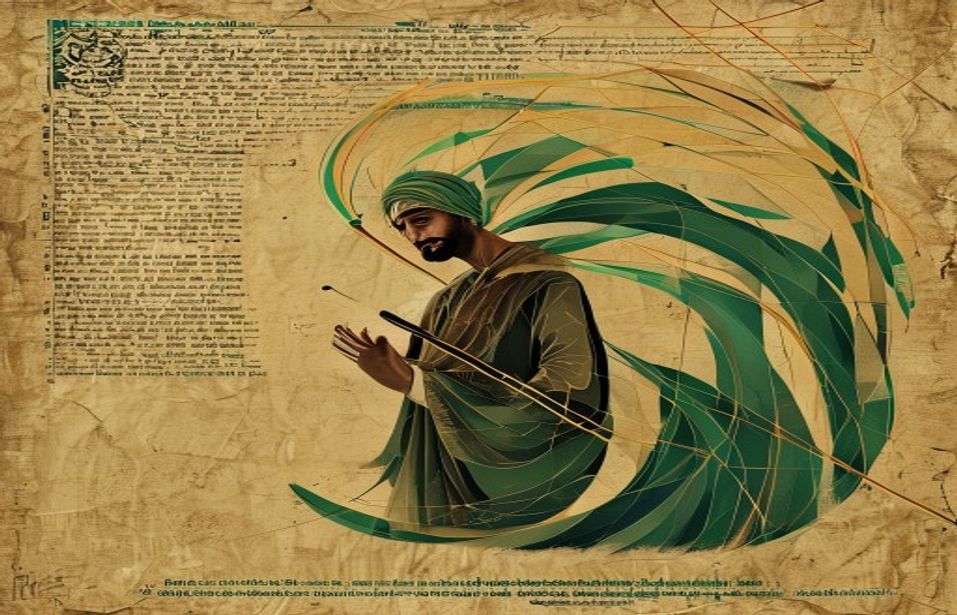
There was a dervish on a ship. He had made his piety his cushion, leaning against it for support. A purse of gold went missing from the ship. They searched everyone. Someone pointed to the dervish and said, “Let’s also search this sleeping poor man.” The owner of the gold, troubled by the accusation, roused him as well. He said, “A purse has gone missing on this ship. We have searched everyone; you cannot escape this inquiry. Remove your cloak, disrobe yourself so that no one suspects you.”
The dervish said, “O Lord, may You send down Your decree upon these base people who accuse Your servant! His heart grieved, and immediately countless heads arose from all sides of the sea. Each held a pearl in its mouth. But what pearls were they? Each was a provincial tax – treasures from God, with no equal to be found. The dervish threw a few pearls onto the ship and leaped out, making the air itself his throne.
Like a sultan upon his throne, he crossed his legs. That air was supreme, and the ship lay before him! He said, “Proceed, go on your way. My right belongs to God; may a poor thief be with you! Let’s see who suffers from this separation. I am twofold with God, singular with the people! He accuses me of theft, but he does not loosen my reins with a single glance!”
Those on the ship said, “O exalted one, what reason have they given you for this lofty rank?” The dervish replied, “For accusing the poor of theft and dishonoring something insignificant by offending God. By no means! It is because I show reverence to the high-ranking; I never suspect ill of the poor. They are so refined, their breaths so pleasant, that God sent down the Surah ‘Abasa’ for their exaltation.”
Their poverty is due to wandering the world, not for worldly possessions. They have accepted destitution and nothingness, knowing that there is nothing but God. How can I suspect them? God has entrusted them with treasures extending seven heavens! Accusations are feelings of baseness; they are not a refined light. The self has become a sophist – strike the head of your ego! For truth is understood through blows, not by presenting evidence.
One sees miracles and becomes enlightened. Later, he says, “It was a vision.” Had it been the truth, that wondrous thing I saw would stand before my eyes day and night. But it resides in pure eyes; it cannot enter an animal’s gaze. That wondrous thing, that miracle, is ashamed to appear. Does a peacock ever enter a narrow well? Do not say to me, “You speak too much.” I tell you one percent of what I know, and even that is very brief, summarized!
Sufis, rebuking a Sufi, came to the shaykh and said, “O our master, grant us victory over this Sufi!” The shaykh asked, “Sufis, what is your complaint?” One replied, “This Sufi has three bad habits: when he begins to speak, he doesn’t stop chattering; he constantly talks. When he starts eating, he eats more than twenty people’s worth of food. And when he sleeps, it’s like the Companions of the Cave.” The Sufis argued before the shaykh about these three faults. The shaykh turned away from the poor man and said, “Whatever your condition may be, maintain moderation in it. ‘The best of things is moderation,’ as the saying goes. The humors of the body are beneficial because of moderation.
If one of these becomes excessive in a person’s body, illness arises. Do not burden your companion too much; do not speak excessively to him, nor praise him too much, for that inevitably leads to separation. Musa’s words were excessive for his friend, and that excess led to the parting of ways between him and Khidr. Musa said, ‘Go now, you speak too much; separation has come!’ Musa replied, ‘Are you speaking too much? Go away, or be silent with me.’”
If he refuses to go and stubbornly sits, then in truth I consider him gone, separated from me.” For example, if you were to sneeze during prayer and someone told you to perform ablution again, would you refuse and insist on continuing the prayer? No matter how much you bow, kneel, or rise, your prayer is lost. Walk with those who are your companions, those who thirst for your words.
The watchman is for the sleepers. What need do fish have of a watchman? Launderers are needed by those who wear clothes. The nakedness of the soul is the manifestation of God. Either leave the naked ones alone or renounce clothing! But if you cannot completely undress, at least reduce your garments and be moderate!”
The poor man recounted his circumstances to the shaykh and apologized for his faults. In response to the shaykh’s questions, he gave beautiful, truthful answers, like Khidr’s replies. Just as Khidr answered Musa’s questions with knowledge from God, so were Musa’s difficulties resolved. Khidr bequeathed keys to the dervish, and he exerted himself in answering the shaykh’s questions. He said: “Moderation is wisdom, but this moderation is relative. It is little for a camel, yet like an ocean for a mouse. If one needs four loaves of bread and eats two or three, that is moderate eating. But if he eats all four, that is not moderate eating; that man has become a slave to his greed. If one has an appetite for ten loaves of bread and eats six, that is considered moderate.
But I need fifty loaves of bread; we are not equal. You tire from performing ten rak’ahs of prayer, but I would not tire if I performed five hundred. One walks to Mecca on foot, while another passes by the mosque. One is so generous that he gives away his life without a pang of heart, while another groans in pain just to give away a slice of bread.
This moderation is relative to the end; it is proportionate to something with a beginning and an end. Something must have a beginning and an end for its middle to be conceived. How can the middle of something infinite be found? God said, ‘If the sea were ink, it would not exhaust My words.’ No one has seen the beginning or end of God’s manifestation.
Even if seven seas were completely filled with ink, do not imagine that they would run out. Let a vine and a forest be pens from beginning to end; this word would still not diminish. That ink and those pens would all perish, but this word, which has no end, would remain. My state is like that of a sleeping man. Those who see me think I am asleep, but know that my eyes sleep while my heart is awake. Know that although I appear weak and powerless, I have work and strength!
The Prophet said, “My eyes may sleep, but my heart does not slumber through God’s grace.” Your eyes are open, and your heart is asleep; my eyes are sleeping, and a door has been opened to my heart! The soul has five separate senses, and the soul’s sense is a window to both worlds. Do not look at me with your weakness; what you see as night is dawn for me. What is a dungeon to you is like a garden to me. Your preoccupation itself is a state of rest for me. Your attack is in mud, but to me, mud is roses cut into bloom. What is an exile to you is a wedding and celebration with drums and flutes! Although I sit with you on earth, I run above the seventh heaven like the star Zuhal. It is not I who sits with you; it is my shadow. My station is beyond thought.
For I have passed through thoughts and suspicions, running outside of them. I am master of anxieties, not a captive to them. The master is dominant over the building. All people are captives to anxieties and suspicions. That is why everyone’s heart is sick, everyone is sorrowful and grieved. To escape from among them, I show myself anxious.
I am a bird flying in the heavens. How can a fly seize me? Those who have broken legs should meet with me so they may talk; for that reason, I descend from the heights of the sky intentionally. When I tire of lowliness, I fly like an angel. My wings are born of myself; I did not attach two wings to my body.
Ja’far al-Tayyar’s wings are from himself, while Ja’far al-Tarrar’s wings are borrowed. To the person who has never tasted it, this is a matter of litigation. But to those of lofty rank, it is not litigation; it is meaning. This word is like dry speech to a crow. Just as a full bowl and an empty bowl are one thing to a fly.
Once, a shaykh, in order to dispel the evil suspicion of the people, vomited into a basin, which filled with pearls. Thus, that discerning pir, pitying the little intelligence of the people, made the pearl visible through sight, so it could be understood by reason. But if something pure is becoming impure within your belly, then lock your throat and hide the key. Let whatever becomes a light of nobility in someone’s heart eat as much as he desires – it is permissible to him!
If you are familiar with my soul, you know that this meaningful word of mine is not empty litigation. Even at midnight, I am by your side; come to yourself at night and do not be afraid; I am your man, your relative—if you say these two claims, then they are true if you recognize the voices of your relatives. Being with you and being a relative are idiomatic, but to a person who understands well, both are of meaning and true.
Your coming close is evidence that this breath comes from the side of a beloved. The taste in the voices of relatives is witness to the truthfulness of that relative. But that ignorant person who cannot distinguish between his own voice and the voice of a stranger because of his ignorance, makes this word litigation. His ignorance leads to denial. But for the intelligent person whose heart is filled with God’s lights, this voice itself is meaning and true.
This is like: if someone who knows Arabic says, “I know Arabic,” then his saying “I know Arabic” is litigation, but his speaking in Arabic is meaning, proof of the litigation. Or if a scribe writes on paper, “I am a scribe; I can read and write; I am an exalted person,” this writing is frivolous litigation, but what is written bears witness to the truth of the claim.
Or if a Sufi says, “Last night in a dream, I saw someone with a prayer rug on his shoulder—that was him.” This word reminds you of the dream. It is a new miracle, an old gold coin. This word appears like litigation, but the one who sees the dream says, ‘Yes.’ He confirms it. As wisdom is lost property for believers, so whoever hears it believes and accepts it. But how can he doubt or err if he finds himself in its presence?
If you were to say to a thirsty person, “Hurry up, quickly, drink the water in the cup,” would the thirsty one say, “This is litigation? Go away, litigant!” Or would he ask, “Show me proof that this water is the beautiful, clear water I am drinking?”
To a child, his mother says, “Come, my son, suckle; I am your mother.” Would the child say, “If I suckle your milk, will my belly be filled? Show me proof!” Every nation has a taste of God in their heart. The faces and voices of the prophets are miracles. When the prophet speaks from afar, the soul of the community prostrates itself, for it has never heard a voice like that in all the world. That unique spirit rejoices in that unparalleled voice and draws closer to God.