
First Volume
There was a grocer, and he had a parrot. It was green, had a beautiful voice, and was a talking parrot. It would keep watch over the shop; to all who came and went, it would make pleasant jokes and witty remarks. When addressing people, it would speak like a human, and it was also skilled at chirping like a parrot.
One day, its master had gone home. The parrot was watching over the shop. Suddenly, a cat leapt into the shop to catch a mouse. The poor parrot, out of fear for its life, jumped down from the top corner of the shop and fled to one side, knocking over a bottle of rose oil as it did so.
Its owner came back from home. Like a merchant, he entered the shop with peace of mind and sat down. But then he saw that the shop was covered in oil, and his clothes were stained with it. He struck the parrot on the head; the parrot became mute, and its head became bald. The parrot was silent for several days and did not speak.
The grocer began to lament out of regret. He was pulling at his beard, crying "Alas!"; the sun of my blessing has gone behind a cloud. At that moment, he wished his hand had been broken; how could he have struck the head of that sweet-tongued one?
He began to give alms to the poor so that the bird would speak again.
Three days and three nights later, while he sat in the shop bewildered, dejected, and hopeless, and, having become a companion to thousands of sorrows and griefs, kept wondering, "When will this bird speak again?"—suddenly, a wandering dervish with a bald head like the bottom of a bowl or basin was passing by. The parrot immediately found its tongue and, like a wise person, shouted at the dervish:
"Hey, bald one, why have you joined the bald? Did you also spill rose oil from a bottle?" At this analogy, people began to laugh. For the parrot had thought the one wearing the patched cloak was like itself.
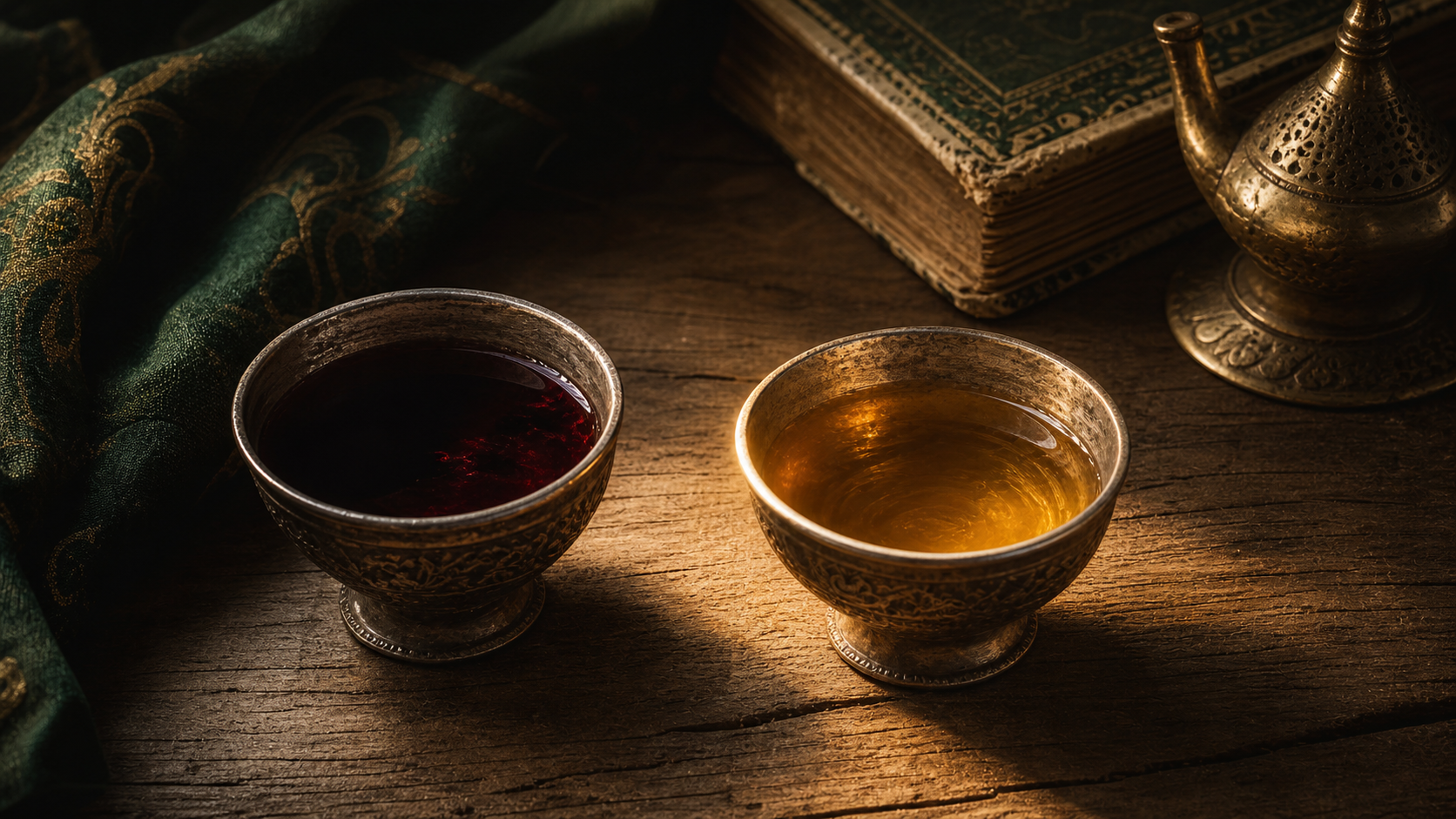
Do not judge the deeds of pure people by yourself; though in writing, shīr (meaning lion) and shīre (meaning milk) look similar. The whole world has lost its way because of this.
Few among the servants of Allah have become aware. They claimed companionship with the Prophets (saying, "We are like them"); they also thought the Friends of God (awliyāʾ) were like themselves.
They said: "Look, we are human, and so are they. We too are bound to sleep and food, and so are they." In their blindness, they did not realize there was an immeasurable difference between them. Both kinds of bees fed from the same place. Yet from one came poison, from the other, honey. Both kinds of deer grazed and drank water. From one came dung, from the other, pure musk. Both reeds drank water from the same stream. One was completely empty, the other was full of sugar.
There are hundreds of thousands of such things that resemble each other; see the seventy-year difference between them! This one eats, and filth comes from it... that one eats, and it becomes entirely the light of Allah. This one eats, and from it comes nothing but baseness and envy... that one eats, and from it comes nothing but the light of the One God. This is pure land, that is barren and foul land. This is a pure angel, that is a devil and a beast!
It is possible for both forms to resemble each other; both bitter water and sweet water are clear. Who but the person of discernment can understand?
Find him! He is the one who understands the difference between sweet and bitter water. One who lacks discernment thinks that both magic and miracle are essentially trickery, comparing them to each other.
The magicians who fought with Moses, out of stubbornness, took staffs in their hands like his staff. There is a great difference between this staff and that staff, a vast distance between this act and that act. Behind this act is the curse of Allah, while in return for that act is the mercy of Allah as fulfillment of His promise. Disbelievers are monkey-natured in their stubbornness. Nature, within, in the heart, is a calamity.
Whatever a human does, a monkey can do; the monkey always imitates what it sees from humans. It thinks, "I did as he did." How can that stubborn creature know the difference between them? This one acts by command, that one out of stubbornness and opposition.
Throw dust on the heads of the stubborn! That hypocrite, together with the sincere, stands in prayer, following stubbornness and imitation; not for supplication and humble entreaty.
The believers gain and lose alongside the hypocrite in prayer, fasting, pilgrimage, and almsgiving. For the believers, there is ultimately gain; for the hypocrite, disgrace in the Hereafter. Though both are engaged in the same act, how great is the difference between them; one is from Merv, the other from Ray!
Each goes to his own station, each walks according to his own name.
He is called "believer" (muʾmin), and his soul rejoices. If he is called "hypocrite" (munāfiq), he hardens, becomes fire. His name is beloved because of his essence. The unloveliness of this one's name is due to his calamities, to his essence characterized by hypocrisy.
There is no greatness in the letters mīm, wāw, mīm, and nūn. The word "believer" is only for definition. If you call him "hypocrite"... that base name scorches his insides like a scorpion. If this name is not severed and separated from Hell, why does it have the taste of Hell? The ugliness of that bad name is not from the letters. The bitterness of sea water is not from the vessel.
The letter is a vessel, the meaning within is like water. The sea of meaning is the essence that is with "Umm al-Kitāb" (the Mother of the Book).
In the world, there are both bitter and sweet seas. There is a barrier between them so that they do not overflow into or mix with each other. Yet both these seas flow from one source. Pass beyond both of them, and walk until you reach their origin.
Gold and base gold are distinguished by the touchstone. Unless you strike the base and the pure on the touchstone, you cannot even guess which is which.
Only the one whose soul Allah places on the touchstone can distinguish certainty from doubt.
If a living person gets a flea in his mouth, when he spits it out, he is relieved. Among thousands of morsels, if a tiny splinter enters his mouth, the living person's senses perceive and detect it.
The sense of the world is the ladder of this world, the sense of religion is the ladder of the heavens. Seek the health of this sense from the physician, the health of that sense from the Beloved (the Messenger of God, peace and blessings be upon him). The health of this sense comes from bodily well-being; the health of that sense comes from the ruin of the body. The way of the soul necessarily destroys the body; after destroying it, it rebuilds it.
How happy and blessed is the soul that, out of love for meaning, has given away its home, property, and possessions. For the treasure of gold, it has ruined its house; but after obtaining that treasure, it has made the house even more prosperous. It has cut off the water and cleaned the channel through which the water flowed, and then pure water has been made to flow through the canal for drinking.
It has split the skin and removed the membrane... then a brand new skin has grown there. It has destroyed the fortress and taken it from the disbeliever, and then built hundreds of towers and moats there.
Who can understand the work of Allah, whose wisdom is unquestioned, who can reach the reality of that work? These words I have spoken are only necessary words for explanation. Sometimes He shows it this way, sometimes the opposite.
It is not possible to comprehend the essence of the matter of religion. One can only be amazed at it. But the one who is amazed in matters of religion is not someone who has turned his back on it and is unaware of it, but one who is absorbed in the Beloved, intoxicated by His face, and has lost himself in wonder.
One's face is turned toward the Beloved, the other's face is turned toward himself. Look at both their faces. Keep both their faces in mind. Through service, it is possible to become a knower of faces. For there are many who have the face of a human but are devils. Therefore, it is not fitting to give one's hand to every hand.
The bird-catcher whistles to catch the bird, imitating its song. The base person recites the words of the dervishes to bewitch a person of sound heart, to enchant him.
The character of the noble is openness and warmth. The work of the base is trickery and shamelessness. To beg, they make a lion out of wool (they take on the appearance of the lions of the path, pretending to be like them).
They give the name Ahmad to Abu Musaylima. The nickname of Abu Musaylima remained "the liar," while Muhammad was called "the possessor of intellect." The seal of that true wine is the bottle's cap; it is pure musk. The seal of the base wine, the bottle's cap, is foul odor and torment.