
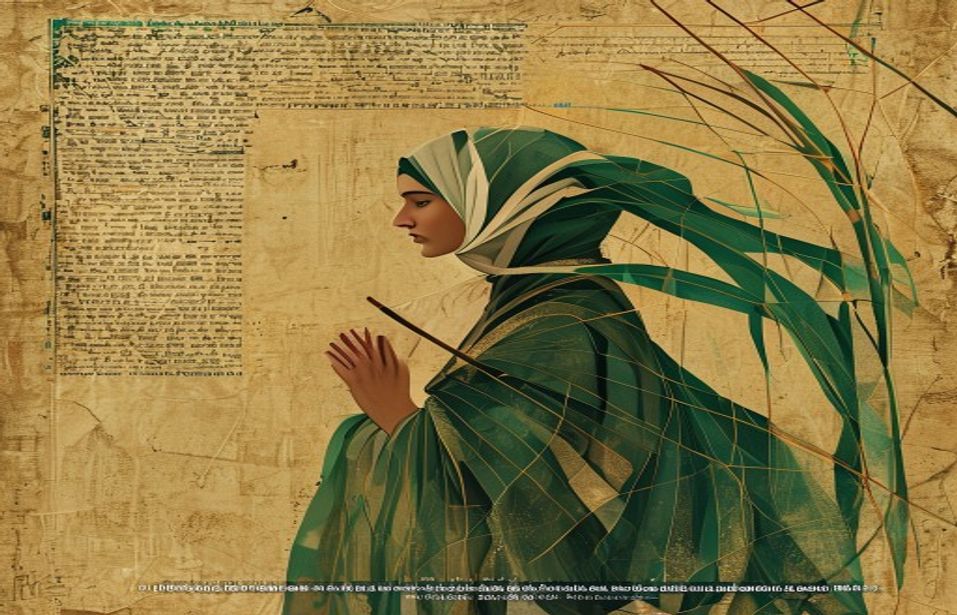
Yahya’s (John’s) mother, shortly before Mary (Maryam) gave birth, secretly said to her: “There is a king in your womb. He is a prophet of firm resolve (ulū’l-ʿazm) and all-knowing. I have seen this with certainty. When I encountered you, the child in my womb immediately prostrated. The child in your womb prostrated to the child in my womb. My body trembled from his prostration.” Mary said, “I too felt that the child in my womb prostrated.”
Fools say: “Stop with this tale. It’s false, it’s wrong. When Mary was about to give birth, she was far from strangers and kin alike. That beautiful woman left the city. She did not return until she had given birth. After giving birth, she took her child in her arms, pressed him to her breast, and came to her people and kin. Where did Yahya’s mother see her, that she told this story, uttered these words?”
This is understood by one who is subject to inspiration (ilhām), who knows things in the horizons and the unseen world as if they were present with him. Even though Yahya’s mother was far away, she could be present with Mary. When there is body and eye, the face of the beloved can be seen even with closed eyes. Suppose she did not see with her physical eyes—what of it? O heedless one, seek to take a lesson from the story!
Do not be like one who, upon hearing stories, clings to their outward form as if the letter “sh” were added to the word “naqsh” (embroidery), attaching himself to the surface of the tale. How could the mute Dimna convey his intent to Kalila? Suppose these animals understood each other’s words—how could a human understand what these animals, who express themselves without speech, mean?
How did Dimna become a messenger between the lion and the ox, and how did he deceive them both? How did that clever ox become vizier to the lion? Why did the elephant fear its own reflection? If the story of Dimna and Kalila is all false, then what dealings could a crow have with a stork, how could it wage war with a stork? Do not say this, brother; a story is like a measure, and the meaning is the grain within. The wise person takes the grain and does not care whether the measure exists or not. There is no trace of speech between them, yet listen to the tale of the nightingale and the rose!
Hear what befell the moth at the candle’s head, and grasp their meaning, my beauty. There is no speech between them, yet the secret and meaning of the word remain. Be aware, soar to the heights, do not fly low like an owl. Someone said, “This is the house of ‘rukh’ in chess.” One who heard this asked, “How did he acquire that house? Did he buy it, or did he inherit it?” Blessed is he who understands the meaning!
One of the grammarians gave the example, “Zayd beat Amr.” The listener said, “Why did he beat him when he was innocent? What crime did Amr commit that that raw Zayd beats him like a slave, though he is blameless?” The grammarian replied, “This is just a measure for meaning. You should take the wheat, there is no need for the measure. Zayd and Amr are used as examples for grammatical inflection; even if they are false, you should try to correct the inflection!” Yet the other says, “I do not care. Zayd, in addition, had once stolen a ‘vav.’ When Zayd realized it, he beat the thief. For Amr had overstepped his bounds, and of course, he needed to be put in his place.”
Upon this, the man says, “Aha, now I accept this wholeheartedly.” Even the truth appears crooked to the crooked. If you say to a cross-eyed person, “The moon is one,” he will say, “It is two. There is doubt about it being one.” If someone mocks and laughs, saying, “Indeed, it is two,” he will accept this as the truth. Such is the due of bad character. Liars speak with lies. The saying, “Impure things are for the impure,” continues to shine as a light. The hands of those whose hearts are open are also open. It is only natural that the blind fall upon stony ground.