SECTION ON PURITY · 143 – THE RULING REGARDING SPITTLE THAT CONTAMINATES CLOTHING

Abu Nadra (may Allah be pleased with him) narrated:
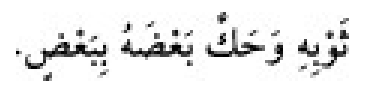
The Messenger of Allah (peace and blessings upon him) spat into his garment and rubbed one part of it against the other.
COMMENTARY:
This honorable hadith is mursal (a type of hadith with a broken chain of narration). Saliva is not impure, but it may contain germs and is also disgusting. The reason for this action was that the Messenger of Allah (peace and blessings upon him) saw someone spitting towards the Qibla during prayer, and he said:
“When one of you stands to pray, he makes supplication to his Lord. Let him not spit towards the Qibla, but rather to his left or beneath his feet.”
Then he took a part of his garment and spat upon it, and rubbed that part against another part, or something like that.
The Messenger of Allah (peace and blessings upon him) has described using a piece of cloth to prevent spitting towards the Qibla during prayer; if one does not have that, then he should wipe it in this manner, and thereby informed that no one has the right to disgust another person.

It is related from Anes bin Malik (may Allah be pleased with him) that a narration similar to the preceding hadith was recounted.
[248]. Bukhari, Book of Friday Prayer, Book 15, p. 217, no. 1; Muslim, Book of Friday Prayer, Book 21, no. 847, p. 581, no. 2
[249]. Tirmidhi, Book of Prayer, Book 357, no. 497, p. 369, no. 2; Nasa’i, Book of Friday Prayer, no. 1381
[250]. Tirmidhi, Book of Prayer, Book 425, no. 605, p. 502, no. 2
[251]. Bukhari, Book of Menstruation, Book 12, p. 80, no. 1
[252]. Bukhari, Book of Purity (Taharah), Book 12, p. 80, no. 1; Muslim, Book of Purity (Taharah), Book 33, no. 291, p. 240, no. 1; Tirmidhi, Book of Purity (Taharah), Book 104, no. 138, p. 254, no. 1; Ibn Majah, Book of Purity (Taharah), Book 118, no. 630, p. 207, no. 1; Nasa’i, Book of Purity (Taharah), nos. 294-394, vol. 1
[253]. Bukhari, Book of Purity (Taharah), Book 67, p. 63, no. 1; Muslim, Book of Purity (Taharah), Book 33, no. 291, p. 240, no. 1; Tirmidhi, Book of Purity (Taharah), Book 104, no. 138, p. 251, no. 1; Nasa’i, Book of Purity (Taharah), Book 13, nos. 294 & 293, pp. 195 & 196, vol. 1; Ibn Majah, Book of Purity (Taharah), Book 118, no. 628, p. 206, no. 1
[254]. Nasa’i, Book of Purity (Taharah), Book 97, p. 155, vol. 1; Ibn Majah, Book of Purity (Taharah), Book 81, no. 540, p. 179, vol. 1; Tirmidhi, Book of Prayer, Book 120, no. 600, p. 196, vol. 2; Nasa’i
[255]. Tirmidhi, Book of Prayer, Book 420, no. 600, p. 496, vol. 2; Nasa’i, Book of Purity (Taharah), Ibn Majah, Book of Ablution (Tayammum), Book
[256]. Muslim, Book of Purity (Taharah); Nasa’i, Book of Purity (Taharah), nos. 285-372-769; Ibn Majah, Book of Purity (Taharah), Book 131, no. 652, p. 214 vol. 1
[257]. Muslim, Book of Purity (Taharah), Book 32, p. 238; Nasa’i, Book , no. 297, p. 156, vol. 1
[258]. Muslim, Book of Purity (Taharah), Book 32, no. 288, p. 238, vol. 1; Ibn Majah, Book of Purity (Taharah), Book 82, no. 537, p. 173, vol. 1
[259]. Muslim, Book of Purity (Taharah); Nasa’i, Book of Purity (Taharah), nos. 285-372-769; Ibn Majah, Book of Purity (Taharah), Book 131, no. 652, p. 214 vol. 1
[260]. Muslim, Book of Purity (Taharah), Book 32, p. 238; Nasa’i, Book , no. 297, p. 156, vol. 1
[261]. Muslim, Book of Purity (Taharah), Book 32, no. 288, p. 238, vol. 1; Ibn Majah, Book of Purity (Taharah), Book 82, no. 537, p. 178, vol. 1
[262]. Bukhari, Book of Ablution (Wudu), Book 69, p. 63, vol. 1; Muslim, Book of Purity (Taharah), Book 32, no. 284, p. 236, vol. 1; Tirmidhi, Gates of Purity (Taharah), Book 112, no. 147, p. 275, vol. 2; Ibn Majah, Book of Purity (Taharah), Book 81, no. 536, p. 178
[263]. Ibn Majah, Book of Purity (Taharah), Book 77, no. 522, p. 174, vol. 1
[264]. Nasa’i, Book of Purity (Taharah), Book 101, no. 305, p. 158, vol. 1; Ibn Majah, Book of Purity (Taharah), Book 77, no. 526, p. 175, vol. 1
[265]. Tirmidhi, Book of Prayer, Book 430, no. 610, p. 509, vol. 1
[266]. Tirmidhi, Book of Prayer, Book 430, no. 610, p. 509, vol. 2; Ibn Majah, Book of Purity (Taharah), Book 77, no. 525, p. 174, vol. 1
[267]. Bukhari, Book of Ablution (Wudu), Book 61, p. 61, vol. 1; Muslim, Book of Purity (Taharah), Book 32, no. 284, p. 236, vol. 1; Tirmidhi, Gates of Purity (Taharah), Book 112, no. 147, p. 275, vol. 2
[268]. Tirmidhi, Book of Purity (Taharah), Book 109, no. 143, p. 266, vol. 2; Ibn Majah, Book of Purity (Taharah), Book 79, no. 531, p. 177, vol. 1
[269]. Bukhari, Book of Prayer, Book 33, p. 106; Muslim, Book of Ablution Places, Book 13, no. 549, p. 389, vol. 1; Nasa’i, Book of Purity (Taharah), Book 104, p. 163, vol. 1
“May ignorance be cured by asking,” he said. “They killed him, may Allah kill them.” [239]
“You have two rewards,” he said. [240]
340 – Narrated from Abu Huraira: Once Omar bin Al-Khattab was delivering a sermon on Friday when a man (Uthman bin Affan) entered. Omar asked him, "Are they imprisoning you from the prayer?" and "Why are you late?” The man replied, “I did not delay much; as soon as I heard the call to prayer, I performed ablution.” Then Omar said, “Did you neglect your ablution like you neglected the prayer? Did you not hear the Messenger of Allah (peace be upon him) say, ‘Whoever comes for Friday should bathe’?” [241]
341 – It is narrated from Abu Sa'id Al-Khudri: The Messenger of Allah (peace and blessings be upon him) said, “It is obligatory for every male who has reached the age of puberty to bathe on Fridays.” [242]
Abu Dawud said: If a man bathes on Friday morning before sunrise, it suffices for him as a bath for Friday, whether he bathed because of impurity or not.
[243]
Abu Dawud’s narration is more complete with Muhammad bin Salama's hadith. Hammad omitted the words of Abu Huraira. [244]
“Even if he slides in the scent of a woman,” he said. [245]
"For every step he takes, he gains the reward of one year spent praying voluntary prayers at night and fasting during the day," he said. [246]
"- Whoever bathes on Friday as he bathes for impurity, then goes to the mosque in the first hour, receives the reward of a camel; if he goes in the second hour, he receives the reward of an ox; if he goes in the third hour, he receives the reward of a ram; if he goes in the fourth hour, he receives the reward of a chicken; and if he goes in the fifth hour, he receives the reward of an egg. When the Imam ascends the pulpit, the angels are present." [247]
People were doing their own things. They were going to Friday with their clothes on. Then it was said to them, "Bathe yourselves.” [248]
354 – Narrated from Samura: The Messenger of Allah (peace and blessings be upon him) said, “Whoever performs ablution on Friday and does ghusl, then it is good; but if he does a complete ghusl, it is better." [249]
355 – Narrated from Kays bin Asim: I came to the Messenger of Allah (peace and blessings be upon him) intending to become Muslim. The Messenger of Allah (peace and blessings be upon him) ordered me to bathe with water mixed with sidr.” [250]
358 – Narrated from Mujahid: A wife of the Pure Ones (Aisha) would not have more than two garments. While she was wearing them, she would experience menstruation.
“If blood were to befall clothing (in small quantity), one would moisten it with saliva and rub it between the fingers,” he said. [251]
He responded, “When menstrual blood befalls a garment of yours, rub it with your finger. Then pour water over it, and perform your prayer.” [252]
“Scrape it off, squeeze it with water, then pour water over it,” he commanded. [253]
– “Scrape it off with (a curved object), wash it with water and *sidr*,” he said. [254]
366 – From Mu’awiya ibn Abu Sufyan, may Allah be pleased with him: His wife and his sister, Ummu Habiba, asked the Messenger of Allah, peace and blessings be upon him, “Does the Messenger of Allah, peace and blessings be upon him, pray in clothing that he has had relations with?” Ummu Habiba said, "He would pray in it if he did not see impurity on it.” [255]
367 – From Aishah, may Allah be pleased with her: “The Messenger of Allah, peace and blessings be upon him, would not pray in our undergarments or bedsheets,” she said. Ubaydu’llah said, "My father wondered whether it was the undergarment or the bedsheet.” [256]
Hammad said: I heard Saad ibn Abu Sadaqa say. I asked Muhammad ibn Sirin about this hadith. He did not relate it to me. And a long time has passed since I heard it. I do not know from whom I heard it, whether from a trustworthy person or a weak one. Ask someone else about it,” he said. [257]
369 – From Maymunah, may Allah be pleased with her: The Messenger of Allah, peace and blessings be upon him, was praying while wearing a woolen cloak on his back. Part of the cloak was over one of his family members. And she was in a state of ritual impurity. The Messenger of Allah, peace and blessings be upon him, continued praying while she was upon it, she said. [258]
370 – From Aishah, may Allah be pleased with her: “I would be present with the Messenger of Allah, peace and blessings be upon him, in a state of ritual impurity. The Messenger of Allah, peace and blessings be upon him, would pray at night. While I had a cloak over me. Part of the cloak was also over him,” she said. [259]
This hadith was related by Hakim as he relates it, and so did A’mesh. [260]
372 – Aishah, may Allah be pleased with her, said: “I would wipe off pre-seminal fluid from the Messenger of Allah's clothing and rub it, and then pray in it.” [261]
373 – It is related from Aishah, may Allah be pleased with her, that she said: "I would wash what had been soiled by pre-seminal fluid from the Messenger of Allah’s clothing, and then I would see (the washed area) as a patch or in colors (streaked)." [262]
“The garments are cleansed due to the urine of girls, and water is sprinkled upon the urine of boys,” he said. [263]
“The urine of a girl’s garment is washed, and water is sprinkled on the urine of a boy,” he said. [264]
“A girl's urine cleanses the garment, and water is poured over the urine of a boy until (he reaches) the age of eating food,” he said. [265]
This is as long as they do not eat food. When they eat food, their urine cleanses the (garment). [266]
“You have been sent to make things easy, and not to make them difficult; do not pour a full bucket or nearly a full bucket of water upon yourselves,” he said. [267]
He responded, “The clean part after impurity cleanses the hem (of the garment),” he said. [268]
A similar narration was related concerning the Messenger of Allah, peace and blessings be upon him, as in the preceding hadith. [269]