
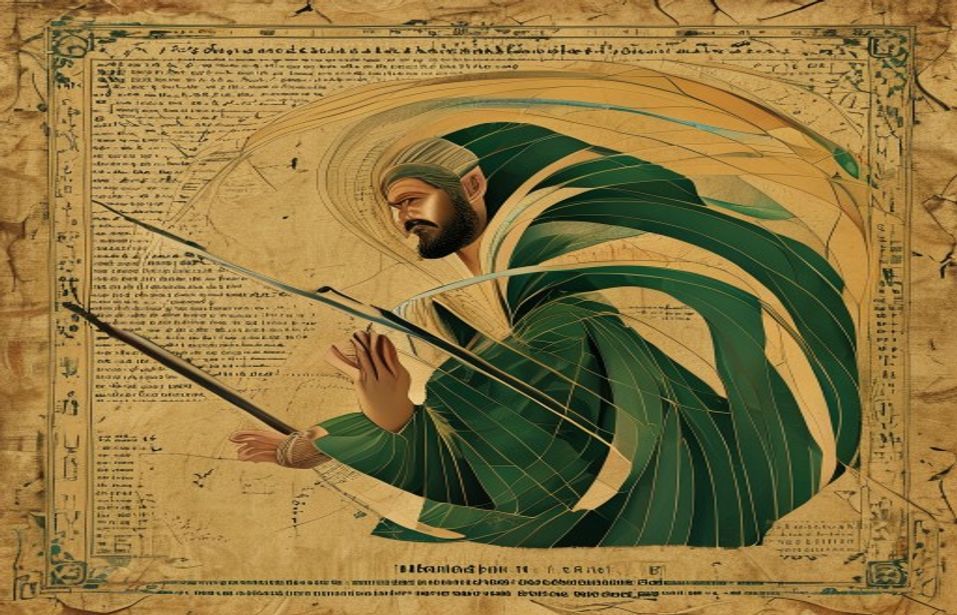
A sultan purchased two slaves at a low price. He spoke with one of them briefly. He found him insightful, intelligent, and eloquent. Indeed, sweet words only emerge from a sweet tongue. The human tongue is a veil over the door to the soul. When a wind blows and lifts that veil, we see what lies within.
Is there pearl or wheat, a treasure of gold, or is it filled with snakes and scorpions? Or perhaps there’s a treasure hidden inside, guarded by a serpent at its gate? For a treasure cannot be without a guardian. The slave spoke so effortlessly, as if thinking what others would ponder for five hundred times.
It’s as though he holds an ocean within him, brimming with pearls that speak eloquently. Each pearl’s radiance illuminates the distinction between truth and falsehood. The Light of the Quran also reveals this difference, particle by particle. If that pearl’s light were the light of our eyes, we would pose the questions and provide the answers ourselves. Instead, you squinted your eye, and therefore saw two moons. This is like doubting and questioning.
Straighten your gaze and look at the moon as one. That is the answer! Straighten your thoughts, observe carefully. For thought itself is a spark from that pearl. Every response born in the ear to the heart; leave it be, say ‘I heard it from Him.’ The ear is an instrument; he who reaches union has eyes; the ears are for gossip!
The ear’s emotion transforms qualities, while the eye’s clear vision changes their very essence. You declared the existence of fire with words; if you attained certainty through words, desire to burn, do not remain in words. That knowledge is not a mirror of certainty until it burns. If you seek this burning, plunge into the fire. The ear penetrates truth, and the eye is blinded. Otherwise, the word remains in the ear and does not affect the heart. This saying has no end. Return now, and I will tell you what the sultan did to those slaves.
Seeing that one slave was intelligent, the sultan commanded the other, “Come here.” The ‘ceğ’ suffix, indicating affection and compassion, is not meant for belittlement or scorn. Just as a mother says ‘my dear’ to her son, it is not an insult. The second slave came before the sultan. His mouth smelled foul, and his teeth were black. The sultan did not enjoy his words but began to search for what was hidden within him.
“Sit a little way off with that foul-smelling breath; but do not go too far. For I must speak with you from afar. You cannot fall or rise with me, nor can you sit with me. Stand a little away so that we may treat that mouth of yours. You are beautiful. I am a skilled doctor. A new kilim is not woven for a single flea, and it would be wrong to completely disregard you. Sit with all your flaws, tell me a few stories, so I can see what kind of mind you have.”
He sent the intelligent slave to the bathhouse to cleanse himself. To the other slave, he said, “Well done, you are an intelligent man; in truth, you are worth a hundred slaves, not one. Your gatekeeper spoke ill of you, but you are not like that at all. That envious fellow almost made us dislike you. He said, ‘He is a thief, not trustworthy, behaves inappropriately, is immoral, cursed, and so on.’”
The slave replied: “He always speaks the truth. I have never seen such a truthful man. Truthfulness is innate in his nature. I cannot deny that what he says is true. I do not consider him to be blind; I accept his faults as my own. My lord, it may be that he sees some flaws in me that I myself cannot see. If everyone first saw their own flaws, would they neglect improving themselves? My father is oblivious. That’s why people see each other’s flaws.
I cannot see my own face, but you can see mine; and you can see mine, but I cannot. The light of one who can see his own face surpasses the light of the people. His light remains eternal, for his vision is God’s vision. The light that sees its own face clearly is not the true light. The sultan said, “Now tell me what flaws you say he has, so that I may know that you are my friend, a trusted representative in my land, and that you love me.”
The slave replied: “My lord, if my gatekeeper is a good companion, let me speak of his faults. His virtues are love, loyalty, humanity, truthfulness, intelligence, and friendship. His least significant fault is generosity, helping the needy. But how generous? He would even give his life. Allah rewards such a gift with hundreds of thousands of lives. How can one be generous if they do not see this? If you saw it, how could you hesitate to sacrifice your life for a single life? One who stands by the water’s edge hoards the water; he does not see the river.”
The Prophet said: “He who knows the reward that will be given on the Day of Judgment, and understands that one good deed will be rewarded tenfold, his generosity increases. Such a person performs all kinds of generous acts.” Generosity is seeing all rewards. Therefore, see the reward; it is the opposite of fear. Stinginess is also not seeing the rewards. Seeing the pearl delights the diver who plunges into the sea.
If everyone saw what would be rewarded for generosity, no one in the world would be stingy. For no one gives anything without a return. Therefore, generosity comes from sight, not from the hand. Sight is what matters; none can escape without an open eye. My friend’s fault is that he does not see himself. He seeks his own faults. He speaks of his own flaws and searches for his own flaws. He knows everyone, is a friend to everyone, but is not a friend to himself.” The sultan said: “Do not praise your friend too much. When you praise him, you risk praising yourself. For if I test him, you will be embarrassed later.”
The slave replied: “By Allah, the Almighty, the Giver of Grace and Mercy, who sends prophets not because of their need but out of His favor, who creates kings from humble earth, who purifies them from the natures of creatures made from the earth, who elevates them above the degrees of the celestial beings, who creates a pure light from fire and illuminates all lights with it, who illuminates the lights born of that light, who created the illuminating radiance through which Adam the Prophet attained knowledge, who passed the light from Adam to Seth, who enabled Adam to see and replace him as his successor.
May He be praised who made Noah receive inspiration and rained pearls in the sea of life. Ibrahim embraced it fearlessly and ran into flames; Ismail laid down his neck before the shining knife because of him. David’s soul was inflamed by its flames, so that iron melted in his hand. Solomon drank from its union, and jinn and fairies obeyed his command.
Jacob received inspiration from its decree and opened his eyes with the scent of his son. Yusuf, the son of Maryam, saw that sun and became so alert in interpreting dreams. The staff touched Moses’ hand and drank water, so Pharaoh’s kingdom was devoured in a single bite. Jesus, the son of Mary, found his ladder and ascended to the fourth heaven. Muhammad divided the moon into two pieces with him.
Abu Bakr attained success and became a companion of such a sultan, confirming him wholeheartedly. Omar fell in love with that beloved and distinguished truth from falsehood. Osman became the very embodiment of clear vision and attained a blessed light, becoming Zayn al-Arifin. Al-Murtada rained pearls because of him and was slain as Allah’s lion in the valley of life.
Junayd attained the ranks beyond count when he received help from his soldiers. Bayazid heard the name “Qutb al-Arifin” when he found a way to His grace. Kharqani became a gatekeeper of His court and became a lover, whose breaths were Allah’s breath. Adhamoğulları raced towards him with joy and became the sultan of sultans.
Shaqiq attained a radiant eye, a seer who sees all things, through the hardships of that lofty path. There are countless hidden Sultans like these who possess glory in the realm of light, who have ranks. Allah has concealed their names from being mentioned by the poor out of His effort. May He be praised for that light and those nuranil who live like fish in the sea.
I am seeking a new name for that realm. That too is from Him, it belongs to Him. Pearls and truths are shells and appearances in relation to Him. I swear by Allah that my gatekeeper and friend are ten times greater than what I have spoken of them. But alas, you do not believe! What can I say? The sultan said: “Now speak about yourself. Why will you talk about the affairs of others now? Tell me, what do you possess, what have you gained, what pearls have you brought from the bottom of the sea?”
That feeling will vanish on the Day of Judgment. Do you have a soul-light that may be pleasing to your heart? The earth will fill your eyes in the grave. Do you have a light to illuminate your grave? Does your hand, foot, wing exist so that your life can fly away? Do you possess an eternal life to replace it when this animalistic life is gone? The condition is not to do good deeds but to receive them; to bring those good deeds to Allah. Do you possess something from humanity or donkeyship? When these lands perish, how will you carry them? How will you convey these prayers and fasts to Allah? For the lands do not remain for two periods of time, they vanish in an instant. There is no way to take the lands. But through the essence, they remove diseases from those lands. Thus, the essence escapes from those disease-lands and changes. Just as a disease passes with fasting; fasting becomes an essence; the bitter mouth sweetens with abstinence. Lands are filled with crops through agriculture. Hair tonic makes hair grow; marriage is a land; from it, a child-essence arises. Breeding horses and camels is a land; its purpose is to obtain the offspring-essence. Planting a garden is a land; the produce in the garden is an essence. Indeed, that is the purpose. If you engage in alchemy, bring forth an essence from it. Polishing a mirror is also a land; but from this land, a pure mirror-essence arises. So do not say, ‘I have performed worship,’ show what has been obtained from those lands, do not be alarmed. Your praising that slave is also a land.”
The slave said: “My lord, if you say that the lands do not transform, then this statement only gives hope of despair. My lord, if the lands do not change shape and not arise again, then the servant will be frustrated. If the lands did not transform into other shapes and take on new forms, things would become futile, words meaningless; these lands transform into another form of existence. Everything transforms into what it is worthy of. The shepherd is a person worthy of the flock. Every land has an image in the Resurrection. Each image of that land also has a shift. Look at yourself; were you not a land, did you not arise from your mother and father and are you not a couple for a purpose?”
Look at houses and palaces. These were all but the ideas of the architect. The beautiful sofa is pleasing. The ceiling, door, that perfect house – it was in the architect’s mind. That land, that thought in the architect’s mind prepared the tools, brought timber from the forests, and the house emerged. What is the origin of every skill but imagination, land, and thought? Look at all the components of the world, but without wonder; nothing has come into being except from land.
The first idea comes to fruition in the end. Know this about the creation of the world from eternity. Fruits arise in the heart before they appear externally. When you start a job and plant a tree, it means you have read the first letter. Though the branch, leaf, and root are earlier, they all come into being for the fruit. Even that mind, which is the brain of the spheres, ultimately became worthy of the secret of “Lev.”
These paragraphs pertain to the transformation of lands. The lion and the trap are all for this purpose. The entire universe is essentially land. The Surah