

Prayer Section · 5 – The Time for Afternoon Prayer



Anas ibn Malik (may Allah be pleased with him) narrated: The Messenger of Allah (peace and blessings upon him) would perform the afternoon prayer when the sun was white, high, and its heat had not changed. He reported that at that time, someone going to Awali could reach it before sunset. [283]
COMMENTARY:
Avali: As will be shown in a subsequent hadith, these are villages located near Medina, approximately two or three miles from Medina. Umar (may Allah be pleased with him) also resided in Awali. (From the Abu Dawud marginal notes)


Zuhri – may Allah be pleased with him – said: The outlying villages are two miles or three miles distant. Ma'mar said: I think Zuhri said four miles.

Ḥayyāsam (may Allah be pleased with him) said: "The life of the sun means finding its warmth."


From Ibn Shihab (may Allah be pleased with him), who said: Urwa stated, “I swear that Aisha (may Allah be pleased with her) informed me that the Messenger of Allah (peace and blessings upon him) would perform the afternoon prayer while the sun was in her chamber, and its shadow had not yet risen to the walls.”


Ali ibn Shayban (may Allah be pleased with him) narrated:
We came to the Messenger of Allah, peace and blessings be upon him, in Medina. He would delay the afternoon prayer until the sun turned pale and white.


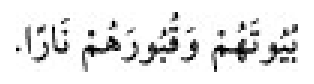
Ali ibn Abi Talib, may Allah be pleased with him, narrated: The Messenger of Allah, peace and blessings be upon him, on the day of the Battle of the Trench said, "The polytheists prevented us from the middle prayer, the afternoon prayer. May Allah fill their homes and graves with fire."





410 – From Abu Yunus, may Allah be pleased with him, the freed slave of Aisha, may Allah be pleased with her: Aisha, may Allah be pleased with her, ordered me to write down a portion of the Qur’an and when I reached the verse:
"(Establish prayer, and [especially] the middle prayer)" (Qur'an 2:238) she instructed me to inform her.
When I recited it to her, she told me to spell out: "(Perform the five prayers, the middle prayer, and the afternoon prayer on time, with reverence, standing before Allah)." And she said, "I heard this from the Messenger of Allah." [286]
EXPLANATION
The reading “Hâfizû alâsselâti vessalâtil vustâ,” and “vesselatil asr” in this hadith is anomalous, as it is reported from a single narrator. The Qur’an, however, relies on widespread transmission. In the authentic narration related from Ubay ibn Kab, the reading is "salâtil Asr" without the waw (vav). According to the anomalous reading narrated from Abu Yunus, the prayer of the middle becomes separate from the afternoon prayer. According to the authentic narration reported from Ubay ibn Kab, it is understood that “salati vustā” is “salāti asr” (the afternoon prayer).




Zayd ibn Saabit -may Allah be pleased with him- related that the Messenger of Allah, peace and blessings be upon him, would perform the noon prayer at the exact middle of the day. He said: “The companions found no prayer more difficult than the noon prayer as performed by the Messenger of Allah, peace and blessings be upon him.” Regarding the noon prayer, the verse (And pray in the middle of the day – 2:238) was revealed. Zayd ibn Saabit said: "Because there are two prayers before noon and two after it."
COMMENTARY
Bukhari narrated it in Tarikh al-Kabir.
According to this honorable hadith, Salat al-Wusta (the middle prayer) is the noon prayer. It is between night and morning, and between afternoon and evening. Thus, the noon prayer becomes the middle prayer. The statement, 'There are two prayers before noon and two after it,' may be Zayd ibn Saabit’s words or it may be the Messenger of Allah's peace and blessings be upon him words. In ‘Awn al-Mabud, it is considered more likely that it is Zayd ibn Saabit’s words. We have preferred this view and translated the last sentence as being from Zayd ibn Saabit.



Abu Hurayrah, may Allah be pleased with him, narrated: The Messenger of Allah ﷺ said: "Whoever catches a rak'ah of the afternoon prayer before sunset, he has fulfilled the afternoon prayer for that day; and whoever catches a rak'ah of the Fajr prayer before sunrise, he has fulfilled the Fajr prayer for that day." [287]
COMMENTARY
At-Tahawi explained this hadith by saying: If a disbeliever becomes Muslim and catches one rak'ah of the Fajr and afternoon prayers, then those prayers become obligatory upon him for that day.
A menstruating woman, if she purifies herself and catches one rak'ah of these prayers, then it is incumbent upon her to perform them. A boy, if he experiences wet dreams while able to catch one rak'ah of these prayers, and reaches puberty, then these prayers become obligatory upon him.
However, At-Tahawi’s explanation has been subject to objections: If someone catches a rak'ah of the Fajr prayer and begins the second rak'ah when the sun rises, the prayer is invalidated. But if someone catches a rak'ah of the afternoon prayer before sunset, even if the sun sets while he performs the remaining rak'ahs, he is considered to have fulfilled the prayer – it is deemed as having been performed properly. (Bezl-ul-Majhud vol. 2, p. 204)






‘Ala bin ‘Abdurrahman (may Allah be pleased with him) said: I went to Anas bin Malik (may Allah be pleased with him) after the noon prayer. He rose to perform the afternoon prayer. When he finished the prayer, we mentioned his haste in it, or he himself mentioned it. He said, “I heard the Messenger of Allah (peace and blessings upon him) say: Whoever sits until the sun yellows and enters between the two horns of Satan or upon them, and then rises and performs four rak’ahs (the afternoon prayer), remembering Allah little; then that is the prayer of the hypocrites. That is the prayer of the hypocrites.” [288]
COMMENTARY
Various probable explanations have been offered regarding what is meant by “the horns of Satan” in this hadith. The most rational of these possibilities is as follows: Those who worship the sun are influenced by Satan’s whispers to worship it, and their worship occurs at three times: when the sun rises in the morning, at midday, and when the sun yellows and approaches its setting. Since their worship is due to Satan's whisper, it appears as if the sun has risen from the top of Satan and set from the top of Satan. (Bezl’ul-Machud, Avn ul-Ma’bud, Maalim us-Sunnah)




From Ibn Umar, may Allah be pleased with him:
The Messenger of Allah, peace and blessings be upon him, said, “One who misses the time for the Asr prayer is like one who has lost his property and family.”
Abu Dawud relates through Ubaydah ibn Umar, saying to Hamza, "Utira," and Salim’s father says, relating from the Messenger of Allah, peace and blessings be upon him, “Wutira.” [289]
EXPLANATION:
This honorable hadith demonstrates the importance of performing the Asr prayer on time and the danger of missing its time. It is stated that one who misses the Asr prayer is like one who has lost all his wealth and family members, thereby drawing attention to the grievous consequences of this negligence.


It is related from Walid that Abu Amr al-Awza'i said: It is when you see the sun yellowing upon the earth (at the time of the afternoon prayer).
COMMENTARY
This interpretation is according to the opinion of Abu Amr al-Awza’i regarding his own legal school. The yellowing of the sun indicates that the first time for the afternoon prayer has arrived, but it does not necessarily signify that the time has completely expired and that one has been excluded from the time for prayer.