
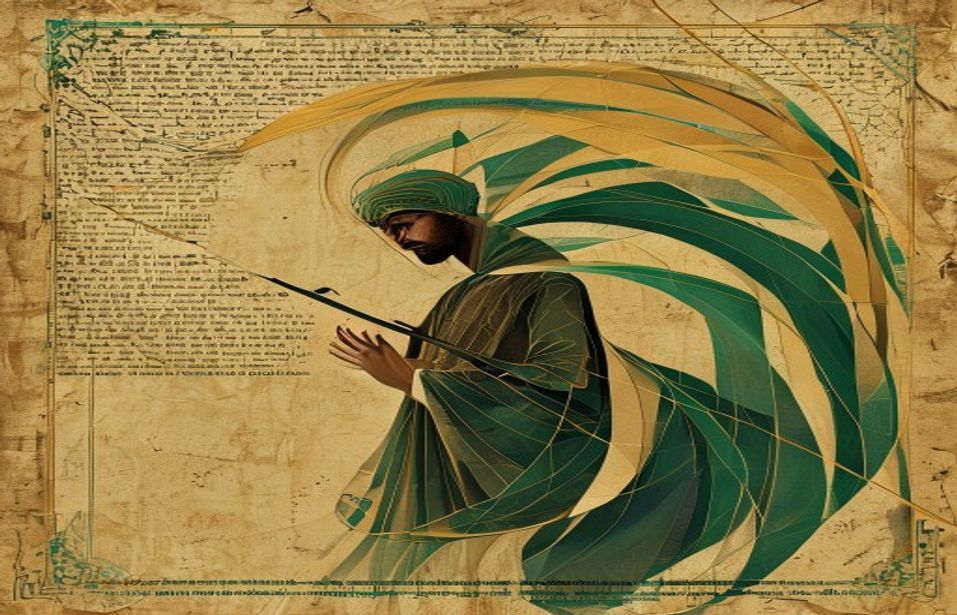
Luqmān, a servant of pure heart, was he not swift and diligent in servitude night and day? His master favored him, considered him superior to his own sons. For Luqmān, though in fact the son of a servant, was a master, free from caprice and desire. Once, a king said to a shaykh during a conversation: “Ask me for something.” The shaykh replied, “O King, are you not ashamed to say such a thing to me? Rise a little higher! I have two servants. They are lowly, despised people, yet both rule over you, both command you.”
The king said, “This is a mistaken statement. Who are these two servants?” The shaykh replied, “One is anger, the other is lust.” Know as king the one who renounces kingship. His light shines on, even without the moon and sun. The one who owns the treasury is the one whose very being has become a treasury. The one who is defeated by existence is the one who is an enemy to existence. Luqmān’s master was, in appearance, his master, but in reality, he was Luqmān’s servant.
In this topsy-turvy world, there are many such opposites. In their eyes, a jewel is even baser than a piece of straw. Every desert is given the name of a place to escape and be saved. Name and form are traps for the minds of the people. One group is recognized by their clothing. When they are seen in that garb, they are called commoners. The appearance of hypocrisy has also given a group the name of asceticism.
Yet in reality, they are drowned in hypocrisy. What is needed is a light purified from imitation and fleeing, so that it may recognize them without listening to their words or observing their actions. Whoever possesses this light enters their heart by the way of intellect, sees their true worth, and does not rely on transmission and narration. The elect servants of Allah, who know the unseen well, are spies of the heart in the realm of souls.
They enter the heart like a dream. Hidden things and states are manifest before them. What strength or power does a sparrow have in its body that its secret should remain hidden from the mind of the falcon? What is the secret of creation before the one to whom Allah has revealed His secrets? Would walking on the earth be difficult for one who has ascended to the heavens? O tyrant, in the hand of Dāwūd (David), iron would melt and become like wax; then what is wax in his palm?
Luqmān was a master in the form of a servant. His servitude was only an outward appearance. For example, if a master goes to an unfamiliar place, he dresses his servant in his own clothes. He himself puts on the garments of the slave and makes the slave his master. He walks behind him like a servant. In this way, he does not reveal himself to anyone. “O servant, you sit at the head of the table. I, like an old servant, will carry your shoes.
You be harsh, scold me, do not show me any hospitality. Now your service, in my view, consists only in ceasing to serve me. In this way, I will sow the seed even in a foreign land,” he says. Masters have accepted servitude so that they may be thought of as servants. Their eyes are sated, they are filled with mastery, and they have always done what was necessary for themselves.
However, these servants of caprice and desire, on the contrary, present themselves as masters of intellect and soul. A master can serve, but nothing other than servitude can appear from a servant. Know that from that world to this world, there are many things that are reflected in reverse. Luqmān’s master knew this hidden state, he had seen a sign from him. Knowing the secret, that guide was skillfully driving his donkey to accomplish his task.
He would have freed Luqmān earlier, but he desired his pleasure. For this was Luqmān’s wish. That lion, that brave one, wanted no one to discover his secret. It is not surprising to hide your secret from the wicked; what is surprising is to hide it from yourself, to conceal it even from yourself. But you, hide your work even from your own eye, so that no evil eye may fall upon it. Surrender yourself to the trap of wages, and then, without your own selfhood, steal something from yourself. To extract the arrowhead from the wounded, they give him opium, they put him to sleep. At the time of death, too, they give a man pains and torments. Then, while he is occupied, they take his soul. Thus, you understand, if you give your heart to any thought, something will secretly be taken from you. Whatever you think, whatever you obtain, the thief comes upon you from the sweat you trust. Therefore, at least engage in the best work, so that the thief may take away from you only the basest, the lowest thing. If the merchant’s load falls into the water, he reaches for a better cloth. Since something of yours will fall into the water and be lost, abandon the lowest thing so that you may find something better.
When food was brought to Luqmān’s master, he would send for Luqmān and call him. Luqmān would first put his hand to the food, and then his master would eat. In this way, he would eat his leftovers with pleasure, enjoy it, and what Luqmān did not eat, he would throw away. Even if he ate it, he would eat it without appetite, without desire. This is true, endless prosperity and unity.
One day, a watermelon was brought as a gift to Luqmān’s master. He said to the servant, “Go, call my son Luqmān.” When Luqmān came, his master cut the watermelon and gave him a slice. Luqmān ate that slice as if it were honey, as if it were sugar. He ate it with such pleasure that his master cut and offered him a second slice. In this way, Luqmān ate the whole watermelon; only one slice remained. His master said, “Let me eat this one; let me see what it is like, surely it must be a sweet watermelon.”
For Luqmān was eating with such pleasure, such delight, such appetite that even those who saw him would feel hungry. As soon as his master ate that slice, a fire from the bitterness of the watermelon filled his mouth, his tongue blistered, his throat burned. For days, he was almost beside himself from the bitterness. Then he said, “O my dear Luqmān, how did you eat such poison so sweetly, how did you count such torment as a favor? What patience is this? Why did you endure so? Was it as if you wished to harm yourself? Why did you not say anything, why did you not say, ‘Let me wait a bit, I cannot eat now’?”
Luqmān said: “From your bountiful, giving hand, I have been so provided for that I am doubled over with shame. How could I say, ‘This is bitter,’ about something you offered with your own hand, O possessor of maʿrifa (experiential knowledge of God)? For all the parts of my body have been formed from your blessings. I was drowned in your grain, in your snare; if I could not endure even this little bitterness and cried out, may all the parts of my body be leveled to nothing!
Would the sweetness of your hand that bestows sugar ever leave any bitterness in this watermelon? Through love, copper becomes gold. Through love, turbid, muddy waters become pure and clear; through love, afflictions find healing. Through love, the dead are revived; through love, kings become servants. This love is also the result of knowledge. How could one who is caught up in nonsense ever sit on such a throne? How could deficient knowledge give birth to love? Deficient knowledge does give rise to a kind of love, but that love is for lifeless things.
The one with deficient knowledge, when he sees the color of the thing he desires in something lifeless, is as if he hears the voice of the beloved in a whistle. Deficient knowledge does not possess discernment and discrimination. In the end, he mistakes lightning for the sun. For this reason, the Prophet called the one who is deficient accursed. But this deficiency, in interpretation, is a deficiency of intellect. One who is physically deficient is to be pitied; to curse such a pitiable person, to wound such a person, is not at all fitting.
The evil disease that deserves to be cursed, the malady worthy of distance, is deficiency of intellect. For it is possible to complete deficient intellects, that is, to become intelligent, but it is not possible to complete a bodily deficiency. The kufr (disbelief) and pharaonic arrogance of every evil person who has fallen far from Allah generally arises from deficiency of intellect. For bodily deficiency, the Qur’an provides a concession: “There is no blame upon the blind” (see Qur’an 24:61). Lightning quickly fades, it is very unfaithful. You cannot distinguish the transient, unilluminated thing from the everlasting. Lightning smiles at that person—do you know whom? The one who attaches his heart to its light.
The lights of the heavens are without end. Can those lights ever resemble the light of Allah, which is found neither in the east nor the west? Know that lightning takes away the light of the eye, but the everlasting light, know that it aids the eyes. Riding a horse on sea foam, reading a letter by the light of lightning, failing to see the outcome because of greed—this is to laugh at your own heart, your own intellect. The special quality of intellect is to see the end of the matter. Intellect that does not see the outcome is nafs (the lower self). Intellect defeated by the nafs has become nafs. If the customer falls under the influence of Saturn, he becomes Saturn-like. In this misfortune, turn your gaze and look at the one who has given you this misfortune! The one who sees ebb and flow escapes misfortune and attains happiness.
Allah, in the process of turning from one state to another, brings forth everything by its opposite and keeps turning you from state to state. In this way, you fear becoming of the People of the Left (Ashāb al-Shimāl), and, like the noble ones, you hope for the delight of the People of the Right (Ashāb al-Yamīn). When you fall into both fear and hope, you have two wings. A bird with only one wing can never fly; it is helpless. Either leave me, let me not speak at all, or give me permission to speak fully.
If you do not want this or that, still, the command is yours. Who knows what your aim is, where your desire lies? The soul must be like the soul of Abraham, so that with its light it may see gardens and palaces in the midst of fire. Let it rise degree by degree to the moon and the sun; let it not remain at the threshold like a ring. Let it, like the Friend (Khalīl), pass beyond even the seventh heaven. For I do not love those that set and pass away. This world of the body has always deceived all but those who have escaped from lust, and will continue to do so.