

SECTION ON PURIFICATION · 98 – PERFORMING GHUSL FROM MAJOR RITUAL IMPURITY



239 – From Jubayr ibn Muṭʿim (may Allah be pleased with him):
The Companions (ṣaḥāba) discussed washing from major ritual impurity (janāba) in the presence of the Messenger of God (peace and blessings be upon him).
The Messenger of God (peace and blessings be upon him) then, indicating with both his hands,
said: “I pour water over my head three times.” [191]
EXPLANATION
This noble hadith is evidence that it is sunnah to pour water three times over the head and other limbs during ghusl, and if the water is poured by hand, it should be poured with both hands (with cupped palms).



240 – From ʿĀʾisha (may Allah be pleased with her):
When the Messenger of God (peace and blessings be upon him) would perform ghusl from janāba, he would ask for a vessel like a bowl used for milking, take a handful of water, and begin with the right side of his head, then move to the left side, then take water again with both hands and pour it over his head (with both hands), she said. [192]
EXPLANATION
Ḥilāb: A vessel used for milking sheep. Our Prophet (peace and blessings be upon him), while performing ghusl, would sometimes scoop water with his hands and pour it over his head, and sometimes hold a bowl with both hands and pour it first over the right side of his head, then over the left.




241 – It is narrated from Jumayʿ ibn Umayr, one of the sons of Taymullah ibn Saʿlaba (may Allah be pleased with him):
My mother and my maternal aunt and I went to ʿĀʾisha (may Allah be pleased with her). One of them asked her, “How did you perform ghusl?” ʿĀʾisha (may Allah be pleased with her) replied:
The Messenger of God (peace and blessings be upon him) would perform ablution (wuḍūʾ) as for prayer, then pour water over his head three times and wash himself. But we, because we had braids in our hair, would pour water five times over our heads. [193]
EXPLANATION
Zufur: Plural of zafira; refers to the braids in women’s hair. In the hadith, the statement of ʿĀʾisha (may Allah be pleased with her) that “we would pour water five times over our heads” may be a particular practice specific to her. Or, if there was doubt as to whether water had reached the roots of the hair, more than three times may have been used to remove that doubt. Although this narration may suggest that it is sunnah for women to pour water five times over their heads, this hadith is weak, and the stronger hadith of Umm Salama (may Allah be pleased with her) has been taken as the basis. In Umm Salama’s hadith, it is commanded for a woman to pour water over her head three times.






242 – From ʿĀʾisha (may Allah be pleased with her): When the Messenger of God (peace and blessings be upon him) would wash from janāba (major ritual impurity)—according to the narration of Sulaiman ibn Harb al-Wāshihī, he would begin with his right and pour onto his left hand. According to the narration of Musaddad: he would wash both hands and pour the bowl into his right hand. Then, according to both their narrations, the Messenger of God (peace and blessings be upon him) would wash his private area.
Musaddad said: He would pour onto his left. And often ʿĀʾisha (may Allah be pleased with her) would refer to the private area by allusion. (In the next part of the hadith, both narrators agree as follows:) Then he would perform ablution (wuḍūʾ) as for prayer. He would dip his hands into the water, run his fingers through his hair until he saw that the scalp was reached or that the skin was cleansed, pour water over his head three times, and pour the remaining water over his head. [194]
EXPLANATION
This hadith reports that ʿĀʾisha (may Allah be pleased with her) would speak by allusion when mentioning the private parts. For the elders, all their states and actions were full of propriety. Nothing but propriety was found in their words and conversations.




243 – It is narrated from ʿĀʾisha (may Allah be pleased with her):
When the Messenger of God (peace and blessings be upon him) wanted to wash from janāba, he would first wash his hands, then wash the parts of the groin where water does not reach, and pour water over the groin. When his hands were clean, he would rub them on a wall, begin his ablution anew, and wash himself by pouring water over his head.
EXPLANATION
Marāfiq: Refers to places where water does not easily reach, such as the armpits, navel hollow, and groin.
The Messenger of God (peace and blessings be upon him) would rub his hands on the wall after washing them with water in order to cleanse them with earth. When substances like soap are available, cleanliness is achieved with them. Especially in homes, it is not always possible to find earth to clean the hands, but soaps and detergents are always available.
The places to pay most attention to in ghusl are those where water is hard to reach: the folds of the ears, armpits, and groin. These areas sweat a lot and are considered the headquarters of dirt. Thus, the Messenger of God (peace and blessings be upon him) would pay special attention to washing these limbs, and after washing them, he would begin ablution anew.


244 – ʿĀʾisha (may Allah be pleased with her) said:
“Let me show you the marks of the Messenger of God’s (peace and blessings be upon him) hands on the wall where he washed from janāba.”









245 – It is narrated from Ibn ʿAbbās (may Allah be pleased with them both) from his maternal aunt Maymūna (may Allah be pleased with her):
I poured water for the Messenger of God (peace and blessings be upon him) while he was washing from janāba. He tilted the bowl toward his right hand and washed his hands two or three times. Then he poured water over his private area and washed it with his left hand. Then he rubbed his hands on the earth and washed them again. He rinsed his mouth and nose, washed his face and arms, then poured water over his head and body. He stepped aside and washed his feet, and when I offered him a towel to dry himself, he did not take it. He would wipe the water off his body with his hand. (Al-Aʿmash) I told this to Ibrāhīm al-Nakhaʿī, and he saw no harm in using a towel, but said (the Prophet) did not take it so that it would not become a habit. [195]
Abū Dāwūd says: Musaddad said:
I asked ʿAbdullāh ibn Dāwūd, “Did he dislike drying himself because it might become a habit?” ʿAbdullāh ibn Dāwūd said:
– Yes, that is so. I found this expression in my book in this way.
EXPLANATION
From this hadith, we learn that the Messenger of God (peace and blessings be upon him) did not dry his body after ghusl, and from the words of Ibrāhīm al-Nakhaʿī, that the Messenger of God (peace and blessings be upon him) saw no harm in drying oneself after ghusl or ablution.
Based on this hadith, there is no objection to drying oneself after ablution or ghusl.





246 – Narrated from Shuʿba (may Allah be pleased with him):
When Ibn ʿAbbās (may Allah be pleased with him) performed ghusl from janāba, he would pour water from his right hand onto his left hand seven times, then wash his private area. Once, he forgot how many times he had poured, and asked me, “How many times did I pour?” When I replied, “I do not know,” he said, “May your mother die, why do you not know?” He then performed ablution as for prayer, poured water over his body, and said, “The Messenger of God (peace and blessings be upon him) would purify himself in this way.”
EXPLANATION
Lā umma lak: Literally means “You have no mother”; in usage, it can be for both censure and praise. When used for praise, it means “You can do everything yourself, you have no need for your mother.” Sometimes, when showing affection to a small child, we say “may your mother die.” In this translation, I have preferred this meaning.
When used for censure, it means “Your mother abandoned you, you were raised by someone else, your mother is unknown.”
In this narration of Ibn ʿAbbās, it is reported that he washed his hands seven times. (See the explanation of the next hadith.)




247 – From ʿAbdullāh ibn ʿUmar (may Allah be pleased with him):
During the day, prayer was fifty times, washing from janāba was seven times, and washing urine from clothing was seven times. The Prophet (peace and blessings be upon him) supplicated to Allah, and prayer was reduced to five times a day, washing from janāba to one time, and washing urine from clothing to one time.
EXPLANATION
According to this hadith, before the Night Journey (Miʿrāj), prayer was fifty times a day. The reduction of prayer from fifty to five times occurred on the night of Miʿrāj.
When washing from janāba, each limb was washed seven times, and anything soiled with urine was washed seven times. On the night of Miʿrāj, the number of prayer times was reduced to five, washing each limb in ghusl once became sufficient, and it was stated that washing something soiled with urine once would suffice.
On this subject, the view of Imām al-Aʿẓam (Abū Ḥanīfa): In ghusl, it is sunnah to wash each limb three times. Impurities are of two types:
1 – Visible impurities: Their removal depends on removing the visible substance. They are washed as many times as needed until the substance is gone.
2 – Invisible impurities: These are washed three times; since urine is among the invisible, it is obligatory to wash it three times.
According to Imām al-Shāfiʿī: It is obligatory to wash clothing soiled with urine once, and recommended (mandūb) to wash it three times.


248 – It is narrated from Abū Hurayra (may Allah be pleased with him):
The Messenger of God (peace and blessings be upon him) said: “Under every hair there is janāba. Wash the hair and cleanse the skin.” [196]
EXPLANATION
This noble hadith is evidence that it is obligatory in ghusl to cleanse the roots of every hair. As for washing the hair itself, it is obligatory to wash the hair on the body. It is also obligatory for men to wash their hair. For women, after washing the roots of the hair, it is not necessary to undo their braids. (al-Khaṭṭābī) (Bazl al-Majhūd, vol. 2, p. 254)


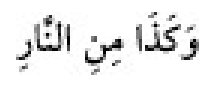


249 – From ʿAlī ibn Abī Ṭālib (may Allah be pleased with him):
The Messenger of God (peace and blessings be upon him) said: “Whoever, while washing from janāba, leaves even a hair’s breadth dry, will be punished thus and thus in Hell.”
ʿAlī (may Allah be pleased with him) said three times: “Because of this, I became an enemy to my head and hair,” and he would have his hair cut. [197]
EXPLANATION
There is no harm for men in shaving their heads completely. However, it is forbidden to shave part of the head and leave part unshaven.