

SECTION ON PRAYER · 136 – HE WHO OMITS SURAH AL-FATIHA IN PRAYER

According to the narration of Abu Sa'id (may Allah be pleased with him), he said: We were commanded to recite Surat al-Fatihah and that which is easy from the Qur’an [in prayer].


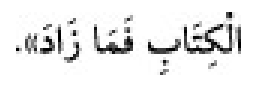
Abū Hurayrah, may Allah be pleased with him, narrated that the Messenger of Allah, peace and blessings be upon him, said to me: “Go forth and announce in Medina: ‘Only prayers performed with recitation of the Qur’an are accepted, even if it is with al-Fātiha and something added to it.’”


Abu Hurayra, may Allah be pleased with him, said: The Messenger of Allah, peace and blessings upon him, commanded me to proclaim, “Only the prayer performed with the Qur’an is acceptable, whether it includes al-Fatiha or more.”















From 'Ala bin Abdurrahman (may Allah be pleased with him), from the slave of Hisham bin Zuhra, Abu Saib:
I heard Abu Huraira say: The Messenger of Allah (peace and blessings upon him) said, "Whoever performs a prayer without reciting Al-Fatiha in it, then that prayer is deficient. That prayer is deficient. That prayer is deficient, it is not complete."
I said: O Abu Huraira, sometimes I am behind the Imam. He pushed me and said, “Recite it from within, O man of Fars!” And I heard the Messenger of Allah (peace and blessings upon him) say:
Allah the Exalted says: "I have divided the prayer between Myself and My servant into two halves. One part is for Me, and one part is for My servant. And what he wishes for is for him."
The Messenger of Allah (peace and blessings upon him) said: “You recite, ‘Praise be to Allah, Lord of the worlds.’” Then Allah (Glorified and Exalted) says: "My servant has praised Me.” The servant says: "You are the sole Master on the Day of Judgment.” Then Allah (Glorified and Exalted) says: "My servant has glorified Me." The servant says: “We do not worship except You, and we seek help only from You.” Then Allah (Glorified and Exalted) says: "This is between Me and My servant. And what he wishes for is for him." The servant says: "Guide us to the straight path, the way of those upon whom you have bestowed favor, not of those who invite [His] wrath, nor of those who are astray.” Then Allah the Exalted says: “These are for My servant, and what he wishes for is for him.”


Ubad ibn Samit (may Allah be pleased with him) narrated: In a narration reaching the Messenger of Allah (peace and blessings upon him): “The prayer of one who does not recite al-Fatiha and an amount of Qur’an along with it is invalid.” The narrator, Sufyan, states that this ruling is only for those praying alone.
EXPLANATION
Those who restrict the narration concerning the invalidity of a prayer without al-Fatiha to those praying alone maintain that it is not necessary for the congregation to recite al-Fatiha behind the Imam. Whereas, according to the position held by Hanafi scholars, and those who extend its scope to both the solitary and congregational prayers, it *is* necessary for the congregation to recite al-Fatiha behind the Imam, as is the case in the Shafi’i school of thought.




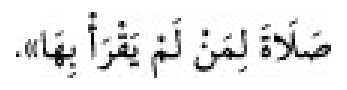
It is narrated by Ubada bin Samit (may Allah be pleased with him) that he said: We were behind the Messenger of Allah (peace and blessings upon him) in the morning prayer. While he was reciting, the recitation of the congregation became burdensome to him. When he finished the prayer, he said, “You are indeed reading aloud behind your Imam.”
We replied, "We recite it openly, O Messenger of Allah."
The Messenger of Allah (peace and blessings upon him) then said: “Do not read anything other than al-Fatiha. Verily, the prayer of one who does not recite al-Fatiha is invalid.”










Nafi bin Mahmud bin ar-Rabbi al-Ansar reported:
Nafi said: Ubadah (bin Samit) was delayed for the Fajr prayer. The mu'adhdhin, Abu Nuaym, made the call to prayer. Abu Nuaym also led the congregation in prayer. While I was with him, Ubadah arrived and joined the row behind Abu Nuaym. Abu Nuaym was reciting openly, and Ubadah was reciting al-Fatiha (the Opening chapter of the Qur’an – Ummu'l-Qur'an). When the prayer was concluded, I said to Ubadah: “You heard Abu Nuaym reciting openly, and you were reciting al-Fatiha.” He said: "Yes." He stated: "The Messenger of Allah ﷺ had performed for us a prayer among those in which recitation is open. After that prayer, during which we experienced difficulty in the recitation [due to the congregation’s reading], he turned to us and asked, ‘Do you recite when I recite openly?’ We said, ‘Yes, we do.’ He then said: 'No, do not. For I say to myself, what has happened to me? The Qur'an is pulling me towards another verse.' Do not recite after me anything other than Ummu’l-Qur’an [al-Fatiha] when I recite openly.” [508]




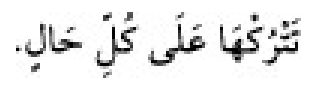
Ubad ibn al-As reported – and it was narrated in a manner similar to the hadith of Rabi' ibn Sulaiman – that Makhul used to recite Surah al-Fatihah secretly in every rakʿah of the Maghrib and Fajr prayers. He (Makhul) said: When the Imam recites Surah al-Fatihah aloud, recite it secretly at the places where he pauses. If the Imam does not pause, recite before him, with him, and after him. In every case, do not omit Surah al-Fatihah.