

SECTION ON FASTING · 80 – MAY A PERSON OBSERVING IʿTIKĀF VISIT THE SICK?



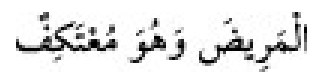
2472 – It is narrated from ʿĀʾisha (may Allah be pleased with her) that she said: When the Prophet (the Messenger of God, peace and blessings be upon him) was observing iʿtikāf (spiritual retreat in the mosque), he would visit the sick without deviating to any side, and would inquire about their condition without staying with them. Ibn ʿĪsā says: ʿĀʾisha (may Allah be pleased with her) said: The Messenger of God (peace and blessings be upon him), while in iʿtikāf, would visit the sick.




2473 – It is narrated from ʿĀʾisha (may Allah be pleased with her) that she said: What is sunnah for the one observing iʿtikāf is not to go out to visit the sick, not to attend funerals, not to touch women, not to have intercourse with them, and not to go out except for a necessary need. There is no iʿtikāf without fasting, and iʿtikāf is not to be observed except in a mosque where prayer is established. Abū Dāwūd said: Apart from ʿAbd al-Raḥmān, no one else narrated the statement "ʿĀʾisha (may Allah be pleased with her) said: what is sunnah." Abū Dāwūd considered this to be the statement of ʿĀʾisha.


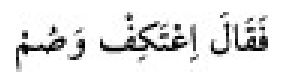
2474 – It is narrated from Ibn ʿUmar (may Allah be pleased with him) that: In the time of ignorance, ʿUmar had vowed to perform iʿtikāf for a day or a night at the Kaʿba and had made it binding upon himself. He asked the Messenger of God (peace and blessings be upon him) about fulfilling this. He said, "Perform iʿtikāf and fast."
EXPLANATION
According to this hadith in al-Nasāʾī, if things that were vowed during the time of ignorance are in accordance with Islamic law, then after becoming Muslim, their fulfillment is required. This is also the view of Imām al-Shāfiʿī. According to Imām al-Aʿẓam (Abū Ḥanīfa), Islam wipes away the sins committed before Islam. If someone swore an oath before becoming Muslim and then breaks that oath after becoming Muslim, expiation is not required. (Maʿālim al-Sunan, vol. 3, p. 349)



2475 – It is narrated from ʿAbdullāh ibn Budayl (may Allah be pleased with him) that he said: Once, ʿUmar was observing iʿtikāf. The people proclaimed the takbīr (Allāhu akbar). ʿUmar said to his son, "What is this, O ʿAbdullāh?" ʿAbdullāh replied: "They are the captives of Hawāzin. The Messenger of God (peace and blessings be upon him) set them free, so (they proclaimed the takbīr)." ʿUmar (may Allah be pleased with him) said: "That slave girl (who is among them), let her go with them as well."
EXPLANATION
Al-Nasāʾī says that in the chain of this hadith is ʿAbdullāh ibn Budayl, and for this reason it is weak. There was a slave girl from Hawāzin with ʿUmar, and he ordered his son to let her go with them as well. So he set her free. [346]