

TRADE SECTION · 31 – AGRICULTURAL PARTNERSHIP





3389 – According to a narration from ʿAmr ibn Dīnār, he said: I heard Ibn ʿUmar say: We saw no harm in muzāraʿa (agricultural sharecropping partnership). I heard Rāfiʿ ibn Khadīj say that the Messenger of God (peace and blessings be upon him) forbade agricultural sharecropping. I mentioned this to Ṭāwūs. Ṭāwūs said: Ibn ʿAbbās told me: The Messenger of God (peace and blessings be upon him) did not forbid agricultural sharecropping. Rather, he said: “For one of you to give his land to another for cultivation without taking anything in return is better than to take a specified portion of the produce as a condition for partnership in cultivation.” [213]
EXPLANATION
Muzāraʿa: In technical terms, it is when one party provides the land and the other provides the labor, and the yield of the land is divided in proportions such as one-third or two-thirds. According to Imām al-Aʿẓam (Abū Ḥanīfa), muzāraʿa is not permissible. According to Imām Muḥammad and Imām Abū Yūsuf, it is permissible. There are eight conditions for the permissibility of muzāraʿa:
1 – The field must be suitable for cultivation,
2 – The parties entering into the muzāraʿa partnership must be of sound mind,
3 – There must be a period sufficient for cultivation, such as one or two years,
4 – It must be specified who will provide the seeds,
5 – The type of crop to be planted must be determined,
6 – The shares of the partners must be determined,
7 – The field to be cultivated must be handed over to the farmer,
8 – When the crop is produced, those who made the agreement must be considered partners. There are seven forms of muzāraʿa:
1 – The land and seeds are from one side, and the labor and animals (or machinery) are from the other side.
2 – The land is from one side, and the labor, seeds, and animals (or machinery) are from the other side.
3 – The labor is from one side, and the land, seeds, and animals (or machinery) are from the other side.
4 – The land and animals (or machinery) are from one side, and the labor is from the other side. This is invalid.
5 – The seeds and animals are from one side, and the land and labor are from the other side. This is invalid.
6 – The seeds are from one side, and the land and animals are from the other side. This is invalid.
7 – The land, seeds, and labor are from one side, and the animals are from the other side. This is invalid. The pillar of muzāraʿa is the offer and acceptance.



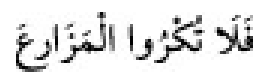

3390 – According to a narration from Zayd ibn Thābit (may Allah be pleased with him), he said: May Allah forgive Rāfiʿ ibn Khadīj. By Allah, I know the hadith better than he does. Indeed, two men came to the Messenger of God (peace and blessings be upon him). In Musaddad’s narration, it is stated that two men from the Anṣār came. Then, the narrators Abū Bakr and Musaddad agreed in their narration and said: Those two men quarreled with each other. Thereupon, the Messenger of God (peace and blessings be upon him) said, “Since this is your situation, then do not rent out lands.” In Musaddad’s narration: Rāfiʿ ibn Khadīj only heard the Messenger of God (peace and blessings be upon him) say, “Do not rent out lands.” [214]



3991 – According to a narration from Saʿd (ibn Abī Waqqāṣ) (may Allah be pleased with him), he said: We used to rent out land in exchange for the produce that grew on the banks of the water channels and was irrigated by their water. The Messenger of God (peace and blessings be upon him) forbade us from this. He commanded us to rent out land in exchange for gold and silver. [215]
EXPLANATION
Sawāqī: Plural of sāqī. Sāqī: The edge of a water channel. Saʿīda: Means flowing. A person would have land, and another would cultivate, irrigate, and rent it in exchange for the produce that grew on the banks of the water channels. Since the amount of produce growing on the banks of the water channels was unknown, disputes would arise in the end. Therefore, the Messenger of God (peace and blessings be upon him) forbade renting in exchange for something whose amount is unknown, and commanded renting in exchange for a specified amount, such as gold and silver.








3392 – According to a narration from Ḥanẓala ibn Qays (may Allah be pleased with him), he said: I asked Rāfiʿ ibn Khadīj (may Allah be pleased with him) about the ruling on renting land for gold and silver. Rāfiʿ ibn Khadīj said: There is no harm in this. Indeed, people used to rent out land on the banks of rivers or at the beginning of water channels, on the condition that a certain portion of the produce or crop would remain with them. This would sometimes be destroyed, and sometimes it would be spared; sometimes it would be spared, and sometimes it would be destroyed. There was no other form of renting for people. Because of this, the Messenger of God (peace and blessings be upon him) forbade renting in exchange for such unknown things. But there is no harm in renting for something specified and payable, such as gold and silver. The narration of Ibrāhīm ibn Mūsā is more complete. In Qutaybah’s narration, it is stated that Ḥanẓala narrated from Rāfiʿ (may Allah be pleased with him). [216] Abū Dāwūd said: The narration of Yaḥyā ibn Saʿīd from Ḥanẓala is also like this.



3393 – According to a narration from Ḥanẓala ibn Qays (may Allah be pleased with him): He asked Rāfiʿ ibn Khadīj about the ruling on renting land. Rāfiʿ ibn Khadīj replied: The Messenger of God (peace and blessings be upon him) forbade renting land. I asked: Did he also forbid renting for gold and silver? Rāfiʿ ibn Khadīj (may Allah be pleased with him) said: "There is no harm in renting for gold and silver."