

Divorce Section · 17 – Chapter on Zihar
















According to the narration of Salama ibn Sahr, Ibn al-Ala al-Bayazi, may Allah be pleased with him, said:
“I was a man afflicted with a weakness and desire towards women that I did not find in others. When the month of Ramadan arrived, I feared that I would touch my wife and this condition would last until morning. So, I vowed zihar to my wife until the month of Ramadan ended. One night, she was serving me, and I saw part of her body exposed, and I could not restrain myself, and I had intercourse with her. In the morning, I immediately went to my tribe and told them what had happened, and I said, ‘Come with me to the Messenger of Allah, peace and blessings be upon him.’ They said, ‘By God, we will not go.’ So, I went to the Messenger of Allah, peace and blessings be upon him, and recounted the story. The Messenger of Allah, peace and blessings be upon him, said to me, ‘Did you do this?’ I replied twice, ‘Yes, I did it. Command me whatever Allah has revealed to you, for I am patient (content) with the command of Allah.’ The Messenger of Allah, peace and blessings be upon him, then said, ‘Set free a slave.’
I struck my neck [referring to his slave] and said, ‘I do not have another neck than this one.’
The Messenger of Allah, peace and blessings be upon him, then commanded me, ‘Observe two consecutive months of fasting.’ I said, ‘This that has happened to me is only because of the fast.’ So he commanded me, ‘Give a wasq of dates to sixty poor people.’ I said, “I swear by Him who sent you as a Messenger, we had no food. We slept hungry.”
The Messenger of Allah, peace and blessings be upon him, then said, ‘Go to the collector of charity from Banu Zureiq, and let him give it to you from their zakat, feed a wasq of it to sixty poor people, and you and your family eat the rest.’
I returned to my tribe and told them, ‘I have seen much pressure and bad views from among you, but I have seen leniency and good views from the Messenger of Allah, peace and blessings be upon him. He has commanded me or for me to give you our charity.’”
**Notes:**
* *Zihar:* A form of divorce vow in pre-Islamic Arabia; considered a serious transgression in Islam.
* *Wasaq:* A unit of measurement for dates or grain.
* *Rakabe:* Literally means "neck," but used here to signify a slave, as the neck was how masters controlled slaves.












Huweyl ibn Malik ibn Sa’leh, may Allah be pleased with him, narrated:
My husband, Aus ibn Samit, wronged me in *zihar*. I came to the Messenger of Allah, complaining to him about it. The Messenger of Allah then argued with my husband and said, "Fear Allah regarding your wife; she is your maternal uncle’s daughter." Not long afterward, verses were revealed from the Qur'an concerning the expiation of *zihar* until the verses which relate to its atonement were revealed. The Messenger of Allah (peace be upon him) then commanded, “Let [one] set free a slave.” Huweyl said, "My husband does not have the means to set free a slave."
The Messenger of Allah (peace be upon him) said: “Then let him fast two consecutive months.”
Huweyl said: “O Messenger of Allah (peace be upon him), my husband is an elderly man and cannot fast.”
The Messenger of Allah (peace be upon him) said: "Let him feed sixty poor people."
Huweyl said: "He does not have anything to give in charity." Then Huweyl narrated, and immediately a basket of dates was brought. I said, “O Messenger of Allah (peace be upon him), may I assist my husband with a basket as well?”
The Messenger of Allah (peace be upon him) said: "Well done! Go and feed sixty poor people on behalf of your husband and return to your husband who is your maternal uncle’s son.”
Ma'mar said: A *rak* is sixty *sa’*.
Abu Dawud said in this topic: Huweyl paid the expiation without his husband’s permission on his behalf. (Abu Dawud says: Aus is the nephew of Ubada ibn Samit.)
**Explanation:**
*Zihar*: A man saying to his wife, "Your back is like my mother's back to me," or “Your head is like my mother's head to me,” or "Your buttocks are like my mother’s buttocks to me," or "Your limbs are like the limbs of my sister to me.” Whoever says one of these words to his wife has not attained [her] until he frees a slave; if he does not find [one], then he fasts for two consecutive months; and if he is unable, then he feeds sixty poor people. This is the expiation that those who commit *zihar* must pay.
*Arak*: A large *harar*. Or a *harar*-sized measure. The verses mentioned above are among the first verses of Surah al-Mujadala.


Muḥammad ibn Salama reported from Ibn Ishaq:
He narrated a similar account of the aforementioned hadith with this chain of narration. However, there he said that it is an area of thirty cubits.


Abu Salama ibn 'Abd ar-Rahman, may Allah be pleased with him, narrated:
"Arak is a statue of fifteen measures."




It was narrated from Sulayman bin Yesar, in this narration; dates were brought to the Messenger of Allah, peace and blessings be upon him, and he gave them to Aws bin Samit. The dates were about fifteen *sa’s*. The Messenger of Allah, peace and blessings be upon him, said to him: “Distribute these as charity.” Aws bin Samit said: "Should I distribute this to someone poorer than myself and my family?" The Messenger of Allah, peace and blessings be upon him, said: “You and your family eat them.”


From the report of Awws, brother of Ubada bin Samit: The Messenger of Allah ﷺ gave fifteen sa's of barley to Awws so that he might feed sixty poor people.



Hisham ibn Urwa, may Allah be pleased with him, related:
Jamila was married to Aws ibn Samit. Aws ibn Samit was a man very fond of women. His fondness for women intensified until he uttered divorce in jest [zihar] concerning his wife. Then Allah, the Exalted, revealed the expiation for zihar regarding him.
COMMENTARY
*Lemem*: It means madness, but here it signifies excessive desire for intimacy with a woman.

A report similar to the aforementioned hadith was narrated from Aisha, may Allah be pleased with her.


From Ikrimah, may Allah be pleased with him, it is narrated:
A man committed *zihar* to his wife, and then had intercourse with her before fulfilling its expiation. He came to the Messenger of Allah, peace and blessings be upon him, and informed him of what he had done. The Messenger of Allah, peace and blessings be upon him, said: “What compelled you to have intercourse with your wife after giving *zihar*?”
The man said: "I saw the whiteness of her pearls in the moonlight (and could not resist)."
The Messenger of Allah, peace and blessings be upon him, commanded: “Stay away from your family until you fulfill the expiation of your *zihar*.” [189]
**Note:** This honorable hadith indicates that if a person who has given *zihar* has intercourse with his wife before fulfilling its expiation, he must still fulfill the expiation.


Ikrimah, may Allah be pleased with him, narrated:
A man had said *zihar* to his wife. His wife’s pearl-like clarity was visible in the moonlight (and he could not resist), so he approached her. Consequently, he came to the Messenger of Allah, peace and blessings be upon him, and related the matter. The Messenger of Allah, peace and blessings be upon him, ordered him to expiate for his *zihar*.

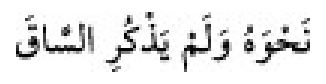
Ikrimah (may Allah be pleased with him) narrated from Ibn Abbas that the Prophet (peace and blessings of Allah be upon him) related a similar narration, but he did not mention the term "Incik" therein.

From Ikrimah, may Allah be pleased with him:
A report was related similar to the hadith of Sufyan.

From Ibn 'Abbas, may Allah be pleased with him, it has been narrated on the same meaning from the Messenger of Allah, صلى الله عليه وسلم.