
VOLUME 3 – 79 – CHAPTER ON SHAVING AND ERROR



Abdullah ibn Umar (may Allah be pleased with him) narrated:
The Messenger of Allah (peace and blessings upon him) said, “O Allah, have mercy on those who shave their heads.” The companions said, "O Messenger of Allah, also have mercy on those who shorten their hair."
The Messenger of Allah (peace and blessings upon him) again said, “O Allah, have mercy on those who shave their heads.” The companions said, “O Messenger of Allah, also have mercy on those who shorten their hair.” The Messenger of Allah (peace and blessings upon him) then said, “Have mercy on those who shorten their hair as well.” [37]
**Explanation:**
Those among the companions who did not have sacrificial animals were commanded to leave ihram after performing the umrah ritual. While leaving ihram, shortening the hair was easier than shaving it. The Messenger of Allah (peace and blessings upon him) desired to indicate that shaving is more suitable for divine acceptance, so he supplicated for mercy on those who shaved their heads twice, then on those who shaved on the third occasion, and also on those who shortened them. Furthermore, the companions had glued their hair with a sticky substance, and stones and dirt lodged within it, which could only be removed by shaving. Therefore, shaving is preferable for those who glue their hair. According to Imam al-A’zam, shortening [the hair] is sufficient.


From Ibn 'Umar, may Allah be pleased with him, it is narrated that:
The Messenger of Allah, peace and blessings be upon him, shaved his head during the Farewell Pilgrimage.





Anas ibn Malik (may Allah be pleased with him) narrated:
The Messenger of Allah (peace and blessings upon him) stoned the Aqaba Jamrah on the Day of Sacrifice, then returned to his lodging in Mina. He had his sacrificial animal brought and slaughtered it. Afterwards, he summoned the barber. He held the right side of his head and shaved it. He distributed one or two strands of hair to those present, then he held the left side of his head and shaved that too. Then he said, “Let Abu Talha come here.” He gave the hair from the left side to Abu Talha. [39]
**Explanation:**
The Messenger of Allah (peace and blessings upon him) began with the right side in his actions. This hadith is evidence that beginning with the right side in shaving is preferable.
*Zibih*: It refers to a sacrificial goat, sheep, or cow.

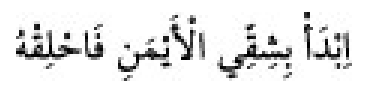
1982 – A similar chain of transmitters relates this hadith from Hisham bin Hassan. This hadith contains the addition that the Messenger of Allah, peace and blessings be upon him, said to the barber, "Begin from my right side and shave my head."
EXPLANATION
This honorable hadith describes how the Messenger of Allah, peace and blessings be upon him, was shaved during his Farewell Pilgrimage. The one who shaved the Messenger of Allah, peace and blessings be upon him, during the Farewell Pilgrimage was Ma’mer bin Abdullah (Bukhari and Aynai). The one who shaved the Messenger of Allah, peace and blessings be upon him, was Hirash bin Abdullah (Muslim Sharh Nawawi).
According to Muslim's narration, he had it shaved on both his right and left sides and distributed it among the people. According to Tirmidhi’s narration, he gave the hair from his right side to Abu Talha and the hair from his left side to the people. According to Abu Dawud’s narration, it is related that he gave the hair from his right side to the people and the hair from his left side to Abu Talha. Imam Ahmad uses this hadith as evidence, saying, "shaving the entire head is obligatory." Imam al-Azam says, “the obligation is fulfilled by shaving a quarter of the head.” Abu Yusuf chose to shave half of the head. According to Imam Shafi’i, cutting three hairs from the head fulfills the obligation.



It is narrated from Ibn ‘Abbas, may Allah be pleased with him:
People were questioning the Messenger of Allah, peace and blessings be upon him, on the Day of Mina. He would say, “There is no difficulty.” A man said to him, “I shaved my head before sacrificing.” The Messenger of Allah, peace and blessings be upon him, said, “Sacrifice what you can without difficulty.” The man said, “Night fell before I threw the stones.” The Messenger of Allah, peace and blessings be upon him, said, “Throw your stones without difficulty.”


It is narrated from Ibn Abbas (may Allah be pleased with him) that the Messenger of Allah (peace and blessings be upon him) said: "There is no shaving of hair for women, but rather shortening it."


From Ibn ‘Abbas, may Allah be pleased with him, it is related that:
The Messenger of Allah, peace and blessings be upon him, said, “There is no shaving for women, but rather shortening [of the hair].”
EXPLANATION:
It is not obligatory for women to shave their heads. It suffices if they trim a portion from the ends of their hair.