
Chapter 57 – The Prophet (peace and blessings be upon him)'s Pilgrimage










































































































From Jafar ibn Muhammad, who related from his father, said:
He stated: We visited Jabir ibn Abdullah, and when we arrived at his presence, he inquired about the identity of each visitor one by one. When my turn came, I said, “I am Muhammad, son of Ali, son of Hussein.” He extended his hand towards my head, loosened the uppermost button and the next one on my shirt, placed his hand between my two chests. I was a young man at that time, and he greeted me, saying, "Welcome, son of my brother," and said, “Ask whatever you wish,” so I asked. He had lost his sight. The time for prayer arrived, and he stood for prayer in a woven garment (meaning it was draped upon him).
Because this garment was small, as he placed it on his shoulders, its ends would turn back. He led us in prayer. His cloak was at the side, where garments are hung. I said to him, “Relate to me the Hajj of the Messenger of Allah, peace and blessings be upon him.” He made nine gestures with his hand, then the Messenger of Allah, peace and blessings be upon him, remained without performing Hajj for nine years. In the tenth year, he announced to the people that he would perform Hajj.
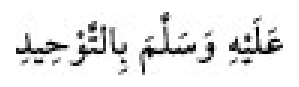
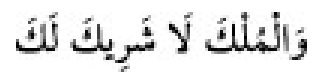
A great number of people came from Medina, all desiring to follow the Messenger of Allah, peace and blessings be upon him, and to do as he did. We set out from Medina with him. We arrived at Zatul-Hulaifa. There, Umeys’s daughter Asma gave birth. The Messenger of Allah, peace and blessings be upon him, received news and said, “What should I do?” He commanded her to bathe, tie a cloth around her as a bandage, and put on Ihram. Then the Messenger of Allah, peace and blessings be upon him, prayed in the mosque of Zatul-Hulaifa. Afterward, he mounted his she-camel, Kuswa, and the camel carried him up Mount Bayda. Jabir, may Allah be pleased with him, says: I looked around as far as my eye could see; there were people on every side of me – some riding camels, others walking. Revelation descended upon the Messenger of Allah, peace and blessings be upon him, among us, and he understood its interpretation. We did whatever the Messenger of Allah, peace and blessings be upon him, did. The Messenger of Allah, peace and blessings be upon him, made the declaration of unity: “Labbaik Allahumma labbaik, Labbaika la sharika laka labbaik, Inna al-hamda wa-l-shukra wa-l-mulk la sharikakalak.” And the people responded with that same declaration. The Messenger of Allah, peace and blessings be upon him, did not say anything in response to their declarations. The Messenger of Allah, peace and blessings be upon him, continued his declaration.
Jabir, may Allah be pleased with him, says: We only intended to perform Hajj, and we did not know that Umrah was performed during the season of Hajj. When we arrived at the Ka’bah, the Messenger of Allah, peace and blessings be upon him, touched the Black Stone (Hajar al-Aswad), ran in three circuits of the Tawaf, walked in four circuits, then came to the Station of Abraham (Makam Ibrahim). He recited the verse which means, "Take from their standing place a station [of prayer]." He placed the Station between himself and the Ka’bah. Jafar ibn Muhammad said, “My father used to say:” Ibn Nufeil and Osman ibn Abi Shayba said: I think that Jabir only narrated this (the verses recited during the Tawaf prayer) because he heard it from the Messenger of Allah, peace and blessings be upon him. Suleyman said: I know that Jabir only recited the (declaration of purity – Ihlas) and (Kafirun) surahs in two rak’ahs of the Tawaf prayer of the Messenger of Allah, peace and blessings be upon him.
After the prayer, the Messenger of Allah, peace and blessings be upon him, returned to the Ka’bah and touched the corner (rukn). Then he proceeded out through the Banu Ma'zum gate to Safa. As he approached Safa, he began from the mention, “Indeed, Safa and Marwa are signs [symbols] of Allah,” and started from Safa. He ascended the hill until he could see the Ka’bah, proclaimed the declaration of unity (Tawhid), and said: "There is no god but Allah alone; He has no partner. His is the dominion, and to Him belongs all praise. He is the one who gives life. He is powerful over all things. There is no god but Allah alone; He fulfilled His promise and helped His slave and defeated the factions of the disbelievers.” Then he made supplication between Safa and Marwa, repeating that same supplication three times. He descended to Marwa, and as his feet inclined in the middle of the valley, he ran, and when he ascended the slope, he walked. When he reached Marwa, he did exactly what he had done from Safa.
As he reached the last circuit of Sa’i between Safa and Marwa, he said: “If I had known before what I know now, I would not have driven a sacrificial animal, and I would have performed Umrah.” He commanded those among the people who did not have a sacrificial animal to leave Ihram and perform Umrah. The Messenger of Allah, peace and blessings be upon him, and all those from amongst the companions who had sacrificial animals left their Ihrams and shaved their heads.
Suraka bin Ju’shum stood up and said: “O Messenger of Allah, is this Umrah (Hajj-i Tamattu’) only for this year or can it be performed until the Day of Judgment?” The Messenger of Allah, peace and blessings be upon him, held his fingers together and said, "Umrah has entered Hajj." He repeated twice, “No, Hajj-i Tamattu’ will continue forever.” Ali, may Allah be pleased with him, brought the sacrificial camels of the Prophet, peace and blessings be upon him, from Yemen.
He found Fatima among those who left Ihram. Fatima was wearing painted garments and had kohl on her eyes. Ali, may Allah be pleased with him, disliked Fatima’s (may Allah be pleased with her) actions and said to her, “Who ordered you to do this?” Fatima, may Allah be pleased with her, replied, "My father commanded me." Ali, may Allah be pleased with him, said: I used to relate that when I was in Iraq, I went to the Messenger of Allah, peace and blessings be upon him, to ask about a statement he related, for I had heard from my father that the Messenger of Allah, peace and blessings be upon him, narrated it to Fatima regarding her leaving Ihram.
“Fatima spoke truthfully and correctly,” he said.
It was asked me about my intention when I intended to perform Hajj, so I replied, “O Lord, I intended as the Messenger of Allah ﷺ performed Ihram and made Talbiyyah.” The Messenger of Allah ﷺ said: "My sacrificial animal is with me, and you may leave your Ihram."
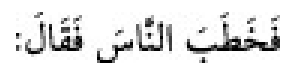
The total number of camels brought by Ali from Yemen and those brought by the Messenger of Allah ﷺ from Medina was one hundred. Everyone had left their Ihram and shortened their hair, except the Messenger of Allah ﷺ and those who had sacrificial animals with him. When the day of Tarwiya arrived, the people intended to perform Hajj and made Talbiyyah towards Mina. The Messenger of Allah ﷺ mounted his camel and performed the Fajr, Zuhr, Asr, and Maghrib prayers in Mina. He waited a while until sunrise, then ordered that a tent be set up for him within the boundaries of Arafat. The tent was pitched at Namirah. The Messenger of Allah ﷺ left Mina, suspecting that the people would act as they did during the days of ignorance. They were not doubtful that the Messenger of Allah ﷺ would perform Wuquf at Ma’shahr-i Haram in Muzdalifah. The Messenger of Allah ﷺ proceeded to Muzdalifah and arrived in Arafat, finding his tent pitched at Namirah. He descended into his tent, and after the time for Zuhr passed, he ordered that Kaswa be brought to him and prepared, mounted her, and came to the middle of the Urani valley, then addressed the people:
“The month you are in, this land, this day, and your blood are forbidden just as they were forbidden during the days of ignorance. I have abandoned all practices of ignorance from among you. All rights of vengeance have been abolished. The first right of vengeance that I abolish is the blood of Rabi’a ibn Harith.” Suleyman said: “The son of Abdulmuttalib, the son of Haris, Rabi’a ibn Harith.” Some narrators say: Rabi’a was searching for a wet nurse for his child among the Banu Sa’d tribe, and Hozai’ killed him. The interest that existed during the days of ignorance has also been abolished. The first interest I abolish is the interest of my uncle Abbas, the son of Abdulmuttalib. All of it has been abolished.”
“Fear Allah concerning women, for you have taken them as a trust from Him, and you have made permissible through His name what was forbidden to you. You have rights over them, so provide them with their food, clothing, and maintenance as is customary among people. I leave behind in your midst a thing upon which if you hold fast, you will never be led astray after me: the Book of Allah.” He said, “And you will be questioned about me, so what will you say?” The companions replied, "We bear witness that you have conveyed the message, fulfilled the trust, and given counsel to the community." Then he raised his index finger and pointed towards the people, saying, “(Allah is my Witness! Allah is my Witness! Allah is my Witness!)” Bilal recited the Adhan and gave the Iqamah. The Messenger of Allah ﷺ performed Zuhr prayer, then gave the Iqamah again and performed Asr prayer, without performing anything in between these two obligatory prayers. He arrived at the place of Wuquf. He turned the chest of his camel Kaswa towards the rocks. He brought it to the place where the crowds gathered and faced the Qibla. When the sun was about to set, he remained in a state of Wuquf. The redness of the sun had begun to disappear. Then, when it completely vanished,
He took Usama on his camel and drove her so hard that her head touched the soft spot in front of the palanquin. He kept saying, “O people, be heavy, O people, be heavy.” Whenever he came across a sand dune, he would not loosen the reins until he reached its top. He arrived at Muzdalifah. He combined Maghrib and Isha prayers with one Adhan and two Iqamahs.
The narrator Osman said:
He did not perform any voluntary prayers between these two obligatory prayers. Then all the narrators agreed on this point. Afterwards, he slept until dawn, and as soon as it became clear, he performed Fajr prayer. The narrator Suleyman said: with one Adhan and one Iqamah. And then all the narrators agreed on the following statement: He mounted his camel again and came to Ma’shahr-i Haram, stood upon it, Osman and Suleiman said:
He faced the Qibla, praised Allah, made Takbir, and recited Talbiyyah. Osman added that he affirmed the Oneness of Allah. He remained in a state of Wuquf until the place became truly illuminated. Then the Messenger of Allah ﷺ drove his camel before sunrise, taking Fadl, the son of Abbas, with him. Fadl was a handsome young man with beautiful hair and a fair complexion.
As he set out, a group of women ran past him. Fadl began to look at the women, so the Messenger of Allah ﷺ covered Fadl’s face with his hand. Then Fadl turned his face in another direction, and then the Messenger of Allah ﷺ turned his hand in that direction, and then Fadl turned his face in another direction and was looking. When he reached the muhassir valley between Muzdalifah and Mina, he quickened the pace of his camel. He took the middle path leading to the Jamrat al-Aqaba. He came to the large Jamrah next to the tree and threw seven small stones at it, reciting Takbir with each stone he threw.
He was bringing them. They were like small pebbles, and he threw them in the valley.
Then he returned to the place of sacrifice. He personally slaughtered sixty-three of his sacrificial animals, and commanded Ali (may Allah be pleased with him) to slaughter the rest, making Ali a partner in the sacrifice. He ordered that a piece of meat be taken from each sacrificed camel. The meats were placed in pots and cooked. The Prophet (peace and blessings be upon him) and Ali (may Allah be pleased with him) ate and drank from the meat and broth of the sacrificial animals. Suleyman says: Then the Prophet (peace and blessings be upon him) mounted his camel and descended to the Ka’bah, performing the noon prayer in Mecca. Afterwards, he came to the sons of Abdulmuttalib. They were distributing Zamzam water. He said to them, “O sons of Abdulmuttalib, bring out the Zamzam water. If it were not for the crowding and rush of the people (for blessings), I would bring it out with you.” They presented a bucket of Zamzam water to the Prophet (peace and blessings be upon him), and he drank from it. [628]
EXPLANATION
Zir: Button.
Ezrar: Buttons. Jabir (may Allah be pleased with him) used to have sight in his later years, but then lost it.
Mishjab: A wooden garment hanger with ends joined and legs left open, like a minbar.
Istizfiri: Binding the lower part so that blood does not flow; this is evidence that a pilgrim (hajjis) can do so. Indeed, there is consensus among the community on this matter.
Tahresh: To set an animal upon another. It means to release some camels against others, and some rams against others. Here it means to say reproachful words to Fatima.
Namirah: A place outside the boundaries of Arafat, where the Masjid al-Ibrahim is located.
Ijaza: He transgressed, he passed. Not allowing foreigners to tread on one’s mattress; it may mean not letting those you dislike into the house, even if they are women. Among the Arabs, it was customary for men to come and speak with women. After the verse of hijab was revealed, this custom ended, so it refers to someone who does not adhere to this command and continues with the old custom.
Habl al-mashat: It means a crowd of pilgrims like mountains.
Sanaka: Intention.
Zimam: Halter, reins.
Mawrik: A hump in front of the camel’s saddle for resting the feet.
Hibal: Means sand dune.
Irha: To loosen the reins.
Tasbih: Here it means supererogatory prayers.
Zaghn: A group of women, meaning women. A female riding animal is also called a zaghn.
Hazf: Stones the size of prayer beads thrown with the thumb and forefinger.






From Ja'far ibn Muhammad, from his father, who related that the Messenger of Allah, peace and blessings be upon him, performed the noon and afternoon prayers on the Day of Arafat with one adhan and two iqamas (combined), without performing a sunna prayer between them. He also combined the evening and night prayers with one adhan and two iqamas (in Muzdalifah), without performing a sunna prayer between them.
Abu Dawud says:
This honorable hadith was related from Jabir, may Allah be pleased with him. However, there is a variation stating that “the Messenger of Allah, peace and blessings be upon him, performed the evening and night prayers with one adhan and one iqama.”
EXPLANATION
The legal rulings derived from this are that on the Day of Arafat, the noon and afternoon prayers should be combined with one adhan and two iqamas and performed at the time of noon. The evening and night prayers should be combined with one adhan and two iqamas at the first time of night in Muzdalifah.
In the hadith related from Jabir, may Allah be pleased with him, it is stated that the Messenger of Allah, peace and blessings be upon him, performed the evening and night prayers with one adhan and one iqama.



Jabir (may Allah be pleased with him) narrated:
The Messenger of Allah (peace and blessings upon him) said: “I sacrificed my sacrifice here, but every area of Mina is a place for sacrificing. He performed the standing at Arafat and said, ‘I have stood here, but every area of Arafat is a place for standing.’ He performed the standing at Muzdalifah and said, ‘I have stood here, truly every area of Muzdalifah is a place for standing.’”

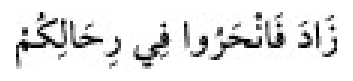
It is also narrated from Ja'far (bin Muhammad) with the chain of narration of the preceding hadith. Ja'far added: “Slaughter your sacrificial animals where you have settled.”
EXPLANATION
The Messenger of Allah, peace and blessings be upon him, stood at Arafat, near Mount Mercy, beside the stones in Muzdalifah, above the Sacred Mash’ar. He cautioned the people so that they would not think that standing (wuquf) could only be performed in this direction of Arafat, and not in any other direction. Similarly with the sacrifice; it is permissible only where the Messenger of Allah, peace and blessings be upon him, slaughtered his own animal. It is not permissible in other parts of Mina.






It is related through Ja'far ibn Muhammad and Muhammad ibn Ali from Jabir, and after the verse, "Take Ibrahim's station as your prayer place," the following sentences were added to the hadith.
(Ja'far ibn Muhammad ibn Ali) said: He recited al-Tawhid (al-Ikhlas) and al-Kafirun in those two rak'ahs. And regarding what appears in this hadith – "Hz. Ali said in Kufa…" – my father (Muhammad, relating to Hz. Ali) stated that he did not relate it from Jabir, and that (Jabir) only narrated the incident concerning Fatima, may Allah be pleased with her.