SECTION · 3 – Hadiths About Undressing (Nudity)




Miwser ibn Mahrama, may Allah be pleased with him, narrated: "I carried a heavy stone and was walking when my garment fell from me (leaving me unclothed). The Messenger of Allah, peace and blessings be upon him, said to me: 'Put your garment back on and do not walk unclothed.'"





It is related from the grandfather of Behz ibn Hakim, Mu’awiya ibn Hayda (may Allah be pleased with him), that he said:
“O Messenger of Allah, which part of our private parts should we cover and which may we leave uncovered?” The Messenger of Allah (peace and blessings upon him) said, “Protect your private parts from your wife and from a female slave you possess.”
I said, “O Messenger of Allah, if a group is comprised of close relatives, does the ruling remain the same?” He said, “If you have the power to prevent anyone from seeing it, then let no one see it.”
I said, “O Messenger of Allah, if one of us finds himself in seclusion, can he [then] uncover?” The Messenger of Allah (peace and blessings upon him) said, "Allah is more deserving that you feel shame before Him than before people."




Abdurrahman (may Allah be pleased with him) narrated from his father, Abu Sa’id al-Hudri (may Allah be pleased with him), who said that the Messenger of Allah (peace and blessings upon him) said: “A man must not look at another man's private parts, nor should a woman look at another woman's private parts. A man must not touch another man in clothing, nor should a woman touch another woman in clothing.” [573]
**Explanation:** Just as it is forbidden for a man to look at a woman and for a woman to look at a man, so too it is not permissible for a man to look at another man’s private parts or for a woman to look at another woman's private parts. However, matters of necessity such as surgery are excepted, because there is therein a need (darura).


It is narrated on the authority of Abu Huraira that the Messenger of Allah (ﷺ) said: "A man should not touch a woman, and a woman should not touch another woman, except their own child or father."
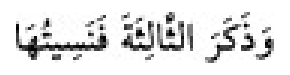
Abu Huraira (Allah be pleased with him) added: I remember something else he said but I have forgotten it.
The explanation: Just as a father may lie in the same bed with his young son, so too may a woman lie in the same bed with her young sons. But for a man to lie naked with another man or for a woman to lie naked with another woman is objectionable.
It is narrated that the Messenger of Allah (ﷺ) forbade entering bathhouses. Then he permitted men to enter them covered with loincloths.
It is narrated on the authority of Abu al-Mughira that a group of women from Syria came to Aisha (Allah be pleased with her). Aisha (Allah be pleased with her) asked them, "From what people are you?" They said, "We are from the people of Syria." Aisha (Allah be pleased with her) said, “I fear that you are from among those who enter bathhouses.” They said, "Yes." Aisha (Allah be pleased with her) then said: "Indeed, I heard the Messenger of Allah (ﷺ) say: 'Whenever a woman removes her garment outside her home, she tears the veil between herself and Allah.'"
"Soon, the land of Persia will be conquered. You will find there buildings called bathhouses. Do not allow men to enter those bathhouses without loincloths. Forbid all women except sick and postpartum women from entering them."
It is narrated that the Messenger of Allah (ﷺ) saw a man washing himself in the desert uncovered, so he mounted the pulpit, praised and glorified Allah, and then said: "The Mighty and Sublime Allah is truly possessor of modesty and concealment. He loves modesty and covering; so let one of you, when bathing, use a covering."
"Do not expose your thigh, nor look at the thigh of any living or dead person.”
It is narrated on the authority of Miswar bin Mahrama that he carried a heavy stone. As he was walking, his garment fell off (and he remained naked). The Messenger of Allah (ﷺ) said to him: "Put on your garment and do not walk naked."
A man said: “O Messenger of Allah! May one of us, if he is in a secluded place?” The Messenger of Allah (ﷺ) said: "Allah deserves that you feel shame from Him more than people do.”
"A man should not look at the exposed part of another man, and a woman should not look at the nakedness of another woman. A man should not be found with another man in such a way as to touch each other’s clothing, and a woman should not be found with another woman in such a way as to touch each other's clothing."