CHAPTER 1 – SECTION


Jabir (may Allah be pleased with him) narrated:
The Messenger of Allah (peace and blessings upon him) recited the first word of Surat al-Baqarah, verse 125, in the imperative form, saying, “Take a portion of [the area around] the Station of Abraham as a place of prostration.” [540]
EXPLANATION:
The first word of Surat al-Baqarah, verse 125, has been narrated from the Messenger of Allah (peace and blessings upon him) in two forms:
1. As it is in this hadith, in the imperative form, *VETTEHIZU*. The recitation of Imam Asim, transmitted by Hafs, is in this form.
2. In the past tense form, *VATTAHAZA*. The recitation of Imam Nafi’ is recited in the past tense form.
When recited in the past tense, the meaning of the verse becomes: “They took a portion of [the area around] the Station of Abraham as a place of prostration.”



Aisha (may Allah be pleased with her) related: A man rose during a part of the night and recited the Qur’an aloud. When morning came, the Messenger of Allah (peace and blessings upon him) said: “May Allah have mercy on this man; he reminded me of some verses that I had forgotten.”




From Ibn Abbas, may Allah be pleased with him:
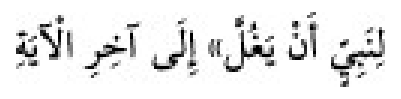
They said, "The red velvet that was lost on the day of Badr, the Messenger of Allah, peace and blessings be upon him, took it." Then the Mighty and Majestic Allah revealed, “It does not behoove any Prophet that he should conceal spoils of war secretly; whoever does [so], he will come with what he concealed on the Day of Resurrection. Then everyone will have what they earned justly, and no injustice will be done to them.” [542]
Abu Dawud said: The word *ya* in the verse is to be recited with a fatha upon the initial *yā*.


Anas ibn Malik (may Allah be pleased with him) narrated: The Messenger of Allah (peace and blessings upon him) said: “O Lord, I seek refuge in You from miserliness and old age.”



Asim ibn Lakit ibn Sabir, may Allah be pleased with him, narrated: I was among the delegation from Banu Muntafik. Or, I was among those who came to the Messenger of Allah, peace and blessings be upon him, from the delegation of Banu Muntafik. The narrator then continued the hadith.
In this narration, the Messenger of Allah, peace and blessings be upon him, recited the sin letter with a kesra [vowel sound] saying, “Lā tahsibanna.” He did not say “Lā tahsebna” with a fatha [vowel sound] on the sin letter.



It is narrated from Ibn Abbas (may Allah be pleased with him) that he said:
The Muslims came upon a man tending a flock of sheep. The man greeted them saying, “As-salamu alaykum.” The Muslims killed him, thinking he gave the greeting not out of faith but out of fear. They also took his sheep. Then (the verse of Surah An-Nisa, verse 94) was revealed: "O you who believe, when you go forth for fighting in the cause of Allah, let not those whom ye suspect of disbelief dishearten you by your words; surely they are more unjust in Allah’s sight. Allah has appointed among them those who say to their brothers (in faith), ‘If thou hadst been with us, thou wouldst have fought bravely.’ But Allah turned away their discord. Allah is well-acquainted with what ye do."
COMMENTARY:
The word *salaam* in this verse was recited with an alif before the lam, as *’as-salaamu*. It has also been recited without the lam, as *salama*.
This verse commands that when Islamic warriors arrive in a land where there are mosques, the call to prayer is being made, and prayers are performed, they should not harm the people of that land. They say that those who claim to be Muslim should not be killed out of fear.




Harith ibn Zayd ibn Sabit, may Allah be pleased with him, narrated from his father, who narrated:
The Messenger of Allah, peace and blessings be upon him, recited the word “ghayra” in (Surah An-Nisa’s verse 94) with a fatha on the ‘raf’. The narrator, Sa’id ibn Mansur, omitted the words "he recited" from his narration.
COMMENTARY:
The word “ghayr” in Surah An-Nisa’s verse 94 has been recited as “ghayru” with an open alif, as a descriptive attribute of the word “ka'idun.” Asim ibn Kays and Abu Amr recite it this way. The word "ghayr" can also be recited with an open ‘raf on the ‘ray’ as “ghairan,” indicating exception or circumstantiality. Nafi’, Ibn Amr, and Kisai recite it in this manner.

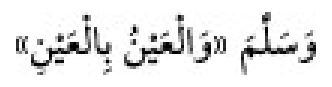
Anas ibn Malik (may Allah be pleased with him) narrated: The Messenger of Allah (peace and blessings upon him) recited, “And for those who seek retribution, a like [retribution]” – pronouncing it with the *zamm* on the *nun*. [546]
COMMENTARY
This verse is verse 45 of Surah al-Ma’idah. It pertains to the law of retaliation (qisas).
The phrase “al-aynü bil ayni” means "an eye for an eye."
The word *aynu* is recited with a *zamm* by Imam Kisai, while others attribute it to the self and recite the *nun* as *a’yun*.
The complete verse reads:
“And We prescribed for them therein: Taking life for life, for eye for eye, for nose for nose, for ear for ear, for tooth for tooth, and for wounds equal for equal. But if anyone foregoes [the demand for] retribution through charity, that is an expiation for him. And whoever is not guided by what Allah has revealed – then those are the people of injustice.”


Anas ibn Malik (may Allah be pleased with him) narrated:
The Messenger of Allah (peace and blessings upon him) recited the ‘ayn with a dammah on its nun, in the verse (of Surah al-Ma’idah), “I have prescribed for them what is written in the Torah.”



Atiyye ibn Sa'd al-Awfi, may Allah be pleased with him, reported:
I recited to Abdullah ibn Umar [the verse] “Allah created you in weakness” (Surah Ar-Rum, 54). Abdullah ibn Umar pronounced the word *Za’f* with a *dhamma* on the *zay*, reading it as *Zu'f*. And I recited this verse to the Messenger of Allah, peace and blessings be upon him, just as you recited it to me. The Messenger of Allah, peace and blessings be upon him, cut short my recitation and said, “Read [it] as *Zu’fun*.” [547]
COMMENTARY:
The reading of the *damma* on the *zay* in the word *Za'f* is according to the vocabulary of the Quraysh. All reciters except Asim read it as *Zu'fun*. Asim reads it as *Za’f*.

Abu Sa'id, may Allah be pleased with him, narrated:
It is related from the Messenger of Allah, ﷺ, that (the verse from Surah Rum, "From weakness," [548] has been recited as “Min Zu’fin”).
EXPLANATION:
Refer to hadith number 3978.

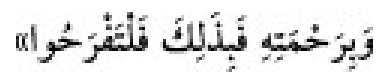
It is narrated from Abdurrahman bin Ebza that the following was said in this verse: Translation, "Let you rejoice in Allah's bounty and mercy."
EXPLANATION
This verse is the 58th verse of Surah Yunus. The word in the verse meaning “rejoice” is *Felyefrahû*, which is an imperative form as a command from the unseen. All the reciters have recited it this way. Only Yakub has recited it with the "tā" at the beginning, changing it to *Veltefrehu* to mean "rejoice," using the plural addressee form.


It is narrated from Ubayy ibn Ka'b, may Allah be pleased with him, that:
The Messenger of Allah, peace and blessings be upon him, recited (Surah Yunus, verse 58), saying:
“Allah’s grace, His mercy, rejoice in it, for it is better than what you have gathered.”
EXPLANATION:
This narration relates that the Messenger of Allah, peace and blessings be upon him, recited the verse using the form of address “rejoice,” (you all). As seen in the explanation of the preceding hadith, all imams except Ya’qub recited it using the form of address for those absent.


It is narrated from Isma bin Yazid (may Allah be pleased with him) that he recited the verse (Hud 46) as, “He committed an evil deed.”
COMMENTARY:
This verse is verse 46 of Surah Hud. Kisai and Yaqub recited it in the past tense form, "Amila," as narrated in the hadith. Other reciters recited it in the infinitive form, "Amelun."
When recited in the past tense, its meaning is: “O Nuh; your son is not from your progeny, for he has committed an evil deed.”
When recited in the infinitive form, its meaning is: “O Nuh; your son is not from your progeny, for what he did is an evil deed.” [549]


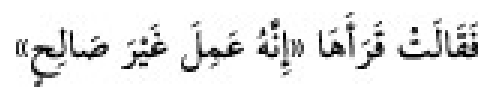
Sa’d ibn Hawshab, may Allah be pleased with him, narrated: I asked the Messenger of Allah, peace and blessings be upon him, how he recited the verse meaning, “That was an evil deed.” Aisha, may Allah be pleased with her, said that the Messenger of Allah, peace and blessings be upon him, recited it in the past tense (mazi form) as, "He committed a bad deed."




According to a narration from Ubayy ibn Ka’b: The Messenger of Allah, peace and blessings be upon him, would begin with himself when making supplication. He would say: “May the mercy of Allah be upon us and upon Moses, for if he had persevered, he would have seen astonishing things from his companion (Khidr).” But Moses said: “If I ask you about anything after this, you must not accompany me; you will be excused on my account.” Hamza bin Ziyad recited the word, prolonging "Ledunnī."
[Explanation:] Nafi’, Abu Bakr, and Abu Ja’far recited the phrase “min Ledunnī” without the shadda on the *nun*, as “min Ladunni.” The other reciters read it with the shadda on the *nun*.


Ubayy ibn Ka'b, may Allah be pleased with him, narrated:
The Messenger of Allah, peace and blessings be upon him, recited the seventy-sixth verse of Surah al-Kahf with the emphatic *nun* (shadda) on “Nun,” [reading it as] "Min Ledunni."


It is narrated from Ibn Abbas, may Allah be pleased with him, that he said: Ubayy ibn Ka’b recited to me, as the Messenger of Allah, صلى الله عليه وسلم, recited to him in the verse "fî amni hamietin," softening the word “hamietin” without an alif.
[Explanation:] This noble verse is verse 76 of Surat Al-Kahf. The topic concerns the story of Dhul-Qarnayn, who reached as far as the Atlantic Ocean and saw the sun setting into a black sludge. Because when the sun sets in the evening, it appears to sink into a mixture of water and darkness resembling sludge. The verse describes this event. He recited the word “Hamietin” with an alif omitted before the "Ha." When the alif is present, it becomes “hâmietin.”


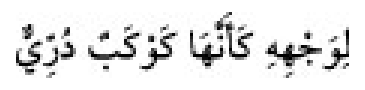

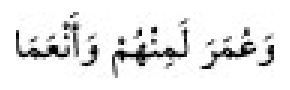
Abū Sa’īd al-Hudrī, may Allah be pleased with him, narrated:
The Messenger of Allah, peace and blessings be upon him, said: "Those who are in the highest level of Paradise look at those among them, and the brightness of the luster of their faces illuminates Paradise."
The narrator said: The hadith reached this wording. The word “Dūriyyīn” is recited without a hamza and with the pronunciation beyond the letter ‘dāl’.
Abū Bakr and ʿUmar are among those in the highest level of Paradise, and they were given more abundant blessings. [554]
**Explanation:**
The word "Dūriyyīn" mentioned in this honorable hadith is from Surah Nūr (Light), verse 35.
The pronunciation beyond the letter ‘dāl’ at the beginning is read with the shaddah of the letters ‘rā’ and ‘yā’.





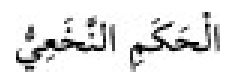
Ferve bin Musayk al-Gutayfi, may Allah be pleased with him, narrated: I came to the Messenger of Allah, peace and blessings be upon him. The narrator mentioned the rest of the hadith. A person from the congregation asked, “O Messenger of Allah! What is Saba? Is it a piece of land or a woman’s name? Inform us.”
The Messenger of Allah, peace and blessings be upon him, said: "Saba is neither a piece of land nor a woman. Rather, he is a man. He had ten sons. Six of them went towards Yemen. Four of them went and settled in the direction of Syria."
One of the narrators, Osman bin Abu Shayba, mentioned ‘Gatafan’ instead of ‘Gutayfi’ regarding the name of the narrator. (And) Hasan bin Hakim al-Nahai reported, saying: [555]
**Explanation:**
The names of Saba's sons who went towards Syria are Lahm, Juzam, Gassan, and Amila.
Those who went towards Yemen are ‘Ezda, Ashar, Humayr, Kinda, Muzhahir, and Anmar. Later, these became the names of tribes. They asked the Messenger of Allah, peace and blessings be upon him, “Who is Anmar?” The Messenger of Allah, peace and blessings be upon him, replied, "He is the one to whom the tribes of Has’am and Bujayl are attributed."



Narrated by Abu Huraira, may Allah be pleased with him:
The Messenger of Allah, peace and blessings be upon him, mentioned the hadith of revelation.
He said, “This is the matter alluded to in Allah’s words: ‘When fear withdraws from their hearts.’” [556]
**EXPLANATION:**
This verse is that of Surat Seba (34), verse 23. The complete verse reads: “No intercessor will be of use except as He permits. And when fear seizes them, they say, ‘What our Lord has commanded is true.’ And the intercessors say, ‘Indeed, our Lord is most just, most knowing.’”
It is reported that the Prophet, peace and blessings be upon him, recited the word *fuzzi’a* with a *zamah* (raised) on the *fa*.
Al-Shami read it as *fezzaa* with an open *fa* and *za* . Other reciters read it as *Fuzzi’a* with a raised *fa*.




Narrated Ummu Salama, may Allah be pleased with her: The Prophet (peace and blessings be upon him) recited this verse in the following manner: “Woe to that person! There came unto him signs from My guidance, yet he rejected them and was arrogant, so he became of the disbelievers.”
Abu Dawud said: This hadith is mursal. Because Rabi did not reach Ummu Salama.
EXPLANATION
This verse is the 59th verse of Surah Az-Zumar. The *ta* and *kaf* letters in the verse are a pronoun addressed to [the person]. If it is read with the vowel point on the *ta*, it becomes *Muzakkir* (masculine); if it is read with the vowel point on the *ta’*, it becomes *Mu'annas* (feminine). It is narrated that the Messenger of Allah (peace and blessings be upon him) recited it with the vowel point on the *ta* as *Kazzabti, Jeetki, Istakbarti, Kunti*, addressing a female. Because the address here is to the soul (*nafs*), and the *nafs* is feminine, it has come in the form of a feminine pronoun.


Aisha (may Allah be pleased with her) related:
I heard the Messenger of Allah (peace and blessings upon him) reciting the verse "Then a soul and its composure" [Surah Al-Waqiah, 89] pronouncing it as “Fa Ru’hun” with an overemphasis on the ‘Ra’ letter. [557]
COMMENTARY:
This is verse 89 of Surah Al-Waqiah. According to the recitation of Asim, the ‘Ra’ letter is pronounced with its upper dot, as 'Ravhun'. It has been related from Aisha (may Allah be pleased with her) that it is also recited as “Ru’hun” with an overemphasis on the ‘Ra’ letter. The meaning of the verse is the same in both recitations: "Then tranquility, good provision, and the Garden of Delight are his."




From Ibn ‘Abdi bin Ya‘la, may Allah be pleased with him, from his father, who related:
I heard the Messenger of Allah, peace and blessings be upon him, recite Surah Az-Zukhruf on the pulpit, reaching the verse (77), saying “Malik” without omitting the *kaf* at its end. Abu Dawud said: Meaning, the word was recited without abbreviation.
EXPLANATION:
Alī ibn Abī Tālib, Ibn Mas‘ūd, and A’mash, may Allah be pleased with them, recited the word "Malik" in this verse omitting the *kaf* at its end, pronouncing it as “Mālū.”


Abdullah ibn Mas'ud, may Allah be pleased with him, narrated: The Messenger of Allah, peace and blessings be upon him, recited to me Surah Zariyat, verse 57, in the meaning, “I am the Giver of sustenance, I am Powerful.”
COMMENTARY
This verse is verse 57 of Surah Zariyat. The well-known recitation is "Innal Laha Huwar-Razik." In Ibn Mas'ud’s narration, it is recited as “Innī Anar-Razzaq.” [559]



According to the narration of Abdullah (bin Mas’ud) – may Allah be pleased with him – the Messenger of Allah, peace and blessings be upon him, would recite Surat al-Qamar (Chapter 54), verse 22, with a heavy pronunciation of the *dal*.
Abu Dawud said: “*Min* is an *ummah*, *Dal* is a *marbutah*, and *Kaf* is an *unabiyyah*.”

Jabir (may Allah be pleased with him) narrated:
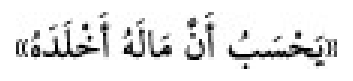
I saw the Messenger of Allah (peace and blessings upon him) reciting Surah Humaza, beginning the verse 3 with a question mark before “Eyahsibü,” using the vowel-point of the sin letter.
COMMENTARY:
There is an interrogative hamza at the beginning of verse 3 of Surah Humaza. The word "Yahsebu" (present tense) is recited as "Eyahsebu." According to narrations from Jabir in Ibn Hibban’s and Hakim’s *Mustadrak*, there is no interrogative hamza before “Yahsebu,” and the word "Yahsebu" is pronounced with the vowel-point of the sin letter, as "Yahsibu." Seven reciters (Qira'at imams) – Asim, Shami, and Hamza – recite it as “Yahsebu” with the upper dot on the sin letter. The other reciters pronounce it as “Yahsibu” with the vowel-point of the sin letter.



According to the narration of Abu Kilaba (may Allah be pleased with him):
Among the verses that the Messenger of Allah (peace and blessings be upon him) taught him were two verses from Surah Fajr: “No one is punished as he was punished, nor is anyone restrained as he was restrained.” – referring to verse 25 and 26. He recited the letter "sin" with a *sukūn* and read it as "yūsekü."
Abu Dawud said: Some people inserted another person between Khalid and Abu Kilaba in this narration.
EXPLANATION
The reading imams, such as Hafs, recited the letter “zā” with its vowel point as “Lā yu’azzibu,” and the letter "sin" with its vowel point as “wa lā yūsikū.” When read in this manner, the meaning is: “On that day, no one can punish like Allah punishes, nor can anyone restrain like Allah restrains with His shackles.”








Abu Kilaba (may Allah be pleased with him) reported:
Someone informed me that the Prophet (peace and blessings be upon him) recited [the verse] to someone, or someone who was recited to by someone whom the Prophet (peace and blessings be upon him) recited to. He recited the verse “They will not be questioned about the deeds of those ignorant” (Surah Fajr, 25) with a *damma* on the letter *Zay*, saying "La yuazzabu."
Abu Dawud said: Asim, Hamish, Talha bin Musarrif Abu Ja'far, Yazid bin Ka'ka', Shaiba bin Nisah, Nafi bin Abdurrahman, Abdullah bin Kasir ad-Dari, Abu Amr bin A’la Hamza az-Zayyad, Abdurrahman al-Ar` , Qatada, Hasan al-Basri, Mujahid, Humayd al-A’raj, Abdullah bin Abbas, and Abdurrahman bin Abu Bakr recited the verse with an *eser* on the letters *Zay* and *Sin*, saying "La yuazzibu" and "Wa la yusiku." Except for one narrated hadith which was reported with an *fathah* on the letter *Zay*, reading “Yuazzabu.”


Abu Sa’id al-Hudri, may Allah be pleased with him, narrated: The Messenger of Allah, ﷺ, related a hadith mentioning the names Gabriel and Michael. When he recited these names, he pronounced them (as Jibril and Mika'il).
EXPLANATION
There are ten linguistic variations for the word *Jibril*. The most well-known is *Jibril*. Abu Amr, Nafi ibn-i Amar, and Asim read it in this way. (These four readings, as *Jebrail*, are considered one transmission.)
Secondly: With the upper dot on the *jim* letter, as *Jebril*. Ibn-i Kisr and Hasan read it thusly.
Thirdly: As *Jebrail*. Hamza and Kisai recited it in this manner.
Fourthly: As *Jebrail*. This is what has been transmitted from Asim.
Fifthly: With the shadda on the lam, as *Jibrille*.
Sixthly: As *Jabrail*. Ikrimah read it thusly.
Seventhly: With a *ya*, as *Jabrayile*.
Eighthly: With two *yas*, as *Jabrayyile*.
Ninthly: As *Jebrale*.
Tenthly: With a *ya* and without a vowel mark, as *Jibriyle*.
Eleventhly: As *Jebrine*.
Twelfthly: As *Cibrine*.
Thirteenthly: As *Cebraiyne*.
Fourteenthly: These are the variations of *Jabrail*.




According to a narration from Muhammad ibn Hāzim, he said:
The names of Jibrīl and Mīkāl were mentioned in the presence of A’mash. From A’mash, through Dāwūd al-Tā’i, who narrated from Atiyyah al-Awfi, who narrated from Sa’īd ibn Hudhrī, who said: The Messenger of Allah ﷺ mentioned Israfil, the blower of the trumpet, and said, “Jibrīl is on my right and Mīkāl are on my left.” He recited the two names drawing out the "r" and "f," placing a *ye* under the hamza.




From Ma'mar, from Zuhri: Ma'mar said: In Zuhri’s narration, Sa'id ibn-Musayyib is mentioned frequently. Sa'id ibn-Musayyib said: The Messenger of Allah ﷺ, Abu Bakr, Umar, and Uthman – may Allah be pleased with them all – (said that) Mervan is the one who pronounces “Maliki yawm al-din” with a lengthening of the ‘meem’ [in Surat al-Fatiha].




Ummü Salama, may Allah be pleased with her, reported that the Messenger of Allah, peace and blessings be upon him, recited the Opening Chapter (Fatiha) with the invocation (Bismillah), verse by verse, pausing at the third verse, omitting the letter ‘mim’ in “Meliki yawm addin.”
Abu Dawud said: I heard it stated that Ahmad ibn Hanbal's previous continuous recitation was “Maliki” [562]



Abū Zarr (may Allah be pleased with him) narrated:
The Messenger of Allah (peace and blessings upon him) rode out one evening as the sun was setting, and he took me along behind him. He pointed to the sun and said, "Do you know where this sets?" I replied, “Allah and His Messenger know best.” The Messenger of Allah (peace and blessings upon him) said, “It goes down into a boiling spring.” [563]
EXPLANATION:
This verse is from Surah Al-Kahf, verse 76. The verse has been narrated as "Fī aynin hamietin" and also as "fi aynın hâmiyetin."
The sun appears to set into the sea while setting over the Atlantic Ocean. The redness of the sun, the waves of the water, and the evening darkness mix together, giving the appearance that it is sinking into a boiling spring. This is how Prophet Zul-Qarnayn saw it. The Noble Qur’an is miraculous. It may be referring to minerals boiling within the sea where the sun sets in the Atlantic Ocean, or to hidden petroleum reserves.



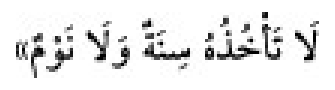
From Ibn al-Asqa’, it is related that the Prophet (peace and blessings be upon him) visited the people of Suffa, who were among the poor emigrants. One of them asked the Messenger of Allah (peace and blessings be upon him), “Which verse in the Qur’an is the greatest?” The Messenger of Allah (peace and blessings be upon him) replied, "It is the Verse of the Throne: ‘There is no god but Allah, the Living, the Sustaining. He never sleeps nor does He slumber.’” And he recited *al-Kayyūm* when reciting this verse.
[Note:] The word *Kayyūm* in Ayat al-Kursi is an exaggeration of the root *qiyām*. It has been narrated from the Messenger of Allah (peace and blessings be upon him) with this form. Amr bin Mas’ud would recite it as *Qiyam*, while Ikrama would recite it as *al-Kayyūm*. Asim would narrate it according to the recitation of *al-Kayyūm*.


It is narrated from Ibn Mas'ud (may Allah be pleased with him) that he recited, "How could you ever believe while hypocrisy lies within your hearts?" The narrator Shaqiq said: We recite it as “Hi’te leke.” That is, Ibn Mas'ud said: It is more pleasing to me to recite it as it was taught to me (namely, “Heyte”).


It is narrated from Shaqiq (may Allah be pleased with him) that he said:
Some people were reciting Surah Yusuf (Chapter 12), verse 23, to Abdullah ibn Mas’ud as “Wa qalat Hitta lak.” Ibn Mas'ud said, "I recite it as I was recited [it], and this is more pleasing to me." He then said, "This verse is (And she said, ‘O Pharaoh, canst thou not?’)."


Abū Saʻīd al-Hudrī (may Allah be pleased with him) narrated:
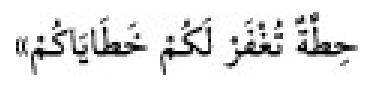
The Messenger of Allah (peace and blessings upon him) said: “Allah commanded the Children of Israel, ‘Enter Jerusalem through its gate in prostration, and say, "May [Our] sins be forgiven."’ He recited this verse, saying “tughfir lakum” instead of “nağfir lakum.”
EXPLANATION
This verse is verse 58 of Surah al-Baqarah. In this verse, the word *nağfir* has been narrated from the Messenger of Allah (peace and blessings upon him) as *tuğfar*. Nafi’ recites *Nağfir*, Ibn ‘Amr recites *Tuğfar*, and other imams recite it with a *nun*, *Nağfir*.

It is narrated through a similar chain of narrators from Hisham bin Sa'd, as in the preceding narration.



Aisha (may Allah be pleased with her) narrated:
The Prophet (peace and blessings of Allah be upon him) was visited by revelation, and he recited to us without *shadda* (a doubling of the consonant): “We have revealed a sign and a guidance.”
Abu Dawud said: Meaning, he recited it without *shadda* up to these verses.
**Note:** The explanatory section following this narration provides variant readings and references to other collections of hadith. These are not part of the direct translation of Aisha’s narration.
Do not think,” He commanded, with the fatha of the sin letter in "Lā tahsebenne." [544]
Muslims came to a person who was at the head of a flock of only a few sheep. The man greeted the Muslims with “Peace be upon you.” They killed him, thinking that he gave this greeting not because of his faith but out of fear, and they took his few sheep as well. Consequently, (the verse of Surah An-Nisa, verse ninety-four) descended, which reads: "O you who believe, when you set forth in pursuit of the Messenger, let every matter be investigated thoroughly, lest he who gives a transient benefit from this world (those few sheep) say to you, ‘You are not one of the believers.’ Allah has abundant rewards." [545]
3976 – It is narrated on the authority of Anas bin Malik that he said: The Messenger of Allah, peace and blessings be upon him, recited "Wal ayn" in verse 45 of Surah Al-Ma'idah which pertains to the law of Qisas, with a *nun* with *damma*. [546]
3978 – It is narrated on the authority of Attiyyah bin Sa’d al-Awfi that he said: I recited (Surah Rum, verse 54) "Allah has created you in weakness" to Abdullah bin Umar. Abdullah bin Umar pronounced the word *Za'f* with a *damma* as *Zu'f*. And I recited this verse to the Messenger of Allah, peace and blessings be upon him, just as you recite it to me. And just as the Messenger of Allah, peace and blessings be upon him, cut short my words, so did I cut short his. And he said, "It is *Zu'f*." [547]
The narration from the Messenger of Allah, peace and blessings be upon him, regarding Surah Rum (verse 54) is “Min Zu’f.” [548]
If it were to be read in the masculine indefinite form, the meaning would be: "O Noah! Your son is not from your progeny, for he has done a deed that is evil." [549]
3983 – It is narrated on the authority of Shahir bin Hawshab that he said: I asked Umm Salamah, “How did the Messenger of Allah, peace and blessings be upon him, recite this verse which means ‘it is a deed that is evil’?” Aishah said that the Messenger of Allah, peace and blessings be upon him, recited it in the past tense: "He committed an evil deed." [550]
3984 – It is narrated from Ubayy bin Ka'b that: The Messenger of Allah, peace and blessings be upon him, would begin with himself when making supplication. He used to say: “May Allah’s mercy be upon us and upon Musa, and if he had been patient, he would have seen wondrous things from his companion (Khidr).” But Musa said: "If you ask me about anything after this, I will not accompany you; you shall be excused." Hamza bin Ziyad recited the word “Ledunnî” with a prolonged sound. [551]
It is narrated from the Messenger of Allah, peace and blessings be upon him, that he recited verse 76 of Surah Al-Kahf with *shadda* on the *nun*: "(Min Ledunnî)." [552]
3986 – It is narrated on the authority of Ibn Abbas that he said: Ubayy bin Ka'b taught me as the Messenger of Allah, peace and blessings be upon him, taught Ubayy bin Ka'b, regarding the verse "in ammati hamietin," to pronounce the word “hamietin” lightly without an *alif*. [553]
Abu Bakr and Umar are among those in the highest section of Paradise. Even greater blessings were bestowed upon them. [554]
Regarding the name of the narrator, Osman bin Abu Shayba, one narrator said "Gatafani" instead of “Gutayfi.” (And) he narrated to us Hasan bin Hakim al-Nahai. [555]
The Messenger of Allah, peace and blessings be upon him, mentioned the hadith of revelation. He said: "This is Allah’s word: ‘When fear goes out from their hearts’," which is a matter indicated in the verse. [556]
I heard the Messenger of Allah, peace and blessings be upon him, recite the letter *Ra* with an over-vowel in verse 89 of Surah Al-Waqi'ah: "Fa Ruhun wa Rayhanun." [557]
The people Ali, Ibn Mas’ud, and A’mesh recited the word Malik in this verse dropping the final *kaf*, as Malu. [558]
This verse is verse 57 of Surah Az-Zariyat. The well-known recitation is "Inna Allah Huwar Raziqu." In Ibn Mas'ud’s narration, it is recited as “inni anar Razzaqu.” [559]
Abu Dawud said: The *min* has an over-vowel, the *dal* has a *damma*, and the *kaf* has an unrounded vowel. [560]
The Messenger of Allah, peace and blessings be upon him, Abu Bakr, Umar, and Osman recited Surah Al-Fatiha, and the one who pronounces the third verse with a drawn out *mim* is Mervan. [561]
Abu Dawud said: I heard that Ahmad bin Hanbal used to recite it as "Maliki." [562]
The Messenger of Allah, peace and blessings be upon him, rode on a mount while I was behind him, during the late afternoon when the sun was setting. He pointed to the sun and asked, “Do you know where this sets?” I said that Allah and His Messenger knew better. The Messenger of Allah, peace and blessings be upon him, said: "Tağrubu fi aynin hamietin," meaning "It goes into a heated spring." [563]
4003 – It is narrated from Ibnul-Asqaa that he said: The Messenger of Allah, peace and blessings be upon him, visited the Suffa people who were among the poor emigrants. One of them asked the Messenger of Allah, peace and blessings be upon him, which verse in the Qur’an was the greatest. The Messenger of Allah, peace and blessings be upon him, replied to him that it was Ayatul Kursi: "There is no god but Allah; He is alive, watching over His creation." Allah does not sleep nor does He slumber," and he recited this verse pronouncing *Al-Kayyumu*. [564]
This verse is verse 58 of Surah Al-Baqarah. The word *nağfir* in this verse is narrated from the Messenger of Allah, peace and blessings be upon him, as *tuğfer*. Nafi recites it as *Yuğfer*, Ibn Amr recites it as *Tuğfer*, and other imams recite it with a *nun* as *Nağfir*. [565]