
Drinks Section · 5 – Prohibition of Intoxicating Substances


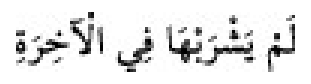
From Ibn ‘Umar, may Allah be pleased with him, it is narrated that the Messenger of Allah, peace and blessings be upon him, said: “Every intoxicant is wine, and every intoxicant is forbidden. Whoever drinks wine and continues to drink it while dying, he will not taste [of the wine] in the Hereafter.”





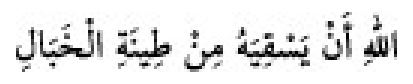
According to the narration of Ibn Abbas, may Allah be pleased with him, the Messenger of Allah, peace and blessings be upon him, said: “Wine is that which obscures reason, and every intoxicant is forbidden. Whoever consumes an intoxicant, forty morning prayers are deficient from him. If he repents, Allah accepts his repentance. But if he returns to it for a fourth time, then it is the right of Allah to cleanse him with the Fire of al-Habah.” They said: “What is the Fire of al-Habah, O Messenger of Allah?”
The Messenger of Allah, peace and blessings be upon him, replied: "It is the pus and blood that flows from the bodies of the people of Hell." He then said: “Whoever gives wine to a child who cannot distinguish between lawful and unlawful, then it is the right of Allah to cleanse him with the pus and blood that flows from the bodies of the people of Hell.”


Jabir ibn Abdullah (may Allah be pleased with him) narrated:
The Messenger of Allah (peace and blessings upon him) said, “Even a little of that which intoxicates is forbidden.” [373]
EXPLANATION:
Everything containing alcohol is prohibited to eat and drink. There is no difference between the little and the much of it. Just as wine and raki are forbidden due to their high alcohol content, beer is equally forbidden because of its low alcohol content. The small amount of alcohol in beer does not render it permissible.







Aisha (may Allah be pleased with her) related:
The Messenger of Allah (peace and blessings upon him) was asked about *bitiğ* made from honey, which is brought from the mountains. The Messenger of Allah (peace and blessings upon him) replied, “Every intoxicant is forbidden.” [374]
Abu Dawud said: This hadith was narrated on the same chain of narration from Zuhri. In this narration is the addition: "*Bitiğ* is honeyed drink; it was consumed by the people of Yemen."
Abu Dawud said: I heard Ahmad bin Hanbal say: There is no god but Allah. Regarding Juraisi, he is not a trustworthy person. There is no one more trustworthy among the people of Hims than him.




Deylem al-Himyeri (may Allah be pleased with him) narrated:
I asked the Messenger of Allah (peace and blessings upon him), “O Messenger of Allah (peace and blessings upon him), we live in a cold land and perform difficult labor. We make drink from wheat, and use it to gain strength against our work and the cold of our region.”
The Messenger of Allah (peace and blessings upon him) asked, "Does it intoxicate?" I said, “Yes, it intoxicates.”
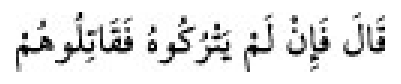
The Messenger of Allah (peace and blessings upon him) commanded, “Beware of drinking that drink.” I said, “People do not cease to drink it.”
The Messenger of Allah (peace and blessings upon him) commanded, “If they do not cease from drinking it, then wage war against them, strive against them.”



Abū Mūsā, may Allah be pleased with him, narrated:
I asked the Messenger of Allah, peace and blessings be upon him, about wine made from honey. The Messenger of Allah, peace and blessings be upon him, said, “It is *bitah*.” I said, "Barley and wheat are also used to make intoxicants." The Messenger of Allah, peace and blessings be upon him, said, “Its name is *mizār*.”
Then the Messenger of Allah, peace and blessings be upon him, said: “Inform your people that every intoxicant is forbidden.”



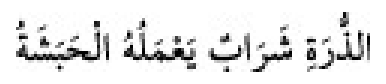
It is narrated from Abdullah bin Amr (may Allah be pleased with him) that the Messenger of Allah (peace and blessings be upon him) forbade intoxicants, gambling, drums, and a drink made from barley called *Gubayra*, and said: “Every intoxicant is forbidden.”
Abu Dawud said: Ibn as-Salam said to Abu Ubayd: *Al-Gubayra* is a drink made from barley used by the Ethiopians.
EXPLANATION
*Gubayra*: A drink made from barley, which the Ethiopians call *Sukarra*.
*Kuba*: Means a drum.

Umm Salamah (may Allah be pleased with her) narrated:
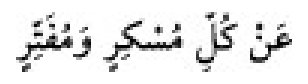
The Messenger of Allah (peace and blessings upon him) forbade all intoxicants and soporifics (from food and drink).


Aisha (may Allah be pleased with her) narrated:
I heard the Messenger of Allah (peace and blessings be upon him) say:
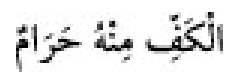
“All intoxicants are forbidden. Whatever quantity causes intoxication, even a handful of it, is forbidden.” [376]
**Note:**
*Ferak:* A measure equivalent to sixteen *ratls*, capable of holding water.
One *ratl* is one hundred and thirty dirhams according to the Baghdad scale.
One *ratl* is twelve *ukiyyas* according to the Damascus scale. Each *ukiyya* is four hundred and eighty dirhams. Therefore, a *ferak* would be the product of sixteen multiplied by four hundred and eighty, which equals seven thousand six hundred and eighty dirhams. If we accept each dirham as two and a half grams, then a *ferak* would be nineteen thousand two hundred grams. Accordingly, it is understood from this honorable hadith that even one gram of a substance causing intoxication weighing nineteen kilograms is forbidden. Beer contains alcohol in proportions of six percent and eight percent. It is clear that nineteen kilograms of beer will cause intoxication. Therefore, even one gram of beer is forbidden.