
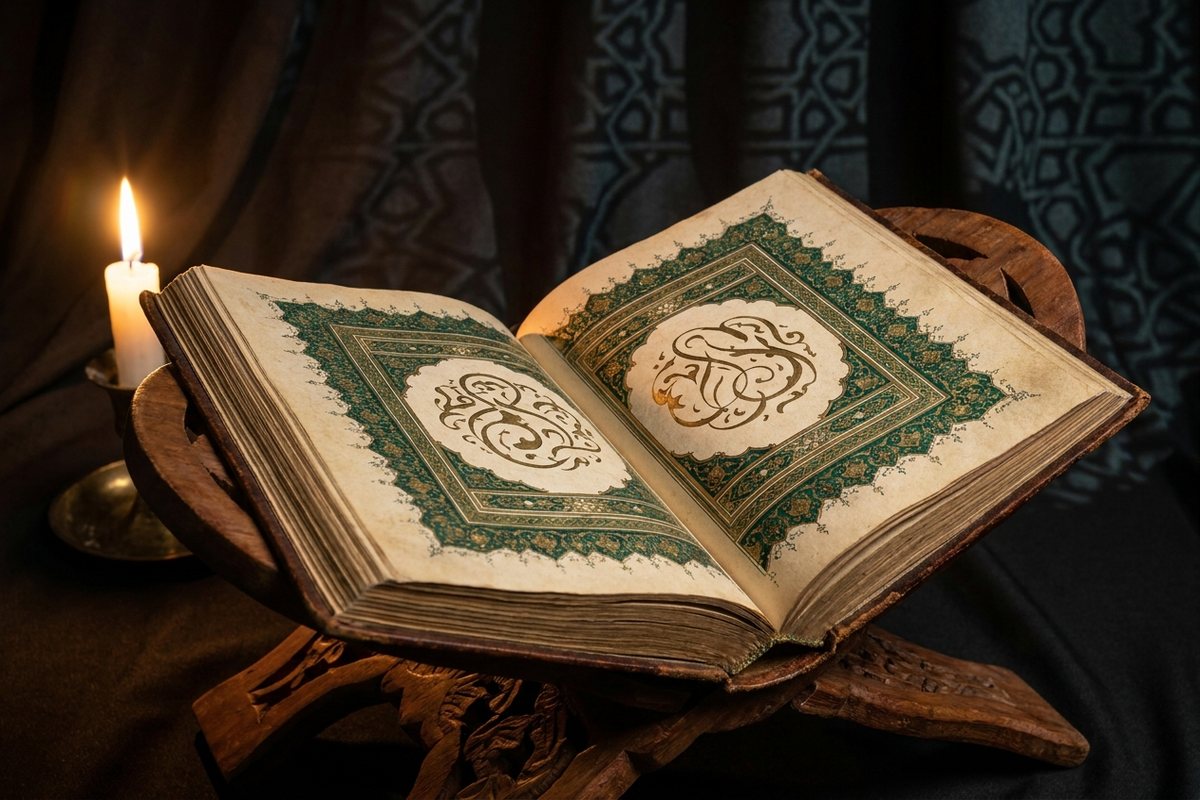
One of the great virtues and tremendous benefactions of ʿUthmān (Hz. Osman) was his gathering of the Qur'an into a single recitation (qirāʾa) and having the muṣḥaf (written codex) inscribed—in the last two years of his life—in the manner that Jibrīl (Gabriel) taught the Messenger of God (peace be upon him). The reason for this was as follows: In one of the battles, the people of Syria and the Iraqis fought together. The Syrians were reciting the Noble Qur'an according to the qirāʾa of Miqdād b. al-Aswad and Abū al-Dardāʾ, while the Iraqis were reciting according to the qirāʾa of ʿAbdullāh b. Masʿūd and Abū Mūsā. Those who did not know that it was permissible to recite the Qur'an according to seven qirāʾāt began to prefer their own recitation over others, to consider others' recitations erroneous, and even to declare them kāfir (performers of kufr, disbelief). This led to severe discord among them and the exchange of harsh words among the people. Thereupon, Ḥudhayfa went to ʿUthmān and said:
"O Commander of the Believers! Take precautions before this umma falls into discord over its Book as the Jews and Christians did over theirs."
After saying this, Ḥudhayfa gave examples of the disagreements among people regarding the recitation of the Qur'an. ʿUthmān gathered the Companions (ṣaḥāba) and consulted with them. He deemed it appropriate to have the Qur'an written according to a single qirāʾa and for the Muslims in other lands to recite the Qur'an according to this qirāʾa. He was convinced that in this way, disputes and disagreements would cease. He requested that the muṣḥaf composed of the Qur'anic verses collected by Zayd b. Thābit at the order of Abū Bakr be brought. This muṣḥaf had remained with Abū Bakr throughout his life, then with ʿUmar after him. Upon ʿUmar's death, the muṣḥaf came into the possession of Ḥafṣa, Mother of the Believers. ʿUthmān requested that this muṣḥaf be brought. He ordered Zayd b. Thābit al-Anṣārī to write an exact copy of it, and commanded Saʿīd b. al-ʿĀṣ al-Umawī to read and dictate this muṣḥaf to Zayd. He also instructed that ʿAbdullāh b. al-Zubayr al-Asadī and ʿAbd al-Raḥmān b. Ḥārith b. Hishām al-Makhzūmī be present during the writing and dictation. If they disagreed on any word, he instructed them to write it in the dialect of Quraysh.
As a result, a muṣḥaf was written for the Syrians, and a second for the Egyptians. He sent a muṣḥaf to Basra, one to Kufa, one to Mecca, and one to Yemen. He left a muṣḥaf in Medina. These muṣḥafs were called imam muṣḥaf (i.e., master codex). None of these were in ʿUthmān's own hand; rather, they were written in the hand of Zayd b. Thābit. Because they were written during ʿUthmān's caliphate and at his command, they were called the ʿUthmānic muṣḥaf. Just as the dinars minted during the reign and in the state of Heraclius were called the Heraclius dinar, so too were these muṣḥafs named. Al-Wāqidī narrated from Abū Hurayra that he said: "When ʿUthmān (may Allah be pleased with him) had the muṣḥafs copied, I went to him and said:
‘You have acted rightly and done well. I witnessed the Messenger of God (peace be upon him) say: "The people I love most from my umma are those who will come after me, who will believe in me without having seen me, and who will follow and act upon what is written on suspended parchment." I did not understand what these parchments were until I saw the muṣḥaf. Then I realized that this is what the Prophet meant.'
ʿUthmān was pleased with my words and ordered that I be given 10,000 dinars. Then he said: ‘By Allah, I know that you have never concealed any hadith of the Prophet from us.'
Then he gathered and burned all other muṣḥafs that had been written in a manner contrary to the one he had commissioned, so that no disagreement or discord would arise among Muslims regarding the recitation of the Qur'an."
Abū Bakr b. Abī Dāwūd narrated from Suwayd b. Ghafla regarding the writing of the muṣḥafs:
"When ʿUthmān burned the muṣḥafs, ʿAlī said to me: 'If ʿUthmān had not done this, I would have.'"
Al-Bayhaqī and others narrated from Suwayd b. Ghafla that:
ʿAlī said:
"O people! Beware of going to extremes regarding ʿUthmān. You say that he burned the muṣḥafs. By Allah, he did so in the presence of a group from among the Companions of Muḥammad. If the caliphate entrusted to him had been entrusted to me, I would have done the same as he did."
It is narrated that Ibn Masʿūd, because his muṣḥaf was taken from him and burned, criticized those who did this and stated that he had become Muslim before Zayd b. Thābit, who wrote the muṣḥafs. He instructed his companions to hide the muṣḥafs in their possession and recited the following verse: "And whoever betrays [by taking] from the spoils will come with what he took on the Day of Resurrection." (Āl ʿImrān 3:161)
Thereupon, ʿUthmān wrote him a letter inviting him to follow the consensus (ijmāʿ) of the Companions, to unite in agreement, and not to cause discord. He responded to this invitation, followed the consensus of the Companions, and abandoned his opposition. May Allah be pleased with them all.
Abū Isḥāq narrated from ʿAbd al-Raḥmān b. Yazīd: "ʿAbdullāh b. Masʿūd entered the mosque at Minā and asked:
‘How many rakʿas did the Commander of the Believers perform for the ẓuhr prayer?' Those present replied: ‘He performed four rakʿas.' Thereupon, Ibn Masʿūd also performed four rakʿas for ẓuhr there. Those with him asked: ‘Did you not tell us that the Messenger of God (peace be upon him), Abū Bakr, and ʿUmar used to perform two rakʿas?' He replied:
‘Yes, I still say so, but I do not like to cause discord.'"
According to an authentic narration, Ibn Masʿūd said regarding this: "I wish I had prayed two rakʿas, as was originally accepted, instead of four."
Al-Aʿmash said: Muʿāwiya b. Qurra, describing the situation, narrated from his teachers: ʿUthmān performed four rakʿas for ẓuhr prayer at Minā. When Ibn Masʿūd heard this, he criticized him. Then, on his journey with his companions, he also performed four rakʿas for ʿaṣr prayer. He was told:
‘You criticized ʿUthmān, but you also performed four rakʿas. Why did you do so?' Ibn Masʿūd replied:
‘I do not like opposition.' In another narration, it is reported that he said: ‘Opposition is evil.'
Since it is established that Ibn Masʿūd followed ʿUthmān in this detail, how could he not follow him regarding the essence of the Qur'an? How could he not follow ʿUthmān in commanding people to recite the Qur'an only according to the qirāʾa in which his muṣḥaf was written, and not according to any other?
According to al-Zuhrī and others, ʿUthmān performed four rakʿas out of fear that the Bedouins would believe that the obligatory prayer was only two rakʿas. According to another opinion, since he had married in Mecca, he was considered a resident and thus performed four rakʿas at Minā.
It is narrated from Yaʿlā and others that ʿUthmān led the congregation in four rakʿas at Minā, then turned to them and said:
‘I heard the Messenger of God (peace be upon him) say: "If a man marries in a town, he is considered one of its people." Since I have married here since my arrival, I performed the full prayer.' This is not an authentic hadith, for although the Messenger of God (peace be upon him) married Maymūna bint al-Ḥārith during ʿUmrat al-Qaḍāʾ, he did not perform the full prayer there. It is said that ʿUthmān, wherever he was, interpreted this as the Commander of the Believers. ʿĀʾisha also interpreted it thus and performed the full prayer. However, there are disputable aspects to this interpretation, for the Prophet was the Messenger of Allah wherever he was, yet during his journeys he did not perform the full prayer, but shortened the four-rakʿa prayers to two rakʿas.
ʿUthmān would order his governors to come for ḥajj every year during the pilgrimage season. He would also send letters to the people saying: "Whoever has been wronged, let him come for ḥajj so that I may obtain his right from his governor." ʿUthmān allowed most of the great Companions to travel to the lands they wished. ʿUmar, however, would not allow the Companions to go wherever they wished, even during war, and would say: "I fear that you will see the world, and the children of the world will see you." During ʿUthmān's time, the Companions traveled to various lands outside Medina, and people gathered around them. Each region's people desired that the Companion among them would become caliph after ʿUthmān. The people of these regions wished for ʿUthmān's death so that their own man would become caliph. When they saw that ʿUthmān's life was prolonged, they grew weary. Some incidents were instigated by the people of certain regions, as we have mentioned on previous pages. Truly, we belong to Allah and to Him we return. There is no power and no strength except in Allah, the Mighty, the Wise. He is exalted and sublime.