
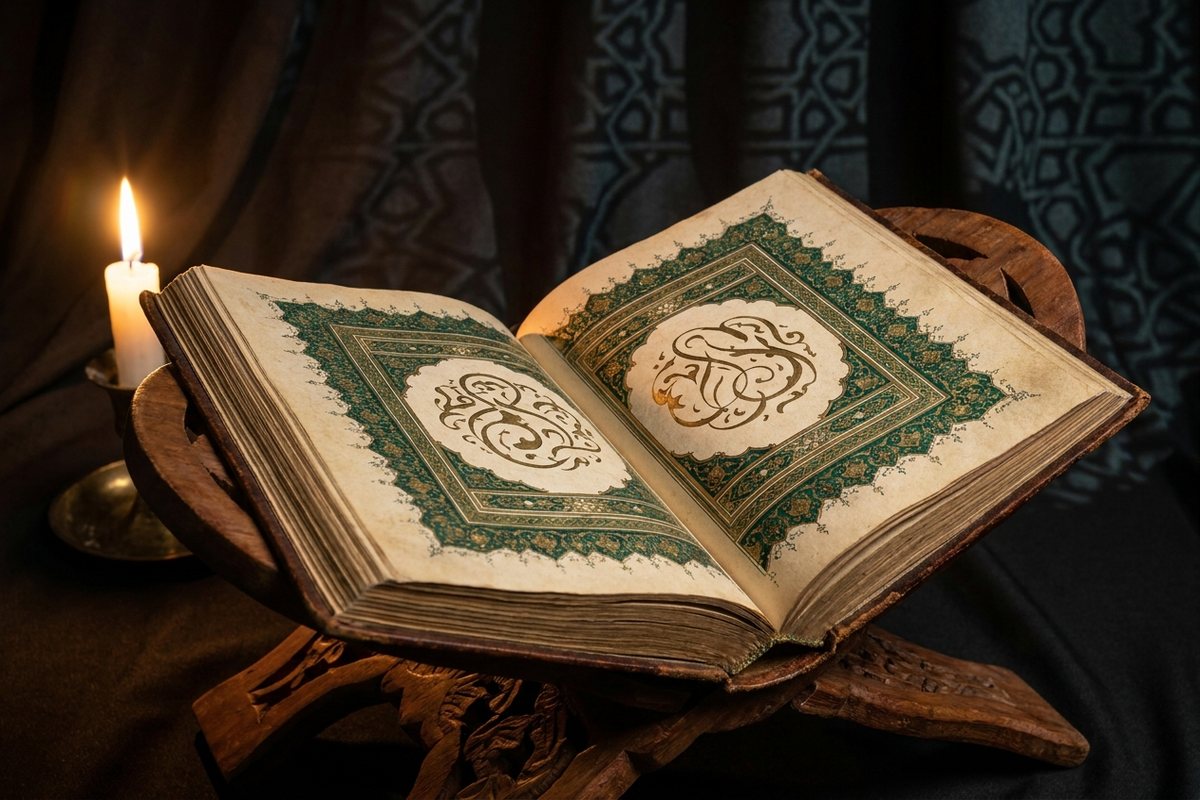
As is categorically stated in the Book of Allah and the sunnah of His Messenger, the coming of the Prophet (peace and blessings be upon him) was foretold by the prophets who preceded him. The other communities who followed previous prophets are also aware of this reality, though many of them conceal it. Regarding this, the Exalted Allah says:
"Those who follow the Messenger, the unlettered prophet, whom they find written in what they have of the Torah and the Gospel, who enjoins upon them what is right and forbids them what is wrong and makes lawful for them the good things and prohibits for them the evil and relieves them of their burden and the shackles which were upon them. So they who have believed in him, honored him, supported him and followed the light which was sent down with him - it is those who will be the successful."
O Muhammad, say: "O mankind, indeed I am the Messenger of Allah to you all, [from Him] to whom belongs the dominion of the heavens and the earth. There is no deity except Him; He gives life and causes death." So believe in Allah and His Messenger, the unlettered prophet, who believes in Allah and His words, and follow him that you may be guided." (al-Aʿrāf 7:157-158)
"Those to whom We have given the Book know that it has been sent down from your Lord in truth." (al-Anʿām 6:114)
"Those to whom We gave the Book recognize him as they recognize their own sons. But indeed, a party of them conceal the truth while they know [it]." (al-Baqara 2:146)
"Say to those who were given the Book and the unlettered: 'Have you submitted?' And if they submit, they are rightly guided; but if they turn away, your duty is only to convey the message." (Āl ʿImrān 3:20) "And this Qur'an has been conveyed to the people so that they may be warned by it." (Ibrāhīm 14:52)
"This Qur'an has been revealed to me that I may warn you thereby and whomever it reaches." (al-Anʿām 6:19)
"But whoever of the groups denies it - the Fire is their promised place." (Hūd 11:17)
"That he may warn whoever is alive and that the word may be justified against the disbelievers." (Yā Sīn 36:70)
The Exalted Allah reminds us that He sent our Prophet as a messenger to the People of the Book, to those without scripture, to Arabs, non-Arabs, and to all of humanity. The Qur'an is a warning for everyone it reaches. Regarding this, the Prophet (peace and blessings be upon him) said:
"By Him in Whose hand is my soul, there is no one from this ummah, whether Jew or Christian, who hears of me and does not have iman (faith) in me, except that he will enter the Fire." This was narrated by Muslim.
In a hadith established in the authentic collections of Bukhari and Muslim, the Prophet (peace and blessings be upon him) said:
"I have been given five things which were not given to anyone before me: I was helped by being cast with awe into the hearts of my enemies from a distance of a month's journey; the spoils of war were made lawful for me, whereas they were not lawful for anyone before me; the earth has been made for me a place of prayer and a means of purification; I have been granted intercession; and every prophet before me was sent only to his own people, but I have been sent to all mankind, to those of red and black skin (in another narration: to Arabs and non-Arabs, and in another: to humans and jinn)."
What we mean is that the glad tidings of the coming of the Prophet (peace and blessings be upon him) were present in the books left by the previous prophets. Prophethood continued among the Children of Israel until the last prophet among them, who was Jesus, son of Mary. He gave this glad tiding to the Children of Israel. The report of Jesus giving this glad tiding about the coming of our Prophet is mentioned in the Qur'an as follows:
"And [mention] when Jesus, the son of Mary, said, 'O Children of Israel, indeed I am the messenger of Allah to you confirming what came before me of the Torah and bringing good tidings of a messenger to come after me, whose name is Ahmad.'" (al-Ṣaff 61:6)
Reports about our Prophet are mentioned in the previous scriptures. The Qur'an informs us of this, and there are also authentic hadiths on this matter. Moreover, he was the most intelligent of all creatures, which is a categorical proof of his truthfulness and prophethood. If he had not had complete confidence in the news he conveyed, this would have caused people to detest him intensely. No intelligent person conveys information to others in which he himself does not believe. Thus, even in the eyes of his opponents, he was the most intelligent of people, and in reality, this is so. His call spread to the east and west of the earth. The dominance and rule of his ummah reached everywhere. This dominance was not achieved by any previous community. If Muhammad (peace and blessings be upon him) were not a prophet, the harm would have been greater than that of anyone else. If that were the case, all the prophets would have warned people strongly against him, and their communities would have detested and avoided him. Indeed, all the prophets warned their communities against the callers to misguidance, as is recorded in their books. They forbade their communities from following the callers to misguidance and from adhering to them. They categorically commanded them not to follow the blind, lying Dajjāl. Even the first of the messengers, Prophet Noah, warned his people in this regard. But it is known that no prophet ever warned his community against Muhammad (peace and blessings be upon him). They only gave praiseworthy reports about him, praised him, gave glad tidings about him, commanded their communities to follow him, and forbade them from opposing him. Regarding this, Allah says:
"And [recall] when Allah took the covenant of the prophets, [saying], 'Whatever I give you of the Scripture and wisdom and then there comes to you a messenger confirming what is with you, you [must] believe in him and support him.' He said, 'Have you acknowledged and taken upon that My commitment?' They said, 'We have acknowledged it.' He said, 'Then bear witness, and I am with you among the witnesses.' And whoever turns away after that - they are the defiantly disobedient." (Āl ʿImrān 3:81-82)
Ibn ʿAbbās (may Allah be pleased with him) said:
"Allah, the Exalted, took this pledge from every prophet He sent: If Muhammad is sent as a prophet during his lifetime, he will surely believe in Muhammad and help him. (If he is not sent during his own lifetime) he was commanded to take this pledge from his own community: If Muhammad is sent as a prophet while they are alive, they will surely believe in him and follow him."
This was narrated by Bukhari.
I have seen the glad tidings about the Prophet (peace and blessings be upon him) in the ancient scriptures. These glad tidings are so well-known and numerous that they cannot be repeated here. In the section on the birth of our Prophet, we have already cited sufficient reports on this matter. In our tafsir (Qur'anic exegesis), we have also cited many hadiths when explaining the relevant verses. Here, we will mention some of the reports we have found in the books of the People of the Book, which they themselves acknowledge as authentic and consider reading them an act of worship. Both their ancient and recent believing scholars have compiled these reports. Indeed, we have found these evidences in the books currently in their possession. In the first book of the Torah in their hands, in the story of Prophet Abraham, it is stated in summary as follows:
"Indeed, the Exalted Allah revealed to Prophet Abraham. After saving him from the fire of Nimrod, He said to him: 'Arise, go to the east and west of the earth. Do this for your children.' When Prophet Abraham told this revelation to his wife Sarah, she hoped that this blessing would be for her own children and, out of great eagerness, wanted to send Hagar and her child away. Eventually, Prophet Abraham, at Sarah's request, took Hagar and her son to the desert of Hijaz and the mountain of Paran. Prophet Abraham thought that this glad tiding would be fulfilled for his son Isaac. Finally, the Exalted Allah revealed to him in summary:
'As for your son Isaac, he will have a great progeny. As for your son Ishmael, I have blessed and exalted him. His descendants will multiply. From his descendants, I will bring forth Muhammad (peace and blessings be upon him). From his descendants, I will bring forth twelve imams. He will have a great community.'"
When Hagar was left by Prophet Abraham beside the Kaʿba, she too was given glad tidings. She was thirsty and saddened for her child. At that moment, an angel came and caused the water of Zamzam to gush from the earth. He also commanded her to protect her son, for from his descendants a great man would be born. He would have as many descendants as the stars in the sky. It is known that from the descendants of Prophet Ishmael, or even from the descendants of Prophet Adam, no one as noble, honored, exalted in rank, and lofty in status as Muhammad (peace and blessings be upon him) has ever been born. He is the one whose community has dominated the east and west, and has ruled over other communities.
In the first book regarding Prophet Ishmael, it is also stated:
"The hand of Ishmael's son will be over all nations, and all nations will be under his hand. He will dwell in the homes of all his brothers."
This cannot be imagined for anyone other than Muhammad (peace and blessings be upon him).
In the fourth book concerning the story of Prophet Moses, it is stated:
"Indeed, the Exalted Allah revealed to Prophet Moses: Say to the Children of Israel: O Moses, I will send for them from among their relatives a prophet like you. I will put My words in his mouth, and you will listen only to him."
In the fifth book, called Miʿad, it is stated:
"At the end of his life, in the thirty-ninth year of their stay in the desert of Tih, Prophet Moses addressed the Children of Israel. Reminding them of the days of Allah, His blessings, and favors, he said: 'Know that just as Allah sent me to you as a prophet, He will also send another from among your relatives as a prophet. He will command you to do good and forbid you from evil. He will make lawful for you what is pure and good, and prohibit what is impure and foul. Whoever disobeys him will be disgraced in this world and punished in the Hereafter.'"
In the fifth book of the Torah in the hands of the Children of Israel, it is stated:
"The Exalted Allah came from Mount Sinai. He shone forth from Mount Seir. He was proclaimed from the mountains of Paran. He appeared from the hills of Jerusalem. On his right is light, on his left is light. All peoples gather around him."
That is, the command and sharia (the sacred law) of the Exalted Allah came from Mount Sinai, the mountain where Allah spoke to Moses. He shone forth from Mount Seir, that is, from the mountains of Bayt al-Maqdis, the home of Prophet Jesus, bringing light to humanity. He was proclaimed from the mountains of Paran, that is, from the mountains of the Hijaz, and his rule was exalted. This was only realized through the tongue of Muhammad (peace and blessings be upon him). The Exalted Allah mentioned these three places in the order of the events: first, the home of Prophet Moses, Mount Sinai; then the home of Prophet Jesus, Mount Seir near Jerusalem; then the city of Muhammad (peace and blessings be upon him). When swearing by these three places, He mentioned first the most virtuous, then the next, and then the most virtuous of all. This is the rule of oaths. The Exalted Allah swore: "By the fig and the olive." Here, the fig and olive refer to the area of Bayt al-Maqdis where Prophet Jesus resided.
"By Mount Sinai." Sinai is the mountain where Allah spoke to Prophet Moses. "And by this secure city." This is the city to which Muhammad (peace and blessings be upon him) was sent with his message. They have interpreted this verse in this way. In the Psalms of Prophet David, the community of Muhammad is described as characterized by jihad and worship, and in the Psalms, a parable is given for Muhammad (peace and blessings be upon him): "He is the capstone of the building." In this regard, a hadith is also reported in the authentic collections of Bukhari and Muslim:
"The example of myself and the prophets before me is that of a man who built a house, completed it, and left only a space for one brick. People would come, visit the house, and say to the builder: 'Why did you not place this brick?'" This hadith is confirmed by the following verse:
"Muhammad is not the father of [any] one of your men, but [he is] the Messenger of Allah and last of the prophets." (al-Aḥzāb 33:40)
In the Psalms, while describing the attributes of the Prophet (peace and blessings be upon him), it is stated:
"His prophethood and call will spread everywhere. His word will be valid from sea to sea. Kings from other lands will come to him with gifts of their own accord. He will save the distressed man, relieve the distress of troubled nations. He will save the weak who have no helper. Prayers and blessings will be invoked upon him at all times. Allah will bless him every day. His remembrance will endure forever."
These attributes apply only to Muhammad (peace and blessings be upon him).
In the pages of Shaʿyān (Isaiah), after a long speech rebuking the Children of Israel, it is stated:
"Indeed, I will send to you and to all nations a prophet who is unlettered, neither harsh nor hard-hearted, who does not shout or raise his voice in the streets, nor cause commotion. I will prepare him for every good deed and provide him with every noble character. Then I will make his garment peace and tranquility. I will make goodness his principle. I will place taqwa (God-consciousness) in his qalb (heart), wisdom in his mind, loyalty in his nature, and justice in his way of life. Truth is his sharia, hudā (guidance) is his religion, Islam is his religion, the Qur'an is his book, Ahmad is his name. Through him, I will save people from misguidance and bring them to hudā. When people are worthless, I will elevate them through him. When people are scattered, I will gather them through him. I will reconcile divided hearts through him. I will make his community the best community brought forth for mankind. Their blood is their sacrifice. Their Gospels are in their breasts. At night, they worship like monks; by day, they are like lions."
"That is the bounty of Allah which He gives to whom He wills. And Allah is the possessor of great bounty." (al-Ḥadīd 57:21)
In the fifth section of Shaʿyān's speeches, it is stated:
"He will crush nations as one threshes grain. Calamity will befall the Arab polytheists. They will be defeated before him."
In the twenty-sixth section of Shaʿyān's speeches, it is stated:
"Let the arid deserts rejoice. Ahmad will be given the beauties of Lebanon. They will see the majesty and greatness of Allah in his spirit and essence."
In the pages of Prophet Ilyas, it is stated:
"Ilyas (peace be upon him) set out on a journey with a group of his companions. When he saw the Arabs in the land of Hijaz, he said to his companions:
- Look at them. They will possess your high fortresses.
- O Prophet of Allah, whom will they worship?
- They will glorify the Exalted Lord, who is higher than every high hill."
In the pages of Hazqil, it is stated:
"Indeed, My servant has chosen Me. I am sending down revelation to him. He will manifest My justice among the nations. I have chosen him for Myself. I have sent him as a messenger to the nations with true judgments." In the Book of Prophets, it is stated:
"One of the prophets passed by Medina. The sons of Qurayza and Nadir hosted him. When the prophet saw them, he wept. They asked him:
- O Prophet of Allah, why are you weeping?
- A prophet whom Allah will send from the land of black stones will come and destroy your land, and take your children captive! Upon hearing this, the Jews wanted to kill that prophet, but he escaped from them."
Another saying of Hazqil (peace be upon him) is as follows:
The Exalted Allah said:
"Before I formed you in the womb and gave you shape, I sanctified you and made you a prophet, and sent you to other nations."
Again, in the pages of Shaʿyān, it is stated:
"May Allah honor him." This phrase has become a proverb for Mecca. O barren one! Rejoice because of the child your Lord will grant you. For through this blessing, all places will be expanded for you. Your stakes will be firmly established in the earth. The doors of those who dwell in you will be raised. From your right and left, the rulers of the earth will come to you with gifts, and this child of yours will possess all nations. Other cities and climates will also come under his dominion. Do not fear, do not grieve; the oppression of your enemies will never reach you again. You will completely forget the evil days of the past."
All these blessings were obtained only through Muhammad (peace and blessings be upon him).
The phrase "O barren one" in the above statements refers to the city of Mecca. Some among the People of the Book have interpreted this as referring to Jerusalem, but this is not appropriate in any way. Allah knows best.
In the pages of Irmiya, it is stated:
"A star rose from the south. Its lights are lightning, its arrows are miracles. The mountains trembled for him." These words again refer to Muhammad (peace and blessings be upon him).
Jesus (peace be upon him) also says in the Gospel:
"I will ascend to the highest heavens. I will send you the Paraclete, the spirit of truth. He will teach you everything. He will not speak anything from his own desire."
By the word Paraclete, Muhammad (peace and blessings be upon him) is meant. As mentioned previously, Prophet Jesus gave the Children of Israel this glad tiding:
"I am the messenger of Allah to you, confirming what came before me of the Torah and bringing good tidings of a messenger to come after me, whose name is Ahmad." (al-Ṣaff 61:6)
This is a vast subject. If we were to enumerate everything people have said on this matter, our discussion would become very lengthy. We have only indicated a small part of it. Whoever Allah enlightens with insight and guides to the straight path will find hudā in what we have related. Most of these texts have been learned by many people from their own scholars and learned men. Nevertheless, they conceal and hide them.
Hāfiẓ Abū Bakr al-Bayhaqī narrated from Gaylān b. ʿĀṣim who said:
"We were sitting with the Prophet (peace and blessings be upon him). His gaze fell upon a man. He called him, and the man came. He was a Jew, wearing a shirt, trousers, and a pair of shoes. This Jewish man said:
- At your service, O Messenger of Allah! The Messenger of Allah (peace and blessings be upon him) asked him:
- Do you testify that I am the Messenger of Allah? The man said nothing, only:
- O Messenger of Allah. The Messenger of Allah (peace and blessings be upon him) again asked him:
- Do you testify that I am the Messenger of Allah? The man again said nothing but "O Messenger of Allah."
The Messenger of Allah (peace and blessings be upon him) asked him:
- Do you read the Torah?
- Yes.
- Do you also read the Gospel?
- Yes. By the Qur'an and by the Lord of Muhammad, if I wish, I can read it as well.
- By Allah who revealed the Torah and the Gospel and created mankind, do you see my attributes in the Torah and the Gospel?
- We were expecting a prophet whose attributes resemble yours and who would appear from your land. However, we hoped he would be from among us. When you appeared as a prophet, we saw that you were not from among us, and you are not the man we were expecting.
- What makes you say that?
- Because we read in the Torah and the Gospel that seventy thousand from your ummah will enter Paradise without reckoning; but I see your numbers are few. How will this be?
Upon this, the Messenger of Allah (peace and blessings be upon him) proclaimed the tahlīl and takbīr, then said:
- By Allah in Whose hand is my soul, I am the prophet you have been expecting, and from my ummah, more than seventy thousand times seventy thousand will enter Paradise without reckoning."