
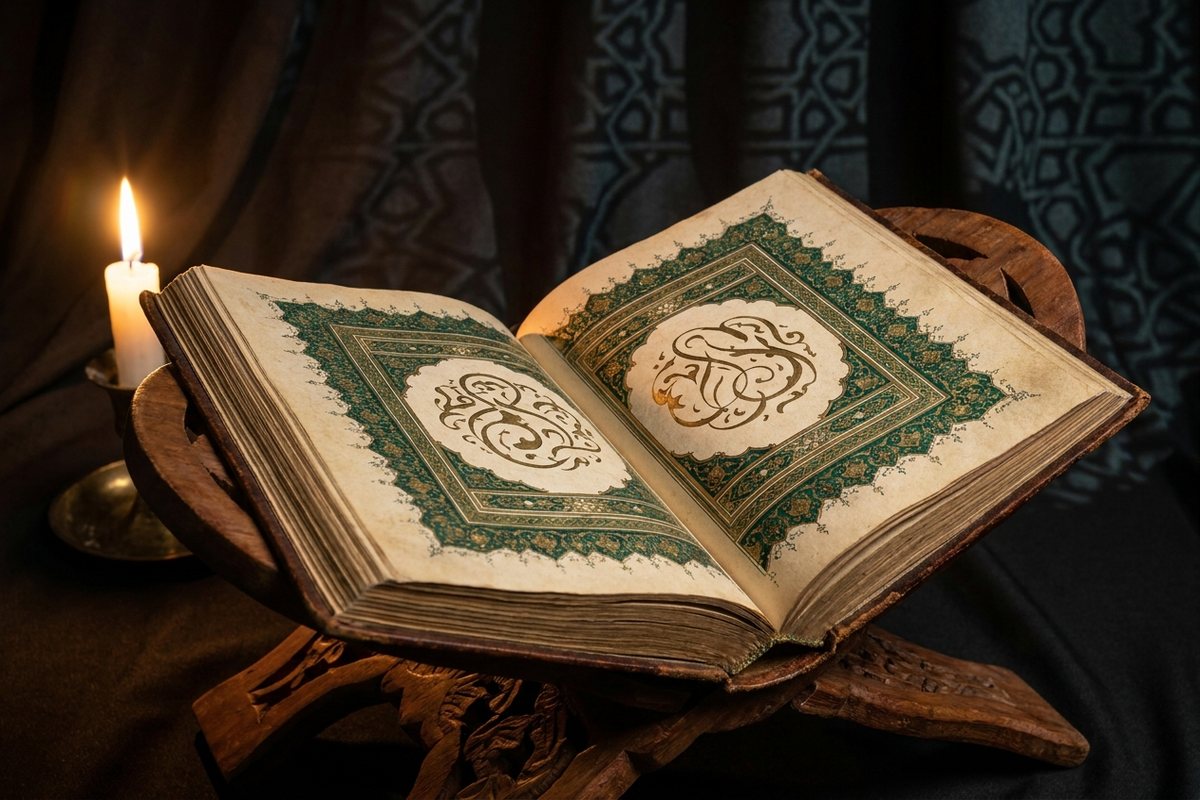
The Exalted Allah said:
“And [there are] those [hypocrites] who took for themselves a masjid to cause harm, kufr (disbelief), division among the believers, and as a station for whoever had warred against Allah and His Messenger before. And they will surely swear, 'We intended only the best.' And Allah testifies that indeed they are liars.
Do not stand [for prayer] within it – ever. A masjid founded on taqwa (God-consciousness) from the first day is more worthy for you to stand in. Within it are men who love to purify themselves; and Allah loves those who purify themselves.
Then is one who laid the foundation of his building on taqwa of Allah and [His] pleasure better or one who laid the foundation of his building on the edge of a bank about to collapse, so it collapsed with him into the fire of Hell? And Allah does not guide the wrongdoing people.
Their building which they built will not cease to be a cause of doubt in their hearts until their hearts are cut. And Allah is Knowing and Wise.” (al-Tawba 9:107-110)
In our tafsir (Qur'anic exegesis), we have sufficiently explained these verses. Praise be to Allah.
Ibn Ishaq narrates how this masjid, whose people were unjust, was built, and how, before entering Medina upon returning from Tabuk, the Prophet (peace and blessings be upon him) ordered its destruction. In summary: “A group of hypocrites built a masjid-like structure near the Masjid of Quba. They wanted the Prophet (peace and blessings be upon him) to pray there so that their corruption, kufr, and obstinacy would gain legitimacy. The Exalted Allah protected His Messenger from praying there. This event took place around the time of the Tabuk expedition. On his return from Tabuk, the Prophet (peace and blessings be upon him) stopped at the place of Dhi Awan, about an hour's distance from Medina. While there, revelation came to him regarding this masjid:
‘[There are] those who took for themselves a masjid to cause harm, kufr, division among the believers, and as a station for whoever had warred against Allah and His Messenger before...’
The word Dırar, which we have translated as ‘to cause harm’ in the noble verse, means that they built this structure to resemble the Masjid of Quba, not for iman (faith), but for kufr, to divide the congregation of the Masjid of Quba, and to serve as a lookout for those who warred against Allah and His Messenger. The one who warred against Allah and His Messenger was the transgressor Abu Amir the Monk—may Allah disfigure his face. When the Prophet (peace and blessings be upon him) invited him to Islam, he refused, went to Mecca, and incited the Meccans to fight the Muslims. They came to fight the Muslims in the year of Uhud, as we have previously described. When Abu Amir’s efforts failed, he went to Caesar, the Byzantine Emperor, seeking help against the Prophet (peace and blessings be upon him). Abu Amir, along with the Arabs who had converted to Christianity with him, followed the religion of Heraclius. He wrote letters to his hypocrite brothers, making promises, but Satan promises them nothing but delusion. His letters and messages always reached his hypocrite brothers, who then built this Masjid al-Dirar. Outwardly it appeared to be a masjid, but inside it was a storehouse of weapons. It became the headquarters for envoys coming from Abu Amir the Monk, and a meeting place for their hypocrite companions. For this reason, Allah said regarding this masjid:
‘...as a station for whoever had warred against Allah and His Messenger before...’
Concerning those who built this masjid, Allah the Exalted then said:
‘And they will surely swear, "We intended only the best." And Allah testifies that indeed they are liars.’
After this, the Exalted Allah commands His Messenger:
‘O Muhammad! Never stand in it.’ Allah forbids His Prophet from entering and praying there so that the building would not be confirmed as a masjid. Then Allah commands His Prophet to pray in the Masjid of Quba, which was founded on taqwa from the first day, and encourages him to do so. The flow of the verse and the hadiths on this subject indicate this. The verse points out that those who frequent the Masjid of Quba are pure people and praises them.
In summary: When the Prophet (peace and blessings be upon him) arrived at Dhi Awan, he received news of the masjid. He then summoned Malik b. Dukhshum, the brother of Banu Salim b. Awf, and Ma'n b. 'Adi or his brother Asim b. 'Adi, and said to them: Go to the masjid of those wrongdoers. Destroy and burn it! Let the gathering there disperse.
Ibn Ishaq said: Those who built Masjid al-Dirar were twelve in number.
Their names are: Hizam b. Khalid (Masjid al-Dirar was adjacent to his house), Sa'labah b. Hatib, Mu'attib b. Qushayr, Abu Habibah ibn Az'ar, 'Abbad b. Hunayf (the brother of Sahl b. Hunayf), Jariyah b. 'Amir, Jariyah’s sons Mujamma' and Zayd, Nabtal b. Harith, Bahzaj (from the Banu Dubaya tribe), Bijad b. 'Uthman, and Wadi'ah b. Thabit from the Banu Umayyah tribe.
I say: During the Tabuk expedition, the Prophet (peace and blessings be upon him) performed the morning prayer behind 'Abd al-Rahman b. 'Awf. He caught up with the imam in the second rak'ah, as he had gone to perform ablution, accompanied by Mughirah b. Shu'bah. He was delayed, so 'Abd al-Rahman b. 'Awf led the prayer. When the congregation finished, they thought they had erred, but the Prophet (peace and blessings be upon him) said: ‘You did well, you were correct.’
Al-Bukhari, through Ahmad b. Muhammad, narrates from Anas b. Malik:
‘When the Prophet (peace and blessings be upon him) was returning from the Tabuk expedition and approached Medina, he said:
“In Medina there are people who, whenever you travel a road or cross a valley, are with you.”’
The Companions (ṣaḥāba) said:
– O Messenger of Allah, but they are in Medina. How is that? The Prophet (peace and blessings be upon him) replied:
– They were in Medina. Their excuses kept them from joining the battle.’
Al-Bukhari, through Khalid b. Makhled, narrates from Abu Humayd:
‘When we were returning from the Tabuk expedition with the Prophet (peace and blessings be upon him) and approached Medina, he said:
“This is Taba (Taba is the name of Medina). And this is Uhud. This is a mountain that loves us and we love it.”’
Al-Bukhari, through 'Abdullah b. Muhammad, narrates from Sa'ib b. Yazid:
‘I remember that I, along with the children, went to Saniyyat al-Wada' to welcome the Messenger of Allah (peace and blessings be upon him) as he returned from the Tabuk expedition.’
Al-Bayhaqi, through Abu Nasr b. Qatadah, narrates from 'A'isha:
‘When the Prophet arrived in Medina, the women and children began to say:
“The full moon has risen over us from the hills of Wada'.
As long as there is one among us who calls upon Allah, gratitude is incumbent upon us.”’
Al-Bayhaqi said: According to what our scholars have told us, the Prophet was welcomed with this poem upon his arrival in Medina from Mecca. However, he also entered Medina from the hills of Wada' upon his return from Tabuk. Allah knows best. We have narrated this here again.
Al-Bukhari, through Yahya b. Bukayr, narrates from Ka'b b. Malik:
‘Except for the Tabuk expedition, I did not stay behind from any of the battles the Messenger of Allah (peace and blessings be upon him) undertook. Although I was not present at the Battle of Badr, the Prophet did not reproach any of those who stayed behind, as the Badr expedition was not originally intended as a battle but to intercept a Quraysh caravan from Syria. Allah caused the Muslims and their enemies to meet unexpectedly. Although the Battle of Badr is more frequently mentioned among the people, for me, being present at the Pledge of 'Aqaba with the Prophet is not less virtuous than being at Badr. As for my staying behind from the Tabuk expedition, I never had more strength and ease than at that time. By Allah, before Tabuk, I never owned two camels, but during the expedition, I had two. The Prophet's custom, when intending an expedition, was to give an impression of heading elsewhere to conceal his true destination. But for Tabuk, he made his intention clear, as it was a long, dangerous journey in very hot weather, and the enemy was strong. He announced his destination so that the Muslims could prepare accordingly. Many Muslims set out with the Prophet. The register could not record all the names of the fighters. No one wished to remain hidden except those who thought the Prophet would not notice unless revelation came. The expedition set out when the fruits were ripe and the shade of the trees was desirable.
The Prophet and the other Muslims prepared for the journey. I too would go out in the morning to prepare, but return in the evening having accomplished nothing. I kept telling myself I could prepare, but this negligence continued until everyone was ready and set out one morning. I had done nothing. I thought, 'I can prepare in a day or two and catch up.' After the army left Medina, I again went out in the morning to prepare but returned having done nothing. This continued until the army had advanced far, and the opportunity slipped away. Still, I considered catching up, but it was not decreed for me. The Prophet did not mention me until he reached Tabuk. While sitting among the Companions, he asked:
– Where is Ka'b?
Someone from Banu Salama said:
– O Messenger of Allah! His fine garments and pride have kept him in Medina.
Mu'adh b. Jabal said:
– What a bad thing you have said! O Messenger of Allah, by Allah, we know nothing of Ka'b but good.
The Prophet remained silent. When I heard the Prophet was returning to Medina, I was overcome with anxiety and began to think of excuses. I consulted everyone I could. When I heard the Prophet was near, I realized that only the truth would save me. So I resolved to tell the truth. When the Prophet arrived, as was his custom, he first went to the masjid and prayed two rak'ahs. Then he sat to receive those who had not joined the expedition. They came, offering excuses and swearing oaths. The Prophet accepted their outward excuses and left their inner reality to Allah. Then I came and greeted him. He smiled with anger and said:
– Come.
I sat before him. He asked:
– What kept you from coming? Did you not pledge at 'Aqaba to support me?
I replied:
– Yes, O Messenger of Allah. By Allah, if I were with anyone else, I could easily make an excuse and escape his anger. I have been given eloquence. But I know that if I lie to you, Allah will soon expose me. If I tell the truth, perhaps Allah will forgive me. By Allah, I had no excuse. I was never stronger or wealthier than when I stayed behind.
Upon this, the Prophet said:
– He has spoken the truth. Get up until Allah decides concerning you.
I left, and some people from my clan reproached me, saying: ‘Why did you not make an excuse like the others? The Prophet would have sought forgiveness for you.’ They kept at me until I almost returned to retract my statement. I asked if anyone else was in the same situation. They said: ‘Yes, two others: Murarah b. Rabi' al-'Amri and Hilal b. Umayyah al-Waqifi, both righteous men who fought at Badr.’ When I heard this, I remained firm.
The Prophet forbade the Muslims from speaking to the three of us. People avoided us, and the earth seemed strange. We endured this for fifty days. My two companions stayed home and wept. I was younger and stronger, so I attended the prayers but no one spoke to me. I would greet the Prophet after prayer and wonder if he moved his lips in response. I would pray near him and watch him. When I looked at him, he would turn away. After this hardship, I climbed the wall of Abu Qatadah’s garden, my cousin and dearest friend. I greeted him, but he did not reply. I asked him by Allah if he knew I loved Allah and His Messenger. He remained silent. I asked again, and again. Finally, he said: ‘Allah and His Messenger know best.’ I wept and left.
One day, while in the market, a man from Syria asked for me and handed me a letter from the king of Ghassan. It said: ‘We have heard your companion has wronged you. Come to us, and we will honor you.’ I said, ‘This is another trial,’ and burned the letter.
After forty days, a messenger from the Prophet came and said: ‘The Messenger of Allah commands you to separate from your wife.’ I asked if I should divorce her. He said: ‘No, just separate.’ The same was said to my two companions. I told my wife to go to her family until Allah decided. Hilal’s wife asked the Prophet if she could serve her husband, as he was old and helpless. The Prophet allowed it but told her not to approach him. She said he only wept since the incident.
Some relatives suggested I ask the Prophet for permission for my wife to serve me, as Hilal’s wife did. I refused, saying I was young. Ten more days passed. On the fiftieth morning, I prayed and was on the roof when someone called out from Mount Sal': ‘O Ka'b, rejoice!’ I fell in prostration, knowing relief had come. The Prophet had announced our repentance was accepted. People came to congratulate us. I gave my only two garments to the bearer of good news and borrowed clothes to go to the Prophet. The Companions greeted me in groups, congratulating me. When I entered the masjid, Talha b. 'Ubaydullah stood, shook my hand, and congratulated me. No one else from the Muhajirun did so. I will never forget Talha’s kindness.
When I greeted the Prophet, his face shone with joy. He said:
– Rejoice in the best day you have ever lived since your mother bore you, O Ka'b!
I asked: ‘Is this from you or from Allah?’ He replied: ‘From Allah.’ When the Prophet received good news, his face would shine like the moon. I said:
– O Messenger of Allah, as part of my repentance, I wish to give away all my wealth in charity for Allah and His Messenger. The Prophet said: ‘Keep some of your wealth; it is better for you.’ I said I would keep my share in Khaybar. I added: ‘Allah saved me because of my truthfulness. I will never speak anything but the truth as long as I live.’ By Allah, since I said this to the Prophet, I have never lied, and I hope Allah will protect me from lying for the rest of my life.
The Exalted Allah revealed these verses concerning us:
“Allah has already forgiven the Prophet and the Muhajirun and the Ansar who followed him in the hour of difficulty after the hearts of a party of them had almost inclined [to doubt], and then He forgave them. Indeed, He was to them Kind and Merciful.
And [He also forgave] the three who were left behind [and regretted their error] to the point that the earth closed in on them in spite of its vastness and their souls confined them and they were certain that there is no refuge from Allah except in Him. Then He turned to them so they could repent. Indeed, Allah is the Accepting of repentance, the Merciful.
O you who have believed, fear Allah and be with those who are true.” (al-Tawba 9:117-119)
By Allah, among the blessings Allah has bestowed upon me, after guiding me to Islam, there is no greater blessing than my truthfulness to the Prophet. Truly, this is a great blessing. To not have lied to the Prophet and thus been destroyed is a great blessing. For Allah revealed concerning those who lied:
“They will swear to you by Allah when you return to them that you would leave them alone. So leave them alone; indeed, they are evil, and their refuge is Hell as recompense for what they had been earning.
They swear to you so that you might be satisfied with them. But if you should be satisfied with them, indeed, Allah is not satisfied with the defiantly disobedient people.” (al-Tawba 9:95-97)
Ka'b continues:
“We three remained after the Prophet had accepted the oaths and excuses of those who swore falsely, until Allah judged concerning us fifty days later. The Prophet delayed our case until Allah’s judgment. This delay was not because we stayed behind from the battle, but because the Prophet postponed our matter and our repentance until after those who had lied and made excuses.”