
(Epistolary Wisdom)
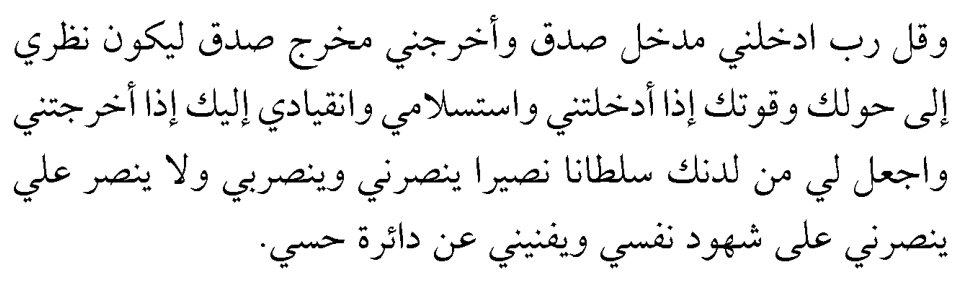
And O sālik (spiritual traveler)! Supplicate thus: O my Lord! Admit me into Your sacred presence with sincerity, and remove me from it with sincerity! So that, when You admit me into Your presence, my gaze of consideration may be directed toward Your power and might, and when You remove me from Your presence, appointing me to guide the people, my submission and humility may be reserved solely for Your unique Essence! And create for me, from Your spiritual domain, such a supporting force that it may aid me and my brethren, and never assist anyone against me! And, along with enabling me to witness the incapacity of my nafs (the lower self), cause me to become annihilated from my realm of sense and perception!
Poetic Translation
Let the murīd (aspirant, disciple) present his need thus
Saying, O my Lord, then utter this
Admit me into Your presence with sincerity
And likewise, remove me from it with sincerity
So that Your power may be my focus
When You, O Allah, admit me
And so that my submission may be to You alone
When You remove me to guide the people
O Divine, grant me a conquering aid
Let it be a helper to me and my brethren
Never let it assist my enemies against me
By Your grace, O God, grant no victory to them
Let it be a witness to my nafs (the lower self)
And cause me to be annihilated from my senses as well
Explanation
The author, a refuge of gnosis, after elucidating in detail with this subtle wisdom the sālik’s (spiritual traveler's) state upon reaching God—namely, the joy of the world of jamʿ al-jamʿ (union of unions) at the station of fanāʾ (annihilation in God), and the manner and quality of descent into the world of distinction and creation at the station of baqāʾ (subsistence in God) when appointed to guide others—then explains to his addressee how to supplicate and entreat God in a manner befitting one's state and servitude. He concludes this wisdom by teaching the supplication which the Lord of Majesty commanded His Prophet (peace and blessings be upon him): "Say: 'My Lord, cause me to enter a sound entrance and to exit a sound exit and grant me from Yourself a supporting authority.'" (al-Isrāʾ 17:80). Here, 'admitting' refers to the sālik’s becoming annihilated from seeing all besides Allah (masiwāllāh) and entering the sacred presence, while 'removal' refers to, after subsisting with God, being appointed to guide people and returning to the realm of distinction and awareness. Thus, entering the presence is the journey of ascent and elevation; removal from it is the journey of descent and return. In these journeys, sincerity (ṣidq) is realized for the sālik through the attainment of the stations of fanāʾ and baqāʾ. As for the exalted wisdom in seeking and supplicating for these two entrances and exits from God: it is that reaching the station of fanāʾ and the rank of baqāʾ, which are the culmination of the sālik’s journey, cannot be attained by the illusory human partial will without divine grace. Indeed, attaining these two sacred stations is only possible by stripping away the self and attachments to all besides God, observing the Divine power and might on the path of ascent, severing all relative ties, and, on the path of descent—returning to the world of awareness and connection with humanity—by surrendering the reins of will and obedience to the Absolute Bestower, and completely purifying thought and action from human desires and natural pleasures. Therefore, the sālik on the path of Truth is commanded to seek and supplicate for the aid of the essential Divine oneness (dhātī aḥadiyya), which is beyond all means and causes. For, without divine assistance, sāliks at the beginning of the path cannot overcome the obstacles of the nafs (the lower self) or erase the effects of desire and sensation, nor can those who reach the end attain the station of guidance and leadership or the rank of nurturing and hudā (guidance).
O my Lord, let my tongue be ever in dhikr (remembrance of God); let my qalb (the heart) be aware of Your eternal act.
In every matter, You are my refuge and support. Lā ḥawla wa-lā quwwata illā billāh (There is no power nor strength except through Allah).